
TP-Link SG3210X-M2 vs Lantronix S2220-1014-NA: Specification Comparison
Both the TP-Link SG3210X-M2 and the Lantronix S2220-1014-NA are 8-port managed switches targeting network infrastructure deployments in security and commercial environments. The SG3210X-M2 is an L2+ managed switch with 2.5GBASE-T copper ports and 10G SFP+ uplinks, while the S2220-1014-NA is a Layer 2 managed Gigabit switch with 10/100/1000BASE-T copper ports and a 100BASE-LX10 single-mode fiber uplink. Buyers evaluating either product are seeking managed switching with fiber connectivity options for a security-focused network backbone.
In This Guide
- Which switch delivers higher port speeds and total throughput?
- What fiber uplink capability and management depth does each switch provide?
- How do power consumption, operating environment, and physical installation compare?
- Which should you choose: the SG3210X-M2 or the S2220-1014-NA?
- Side-by-Side Specs
- FAQ
Which switch delivers higher port speeds and total throughput?
The TP-Link SG3210X-M2 provides 8 ports of 2.5GBASE-T copper connectivity alongside 2 × 10 Gbps SFP+ uplink slots, yielding a switching capacity of 80 Gbps and a forwarding rate of 59.52 Mpps. The 2.5G copper ports directly benefit NVRs, cameras, and workstations capable of multi-gigabit throughput, and the dual SFP+ slots support both single-mode and multimode fiber modules (sold separately).
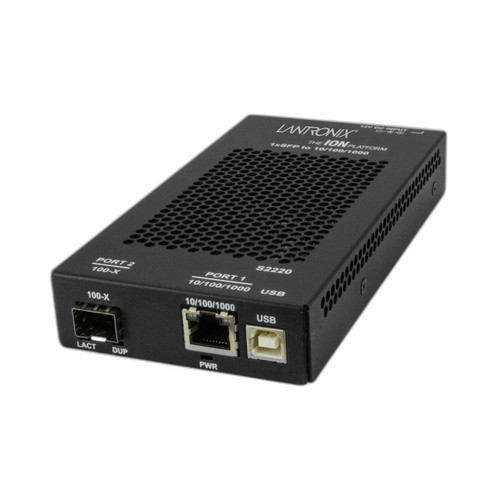
The Lantronix S2220-1014-NA offers 8 ports of 10/100/1000BASE-T (Gigabit) copper with a single 100BASE-LX10 single-mode fiber uplink via SC connector, rated to 10 km. Switching capacity and forwarding rate are not specified in the provided data. The fiber uplink is fixed at 100 Mbps (100BASE-LX10), not Gigabit, which constrains backbone bandwidth to well below the copper port aggregate.
For installations requiring higher-bandwidth backbone connectivity or future-proofing copper ports beyond 1G, the SG3210X-M2 has a measurable throughput advantage based on the available specifications. The S2220-1014-NA's switching capacity figure is absent from its spec sheet, preventing a direct numerical comparison on that axis.
What fiber uplink capability and management depth does each switch provide?
The SG3210X-M2 uses 2 × SFP+ slots supporting 10G fiber with single-mode or multimode modules (sold separately), giving integrators flexibility to choose fiber type and reach per deployment. Management depth is L2+: Web GUI, CLI, SNMP, RMON, Omada SDN controller integration, 802.1x with RADIUS/TACACS+ authentication, ACL, QoS (802.1p/DSCP), IGMP snooping, ERPS ring protection, LACP, DDM, and OAM are all specified.
The S2220-1014-NA includes a fixed 100BASE-LX10 single-mode fiber port with SC connector rated to 10 km maximum range. This uplink is built-in and non-modular. Management features listed are VLAN support, traffic prioritization, and remote monitoring. Specific protocols (SNMP version, ACL, QoS standards, authentication methods, spanning tree variants) are not specified in the provided data.
The SG3210X-M2 offers a broader and more explicitly documented management feature set. The S2220-1014-NA's 10 km single-mode reach is a stated advantage for campus or inter-building runs at 100 Mbps, but its management protocol depth cannot be fully evaluated from available specifications.
How do power consumption, operating environment, and physical installation compare?
The SG3210X-M2 draws a maximum of 15.3 W at 220V/50Hz and 15.0 W at 110V/60Hz, with a 6.0 W standby figure. It operates from −5 °C to +50 °C (23 °F to 122 °F), supports wall, ceiling, and rack mounting, and has stated MTBF of 340,091 hours at 25 °C. Physical dimensions are 11.6 × 7.1 × 1.7 in (294 × 180 × 44 mm). Memory is 32 MB Flash and 256 MB DRAM.
The S2220-1014-NA does not include power consumption, operating temperature range, MTBF, memory, or physical dimensions in the provided specifications. Mounting options are not stated. The warranty is specified as 2 years; no warranty duration is listed in the provided TP-Link specifications.
Because power draw, thermal range, MTBF, and form-factor data are absent for the S2220-1014-NA, a direct environmental and installation comparison cannot be made from the available specs. Buyers with strict rack-space, temperature, or power-budget requirements should request the Lantronix datasheet before finalizing a decision.
Which should you choose: the SG3210X-M2 or the S2220-1014-NA?
Our take: The SG3210X-M2 is the stronger choice when port speed, throughput, and management depth are primary requirements. The TP-Link unit delivers 2.5GBASE-T on all 8 copper ports versus the S2220-1014-NA's 1G maximum per port — a 2.5× copper-speed advantage per endpoint. Uplink bandwidth is 10 Gbps (SFP+) versus 100 Mbps (100BASE-LX10), a 100× difference in fiber backbone capacity. The SG3210X-M2's management feature set is explicitly documented with SNMP, ACL, QoS, RADIUS/TACACS+, ERPS, and Omada SDN, while the S2220-1014-NA's management depth is underspecified from available data. The S2220-1014-NA's built-in 10 km single-mode fiber uplink is a meaningful advantage for inter-building runs at modest bandwidth. Buyers with a defined long-reach fiber requirement and a Gigabit-sufficient design may find it suitable, but critical environmental and power specs are absent and should be verified directly with Lantronix before deployment.
Side-by-Side Comparison
Spec-for-spec, from manufacturer data.
| Specification | TP-Link SG3210X-M2 | Lantronix S2220-1014-NA |
|---|---|---|
| Device Type | L2+ Managed Switch | Layer 2 Managed Switch |
| Copper Ports | 8 × 2.5GBASE-T (RJ45) | 8 × 10/100/1000BASE-T (RJ45) |
| Max Copper Port Speed | 2.5 Gbps | 1 Gbps |
| Fiber Uplink | 2 × 10G SFP+ (module sold separately) | 1 × 100BASE-LX10 single-mode (SC, built-in) |
| Fiber Speed | 10 Gbps (per SFP+ slot) | 100 Mbps |
| Max Fiber Range | Depends on SFP+ module selected | 10 km (single-mode) |
| Fiber Mode | Single-mode or multimode (per module) | Single-mode only |
| Switching Capacity | 80 Gbps | — |
| Forwarding Rate | 59.52 Mpps | — |
| Management Level | L2+ (Web, CLI, SNMP, RMON, Omada SDN) | Layer 2 (VLAN, traffic prioritization, remote monitoring) |
| Authentication | 802.1x, RADIUS, TACACS+ | — |
| Power Consumption (max) | 15.3 W @ 220V / 15.0 W @ 110V | — |
| Operating Temperature | −5 °C to +50 °C (23 °F to 122 °F) | — |
| MTBF | 340,091 h @ 25 °C | — |
| Flash / DRAM | 32 MB Flash / 256 MB DRAM | — |
| Warranty | — | 2 years |
Frequently Asked Questions
Which should you choose: the SG3210X-M2 or the S2220-1014-NA?
The SG3210X-M2 is the stronger choice when port speed, throughput, and management depth are primary requirements. The TP-Link unit delivers 2.5GBASE-T on all 8 copper ports versus the S2220-1014-NA's 1G maximum per port — a 2.5× copper-speed advantage per endpoint. Uplink bandwidth is 10 Gbps (SFP+) versus 100 Mbps (100BASE-LX10), a 100× difference in fiber backbone capacity. The SG3210X-M2's management feature set is explicitly documented with SNMP, ACL, QoS, RADIUS/TACACS+, ERPS, and Omada SDN, while the S2220-1014-NA's management depth is underspecified from available data. The S2220-1014-NA's built-in 10 km single-mode fiber uplink is a meaningful advantage for inter-building runs at modest bandwidth. Buyers with a defined long-reach fiber requirement and a Gigabit-sufficient design may find it suitable, but critical environmental and power specs are absent and should be verified directly with Lantronix before deployment.
Is the SG3210X-M2 or S2220-1014-NA better for larger deployments with high-bandwidth cameras?
Based on available specs, the SG3210X-M2 is better suited for high-bandwidth camera deployments. Its 8 ports run at 2.5GBASE-T (versus 1G on the S2220-1014-NA) and its 10G SFP+ uplinks provide 100× the fiber backbone bandwidth compared to the S2220-1014-NA's 100BASE-LX10 uplink. Total switching capacity is 80 Gbps for the SG3210X-M2; the S2220-1014-NA's switching capacity is not specified in the provided data.
Which switch is the better fit if I need to connect two buildings over single-mode fiber?
The S2220-1014-NA includes a built-in 100BASE-LX10 single-mode fiber uplink rated to 10 km via SC connector. The SG3210X-M2's SFP+ slots support single-mode modules (sold separately), and with appropriate SFP+ modules can also support long-reach single-mode fiber. If 100 Mbps inter-building bandwidth is sufficient and a fixed SC single-mode port is preferred, the S2220-1014-NA addresses that need directly. If higher inter-building bandwidth is required, the SG3210X-M2 with suitable SFP+ modules would be the appropriate choice.
Does either switch support Omada SDN or centralized controller-based management?
Only the SG3210X-M2 specifies Omada SDN controller integration in its provided specifications. It also documents Web GUI, CLI, SNMP, RMON, 802.1x, RADIUS/TACACS+, ACL, QoS, LACP, DDM, and OAM support. The S2220-1014-NA lists VLAN support, traffic prioritization, and remote monitoring, but does not specify compatibility with any SDN platform or the specific management protocols supported. Buyers requiring centralized controller-based management should confirm the S2220-1014-NA's capabilities directly with Lantronix.
More Network Switch Comparisons
- TP-Link SG2210XMP-M2 vs Ubiquiti USW-FLEX-2.5G-8
- TP-Link SG2210XMP-M2 vs Comnet CNGE8MS
- TP-Link SG2210XMP-M2 vs Lantronix S2220-1014-NA
- TP-Link SG2210XMP-M2 vs TP-Link S4500-8GP
- TP-Link SG2210XMP-M2 vs TP-Link SG2008P
- TP-Link S4500-8GP vs Ubiquiti USW-FLEX-2.5G-8
Network Switch Buying Guides
Get a Second Opinion on Your Camera Choice
Share your site layout, coverage goals, and budget. Our team will validate the camera selection, flag anything we would change, and recommend products that match the use case.