
Showing Results for Heat Detectors
-

Honeywell ProSIX Wireless Smoke/Heat Detector - PROSIXSMOKEV
Wireless smoke and heat detector designed for integration with Honeywell's ProSIX wireless security platform
- Combines optical smoke and heat sensing in one wireless unit, reducing device count.
- Integrates natively with the ProSIX wireless platform for streamlined panel enrollment.
- Wireless design eliminates detector wiring runs, cutting installation time and conduit cost.
Usually Ships in 2-3 Weeks Free shipping over $499$65.99 -

Honeywell Wireless Smoke/Heat Detector - 5800SMOKEV
Wireless dual-sensor smoke and heat detector designed to integrate into Honeywell security and fire detection systems
- Dual photoelectric and thermal sensors cover smoke and heat in one wireless unit.
- 900 MHz 5800 protocol integrates with VISTA-15P through VISTA-250BPT panels.
- 2x AA batteries deliver 3–5 years of runtime, reducing maintenance intervals.
Usually Ships in 2-3 Weeks Free shipping over $499$105.99 -
Save $22.89

System Sensor 5151 Low-Profile Heat Detector
Low-profile 35VDC heat detector for discrete ceiling/wall mounting
- Operates at 35VDC for direct integration into conventional fire alarm loops.
- Low-profile form factor supports discrete ceiling or wall mounting in tight spaces.
- Thermal detection avoids false alarms in kitchens, loading docks, and mechanical rooms.
In stock · Ships same business day Free shipping over $499$70.88 $47.99 Save $22.89 -
Save $7.46
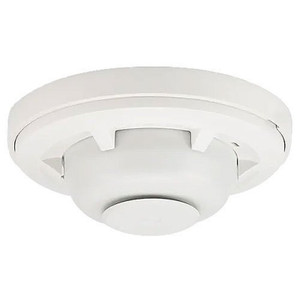
System Sensor 5601P Fixed/Rate-of-Rise Heat Detector
Dual-mode 135°F mechanical heat detector for two/four-wire fire loops
- Dual fixed-temperature (135°F) and rate-of-rise detection reduces nuisance alarms.
- Runs on 35VDC across two-wire or four-wire fire alarm circuits for flexible integration.
- Electronics-free mechanical design eliminates firmware dependencies and processor latency.
Usually Ships in 2-3 Weeks Free shipping over $499$30.45 $22.99 Save $7.46 -
Save $7.99

System Sensor 5602 Heat Detector
Two-wire mechanical heat detector for conventional fire alarm circuits
- Dual fixed/rate-of-rise detection responds to both steady heat and rapid temperature spikes.
- Two-wire conventional circuit at 35VDC connects directly to existing FACP without added modules.
- Mechanical thermal element operates without electronic polling, reducing points of failure.
Usually Ships in 2-3 Weeks Free shipping over $499$30.98 $22.99 Save $7.99 -
Save $7.99

System Sensor 5604 Fixed Temperature Heat Detector
Fixed temperature heat detector for conventional 2-wire fire alarm systems
- Operates on 35VDC conventional 2-wire loops—no addressable module or converter needed.
- Box form factor supports ceiling or wall mounting in warehouses and mechanical rooms.
- Mechanical thermal element requires zero calibration or configuration post-installation.
Usually Ships in 2-3 Weeks Free shipping over $499$30.98 $22.99 Save $7.99 -
Save $17.71

System Sensor 5621 135F Heat Detector
135°F dual-circuit heat detector for conventional and addressable systems
- Dual-circuit design supports both conventional and addressable panels without relay adapters.
- 135°F fixed-temp plus rate-of-rise detection reduces nuisance alarms in mixed-use spaces.
- Operates at 35VDC, compatible with standard conventional fire alarm control panels.
In stock · Ships same business day Free shipping over $499$56.70 $38.99 Save $17.71 -
Save $20.24

System Sensor 5622 Fixed/Rate-of-Rise Heat Detector
Dual-circuit heat detector with fixed and rate-of-rise sensing for fire alarm systems
- Dual fixed-temp and rate-of-rise sensing catches both slow smoldering and fast fires.
- Operates at 35VDC for direct integration with conventional fire alarm control panels.
- Ceiling-mount installation follows NFPA 72 spacing standards for commercial deployments.
Usually Ships in 2-3 Weeks Free shipping over $499$57.23 $36.99 Save $20.24 -
Save $19.24
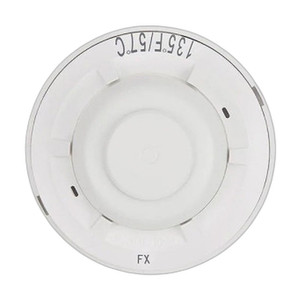
System Sensor 5623 135F Heat Detector
135°F fixed-temperature heat detector with dual-circuit conventional and addressable wiring
- Fixed 135°F thermal setpoint eliminates false alarms in dusty or vapor-heavy spaces.
- Dual-circuit design supports both two-wire conventional and addressable loops on one SKU.
- Rated for 35VDC operation; confirm panel voltage and loop config before deployment.
In stock · Ships same business day Free shipping over $499$57.23 $37.99 Save $19.24 -
Save $19.24
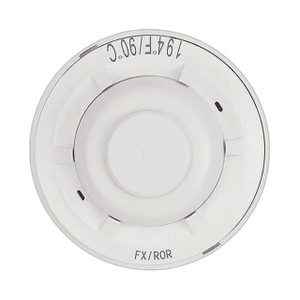
System Sensor 5624 194F Fixed Heat Detector
Dual-circuit fixed temperature heat detector with TCP/IP networking
- Fixed 194°F activation threshold eliminates sensitivity tuning in high-heat zones.
- Operates at 35VDC from the FACP—no external power supply or special config needed.
- Dual-circuit design supports conventional loop wiring for alarm and supervisory states.
In stock · Ships same business day Free shipping over $499$57.23 $37.99 Save $19.24
