
Showing Results for CO Detectors
-

Honeywell ProSIX Wireless CO Detector - PROSIXCOV
Wireless carbon monoxide detector designed for integration with Honeywell Home ProSIX control panels
- Enrolls to ProSIX panels in 20 seconds via pull-tab activation, no tools needed.
- 10-year battery service life on one CR123A cell minimizes scheduled maintenance visits.
- Operates 32–122°F; integrates CO life-safety reporting directly into existing ProSIX panels.
In stock · Ships same business day Free shipping over $499$102.99 -
Save $113.99

Honeywell PROSIXCO ProSeries SiX Carbon Monoxide Detector
Wired 2D handheld scanner for retail and warehouse barcode capture
- ProSeries SiX wireless carbon monoxide detector
- User-replaceable battery for routine maintenance
- Wireless sensor for ProSeries security panels
Usually Ships in 2-3 Weeks Free shipping over $499$209.98 $95.99 Save $113.99 -

Honeywell Wireless CO Detector - Canada - 5800COA
Battery-powered wireless carbon monoxide detector designed to integrate with Honeywell VISTA series control panels equipped with a 5881 RF receiver
- Integrates with VISTA-series panels via 5881 RF receiver—no hardwired sensor runs needed.
- Reports alarm, trouble, tamper, EOL, and low-battery states to the control panel wirelessly.
- CSA 6.19-01 listed with supervised fault detection for residential and commercial deployment.
Usually Ships in 2-3 Weeks Free shipping over $499$116.99 -
Save $217.01
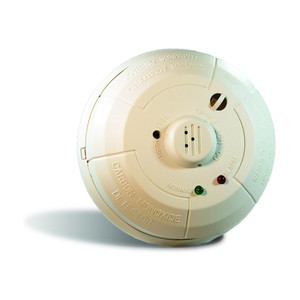
Inovonics EN1245 EchoStream Wireless CO Detector 902-928 MHz
Wireless CO detector with 902-928 MHz EchoStream for facility monitoring
- Wireless CO detector reports to EchoStream 902-928 MHz receivers
- Standalone environmental sensor for boiler rooms and tenant spaces
- No wired pull required - replaces stranded-cable runs to detectors
In stock · Ships same business day Free shipping over $499$435.00 $217.99 Save $217.01 -
Save $53.11

Potter CO1224T Carbon Monoxide Detector
Supervised wall-mount CO detector with zone reporting for commercial systems
- Supervised loop architecture alerts the panel instantly if the detector fails or is removed.
- Zone-level CO reporting pinpoints the affected location, cutting response time in large facilities.
- Compact 5.1"×3.3"×1.3" wall/ceiling form factor suits retrofit and new commercial installations.
Usually Ships in 2-3 Weeks Free shipping over $499$149.10 $95.99 Save $53.11 -
Save $98.86

Potter PAD200-PCD Smoke & Carbon Monoxide Detector
Dual smoke & CO detector combines two life-safety sensors in one unit
- Photoelectric smoke plus electrochemical CO sensing in one ceiling-mount unit.
- Meets NFPA 72 smoke and UL 2075 CO detection requirements from a single device.
- On-board test button verifies both sensors in the field without removing the unit.
Usually Ships in 2-3 Weeks Free shipping over $499$270.85 $171.99 Save $98.86 -
Save $131.76

Potter PAD200-PCHD Smoke / Heat / Carbon Monoxide Detector
Triple-threat detector for smoke, heat, and carbon monoxide in one unit
- Combines optical smoke, thermal heat, and electrochemical CO sensors in one unit.
- Reduces ceiling penetrations and device count per monitoring point at installation.
- UUKL Listed for Smoke Control; backed by a 5-year manufacturer warranty.
In stock · Ships same business day Free shipping over $499$369.75 $237.99 Save $131.76 -
Save $112.41
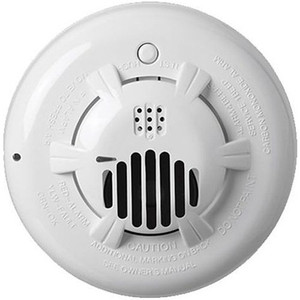
Qolsys QS5210-840 IQ CO Detector Controller
Wireless 345MHz CO detector for Qolsys IQ panels, battery-powered
- Wireless CO detector on 345 MHz to Qolsys IQ panel receivers
- Battery-powered - no CO sensor wire runs through finished walls
- Operates 40 to 100 degrees F with 15-95% RH non-condensing
Usually Ships in 2-3 Weeks Free shipping over $499$207.40 $94.99 Save $112.41 -
Save $0.98

System Sensor CO-PLATE CO Detector Replacement Plate
TCP/IP CO detector replacement plate for networked fire safety systems
- Replaces CO1224T, CO1224TR, and CO1224A faceplates without full device re-certification.
- Mounts to a standard single-gang back box and runs on the existing 24VDC supply.
- Maintains UL 2075 (US) and CSA 6.19-01 (Canada) compliance after plate swap.
In stock · Ships same business day Free shipping over $499$48.97 $47.99 Save $0.98 -
Save $54.21

System Sensor CO1224TR 4-Wire CO Detector with Form C Relay
4-wire CO detector with Form C relay for fire alarm integration
- 24VDC 4-wire design integrates directly into conventional or addressable fire alarm panels.
- Form C relay output enables dry-contact alarm signaling without intermediate interface modules.
- 10-year end-of-life timer and RealTest capability reduce commissioning and maintenance overhead.
Usually Ships in 2-3 Weeks Free shipping over $499$151.20 $96.99 Save $54.21 -
Save $73.65

System Sensor COSMO-2W CO/Smoke Detector
Dual smoke/CO detector on single 2-wire loop with integrated sounder
- Photoelectric smoke and electrochemical CO sensing share one 2-wire loop address.
- Integrated sounder eliminates external horn modules, reducing device count per zone.
- Mounts to 3.5"/4" octagonal, single-gang, 4" square, or round ceiling boxes.
Usually Ships in 2-3 Weeks Free shipping over $499$220.64 $146.99 Save $73.65 -
Save $73.87

System Sensor COSMO-4W Combination CO/Smoke Detector
4-wire combo CO/smoke detector with built-in sounder for conventional panels
- Combines CO and ionization smoke detection in one unit, reducing loop device count.
- Built-in sounder eliminates separate notification appliance wiring at each install point.
- 35VDC 4-wire design integrates directly with conventional fire alarm control panels.
Usually Ships in 2-3 Weeks Free shipping over $499$223.86 $149.99 Save $73.87