
How to Choose the Right Outdoor IP Camera
A technical buyer's guide for security integrators, IT directors, facility managers, and system designers who specify or install commercial outdoor surveillance systems. Covers resolution and lens selection, environmental ratings, infrared performance, compression efficiency, PoE power budgeting, and on-board analytics.
In This Guide
Outdoor cameras face conditions that indoor models never see: direct sunlight, rain, ice, dust, vibration from wind loading, and temperature swings that can span 140°F in a single year. Every specification discussed below exists to address a specific failure mode in that environment. Understanding why a spec matters is what separates a camera that delivers forensic evidence five years from now from one that delivers blurry, washed-out footage within months.
Key Specifications Explained
Resolution: Megapixels and Pixel Density
Resolution determines how much detail you can extract from a scene at a given distance. The practical metric is pixels per foot (PPF) at the target area, not the raw megapixel count printed on the box. A 2MP (1080p) camera with the right lens resolves facial features at roughly 25-30 feet. A 4MP camera extends that to approximately 40-50 feet. An 8MP (4K) camera can push identification range past 80 feet with a properly matched varifocal lens. For dedicated long-range identification, consider LPR cameras designed specifically for license plate capture at distance.
Higher resolution is not automatically better. An 8MP camera generates roughly four times the bandwidth and storage of a 2MP camera at the same frame rate and compression settings. Size the resolution to the identification distance you actually need, then verify your network switches and NVR can sustain it.
Ingress Protection: IP66, IP67
The IP (Ingress Protection) rating is a two-digit code. The first digit rates solid particle protection (dust); the second rates liquid protection. For outdoor cameras, you need at minimum IP66: complete dust protection (6) and protection against powerful water jets from any direction (6). IP67 adds brief immersion protection, which matters for cameras mounted at ground level or in flood-prone areas.
The rating only applies to the camera body as shipped. If you drill a mounting hole through the housing, run unsealed conduit into the junction box, or leave the sunshield off a dome, the rating is void. Installation quality determines whether the IP rating survives year one.
Vandal Resistance: IK Ratings
IK ratings measure impact resistance in joules. IK08 handles 5 joules (equivalent to a 1.7kg mass dropped from 300mm), which stops casual tampering. IK10 handles 20 joules (5kg from 400mm), which resists deliberate attacks with tools. For parking garages, detention areas, public-facing locations (see vandal dome cameras), and anywhere the camera is within arm's reach, IK10 is the standard. For cameras mounted at 15+ feet in controlled areas, IK08 is usually sufficient.
Infrared Range and Low-Light Performance
IR illuminator range is measured under ideal conditions (no fog, no rain, reflective surfaces). Real-world effective range is typically 60-70% of the published spec. A camera rated for 100 feet of IR range will deliver usable illumination at about 60-70 feet in typical outdoor conditions.
Wide Dynamic Range (WDR) matters more than most buyers realize. Any camera position that faces a doorway, window, loading dock opening, or parking lot entrance deals with extreme contrast. True WDR (120dB or higher) uses multi-exposure sensor techniques to balance both zones. Digital WDR cannot match this. For any position with mixed lighting, specify true WDR with a rating of at least 120dB. For complete darkness without IR, thermal cameras detect heat signatures regardless of lighting conditions.
Lens Selection: Fixed, Varifocal, and Motorized
Fixed lenses are set at the factory and cannot be adjusted. They cost less and have fewer failure points but require precise planning before installation. Varifocal lenses allow adjustment during installation (typically 2.8-12mm). Motorized varifocal lenses can be adjusted remotely from the VMS.
Focal length controls field of view and identification distance. A 2.8mm lens gives roughly 110° horizontal view. A 12mm lens narrows to about 30° but extends identification range significantly. For parking lots and perimeter fencing at 80-150 feet, consider varifocal lenses in the 5-50mm range. For active tracking across large areas, PTZ cameras offer motorized pan, tilt, and optical zoom controlled from your VMS. See also our Lens Coverage Geometry Guide for field-of-view calculations.
Video Compression: H.264, H.265, Smart Codecs
H.265 (HEVC) delivers the same visual quality as H.264 at roughly 50% less bandwidth. For a 4K camera streaming 24/7, that translates to approximately 8-10 Mbps with H.265 versus 16-20 Mbps with H.264. Over a 30-day retention period, the storage difference per camera is roughly 2-3 TB.
Smart codec extensions (Axis Zipstream, Hikvision H.265+, Dahua Smart H.265+) further reduce bandwidth by 30-50% beyond standard H.265. Confirm your NVR or VMS supports the specific smart codec before specifying it. Use our Video Retention and Storage Calculator to estimate the bandwidth and storage impact of different compression settings.
PoE Power Class
Standard PoE (IEEE 802.3af, Class 3) delivers up to 15.4W at the PSE. This powers most fixed-lens cameras with basic IR. Cameras with PTZ, heaters, long-range IR arrays, or motorized varifocal lenses often require PoE+ (802.3at) at 30W. Some PTZ cameras with wiper and heater accessories need 60W (802.3bt). Check the camera datasheet for maximum power consumption including heater and IR at full draw. For remote cameras far from your switch, PoE injectors and midspans add power where cable runs exceed switch capacity. Use our PoE Power Budget Calculator to plan infrastructure. See also the Network and PoE Planning Guide.
On-Board Analytics and Edge AI
Modern outdoor cameras increasingly run analytics at the edge: person/vehicle classification, line crossing, loitering detection, license plate capture, and object left/removed. Edge analytics reduce NVR processing load and enable event-driven recording that cuts storage by 40-70%. If your deployment will use analytics, specify cameras with dedicated AI processors (NPU/VPU) rather than cameras that run analytics on the main image processor. For wide-area coverage with analytics, panoramic cameras and multi-sensor cameras cover large spaces from a single mounting point.
NDAA Compliance
Section 889 of the NDAA prohibits U.S. federal agencies (and many state/local agencies and federal contractors) from purchasing or using video surveillance equipment from specific manufacturers. If your project has any federal funding, government tenants, or federal contract requirements, NDAA compliance is mandatory. Check the camera and all components (chipset, firmware) for compliance. NDAA-compliant options are available across all form factors including bullet, dome, turret, and box cameras, not just the brand label on the housing.
Featured Outdoor IP Cameras
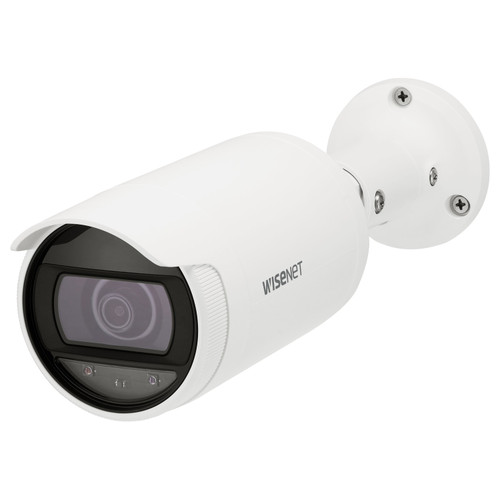
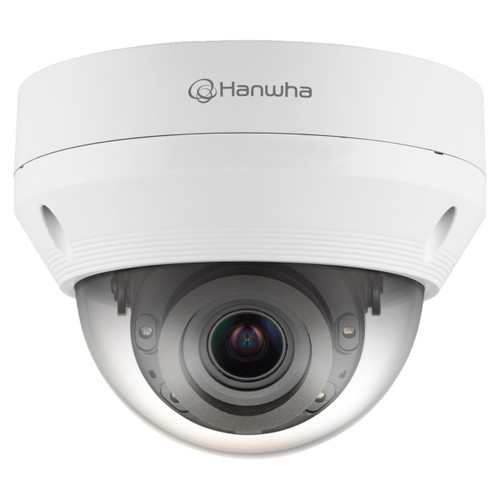
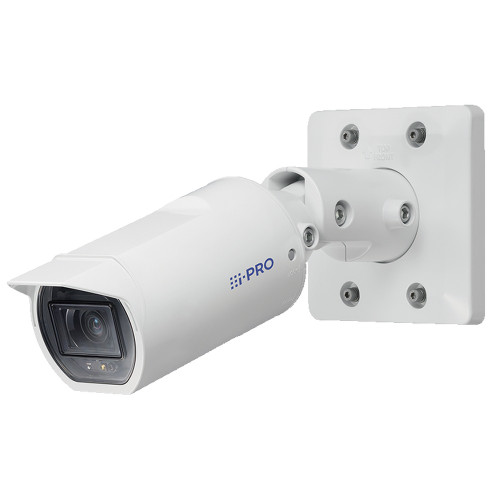
Top-selling products in this category, selected by our technical team.
Deployment Scenarios
Parking Garage
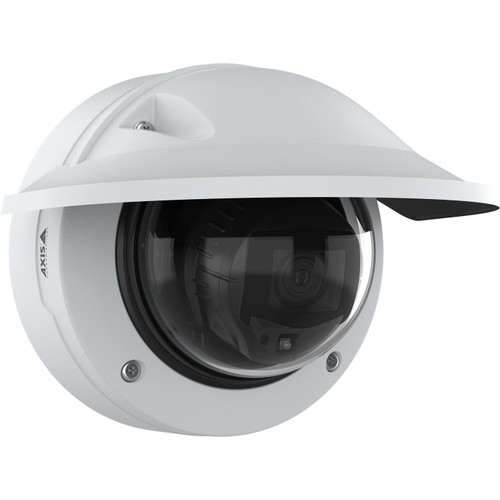
Parking garages combine long distances, vehicle headlights, dark corners, and vandal exposure at lower levels. Recommended: 4MP or 8MP vandal dome or turret camera, varifocal 2.8-12mm minimum, true WDR at 120dB+, IK10 for cameras below 10 feet, IR range 100 feet+. A camera like the Axis P3277-LVE 5MP Outdoor AI IR Dome Camera delivers 5MP AI-powered analytics with built-in IR. Use H.265+ smart codec. Budget PoE+ for cameras with integrated heaters in unheated garages.
Loading Dock
Loading docks require cameras that handle extreme contrast of an open bay door. True WDR at 130dB+ is critical. 4MP is usually sufficient at 15-40 feet. Use a fixed 2.8mm or 4mm lens. Consider cameras with audio recording for dispute resolution. IR range of 50 feet is typically adequate. The Hanwha ANO-L7012R 4MP Outdoor Bullet Camera is well-suited for this scenario with its wide-angle low-light sensor. Pair with an NVR that supports audio recording.
Perimeter Fence Line
Perimeter applications prioritize detection range over identification resolution. A 2MP camera with a 12mm+ lens and 200-foot IR range can monitor a 300-foot fence section. Pair with on-board line-crossing analytics. For critical infrastructure, consider thermal cameras that detect body heat through fog, rain, and total darkness at ranges exceeding 500 feet. Add LPR cameras at vehicle entry points for plate capture. See our Thermal Camera Deployment Guide and PTZ Deployment and Guard Tour Guide for perimeter best practices.
Retail Storefront
Storefronts need cameras that identify faces at 15-25 feet, cover the transaction counter, and blend architecturally. A 4MP turret camera with 2.8mm fixed lens covers a typical 20-foot entrance zone. For exterior-facing positions, a bullet camera like the Axis M2036-LE 4MP Outdoor Bullet Camera provides visible deterrence. True WDR handles glass door reflections. IK08 for interior ceiling-mount. IP67/IK10 bullet or dome for exterior-facing positions.
More Top-Selling Outdoor Cameras
Top-selling products in this category, selected by our technical team.
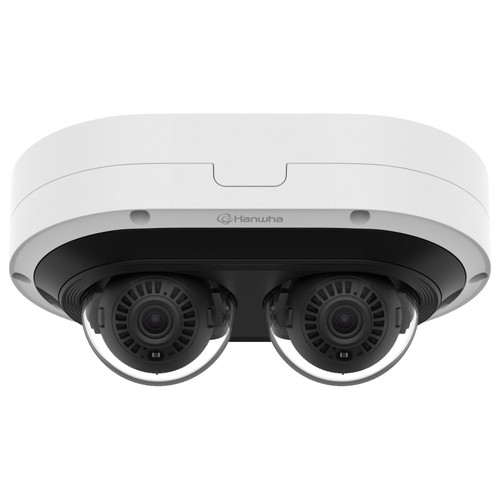
Hanwha PNM-C12083RVD 12MP Multi-Sensor Dome
PNM-C12083RVD
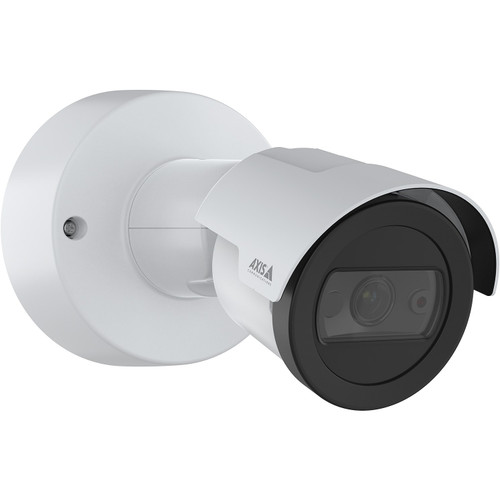
Axis M2036-LE 4MP Outdoor Bullet Camera
02125-001

Hikvision DS-2CD2043G0-IB 4MP Outdoor Bullet
DS-2CD2043G0-IB
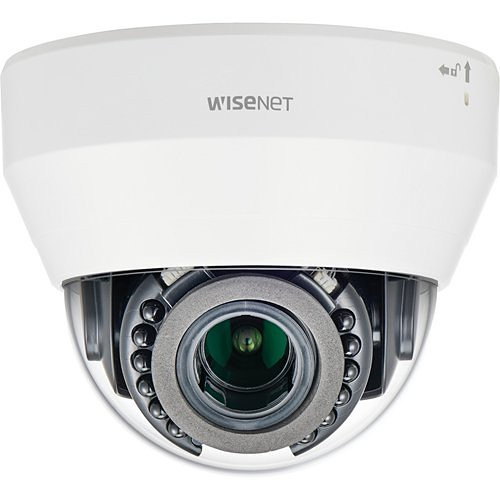
Hanwha LND-6012R 2MP IR Dome Camera
LND-6012R
Common Mistakes to Avoid
- Specifying resolution without calculating pixel density. An 8MP camera with a 2.8mm lens aimed at a 200-foot parking lot delivers fewer PPF at the far end than a 2MP camera with a 12mm lens. Resolution without lens selection is meaningless.
- Trusting published IR range at face value. Reduce published IR specs by 30-40% for real-world planning.
- Ignoring PoE power budgets. A 24-port PoE switch rated at 370W total cannot power 24 cameras that each draw 25W at peak. Calculate total peak draw, not typical draw, and leave 20% headroom.
- Skipping WDR on entrance cameras. Every exterior door camera faces a backlighting problem at some point during the day. Cameras without true WDR produce silhouettes instead of identifiable faces. See our IP Camera Selection Guide for camera positioning best practices.
- Mixing incompatible compression formats. Specifying H.265+ cameras but deploying an NVR that only decodes standard H.265 or H.264 negates bandwidth savings.
- Overlooking surge protection. Outdoor cameras connected to long cable runs act as antennas during electrical storms. Inline surge protectors at both ends cost under $30 and prevent $500-$2,000 per strike.
What to Ask Your Integrator
- What is the calculated pixel density (PPF) at each identification zone? Can you show the camera layout with coverage maps?
- What is the total PoE power budget per switch, and what percentage of capacity are we using at peak draw?
- Are all proposed cameras NDAA-compliant, including chipset and firmware, not just the brand?
- What is the effective IR range in our specific environment (not the published spec)?
- How does the system handle camera failure? Is there any recording redundancy or failover?
- What is the compression format, and does the NVR or VMS fully support it, including smart codec extensions?
- What is the maintenance plan for cleaning domes and lenses, checking seals, and verifying IR performance?
Quick Comparison: Outdoor Camera Tiers
| Specification | Budget Tier | Mid-Range | Premium |
|---|---|---|---|
| Resolution | 2MP (1080p) | 4MP | 8MP (4K) |
| Lens | Fixed 2.8mm or 4mm | Motorized varifocal 2.8-12mm | Motorized varifocal 5-50mm |
| WDR | Digital WDR | True WDR 120dB | True WDR 140dB+ |
| IR Range | 30-50m (published) | 50-80m (published) | 80-150m+ (published) |
| IP / IK Rating | IP66 / IK08 | IP67 / IK10 | IP67 / IK10+ |
| Compression | H.264 / H.265 | H.265 + Smart Codec | H.265+ with AI scene adaptation |
| Analytics | Basic motion detection | Person/vehicle classification | Full AI (face, LPR, behavior) |
| PoE Class | 802.3af (15W) | 802.3af/at (15-30W) | 802.3at/bt (30-60W) |
| Typical Price Range | $150 - $350 | $350 - $800 | $800 - $2,500+ |
Frequently Asked Questions
What IP rating do outdoor cameras need?
Outdoor cameras should be rated IP66 at minimum, which protects against heavy rain, dust, and powerful water jets. For coastal, industrial, or harsh environments, step up to IP67 for temporary submersion resistance or IP68 for continuous underwater rating. The first digit (6) indicates a complete dust seal. The second digit grades water resistance from jets (6) to immersion (7-8). Cameras mounted under eaves can technically use IP65, but IP66 is the safer standard and barely costs more.
How far can outdoor IR cameras see at night?
IR range depends on the camera's illuminator power and lens focal length. Entry-level outdoor cameras provide 60-100 feet of IR, mid-tier cameras typically deliver 130-165 feet, and long-range bullets can push 200-500 feet. Keep in mind that published IR range assumes reflective targets like white clothing. Dark clothing, wet pavement, and foliage cut effective range by 30-50%. For parking lots and perimeters over 150 feet, pair IR cameras with white light spotlights or choose models with built-in white light LEDs.
Should I choose PoE or PoE+ for outdoor cameras?
Standard PoE (802.3af, 15.4W) works for fixed outdoor bullets and domes without heaters. PoE+ (802.3at, 30W) is required for cameras with built-in heaters, defrosters, PTZ motors, or high-power IR. Cold-climate deployments should always use PoE+ because camera heaters draw 10-20W just to keep lenses clear. Check the camera spec sheet for maximum draw during peak heating plus IR plus PTZ operation, then size your switch or injector with 25% headroom.
What's the difference between IK08, IK09, and IK10 vandal ratings?
IK ratings measure impact resistance in joules. IK08 withstands 5J (equivalent to a 1.7kg object dropped from 29cm), suitable for general commercial use. IK09 handles 10J, appropriate for parking garages and schools. IK10 tolerates 20J impacts, the highest standard rating, required for cameras below 10 feet in transit stations, correctional facilities, and high-vandalism environments. Dome and turret form factors offer the best IK performance because their recessed lens resists direct strikes better than protruding bullet cameras.
How many megapixels do I need for outdoor surveillance?
Resolution needs depend on your target distance and whether you need detection, recognition, or identification. For general perimeter awareness up to 50 feet, 4MP is sufficient. For license plate capture at 30-60 feet or facial identification at 20 feet, use 5MP to 8MP with a tight zoom lens. For wide-area coverage of parking lots or storage yards spanning 100+ feet, multi-sensor 16-32MP cameras or 4K single-sensor models provide the pixel density needed. Higher resolution also means more storage, so balance megapixels against your retention goals.
Do outdoor cameras need surge protection?
Yes, outdoor cameras should always have surge protection on the network cable. Ethernet runs act as antennas for nearby lightning strikes and ground potential differences, which easily destroy camera electronics and switches. Install a PoE surge suppressor at the camera end for long outdoor runs, and another at the switch end to protect the switch. Pair this with properly grounded metal enclosures and weatherproof cable glands. Quality surge protection adds $30-80 per camera and prevents thousands in damage during a single storm event.
Ready to Choose Your Outdoor Cameras?
Share your facility type, coverage distances, and environmental conditions. We will recommend the right camera class, lens, and environmental rating for each position.