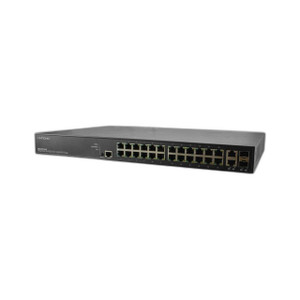
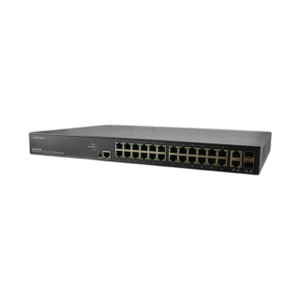
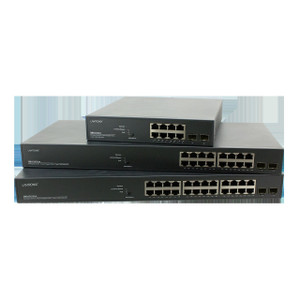
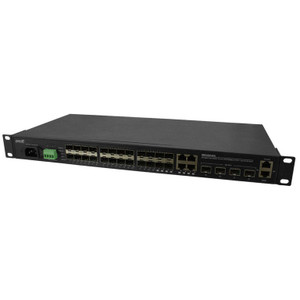
Lantronix S2220-1014-NA 8-Port Managed Gigabit Switch
The Lantronix S2220-1014-NA is a Layer 2 managed gigabit switch purpose-built for distributed security deployments requiring both copper and fiber backbone connectivity. It pairs eight 10/100/1000BASE-T RJ45 ports with a 100BASE-LX10 single-mode SC fiber port, enabling flexible topology across geographically separated camera arrays, NVRs, access control systems, and edge analytics appliances spanning multiple buildings or campuses. Managed switching with VLAN support and traffic prioritization ensures video streams, access control payloads, and intercom data can coexist on the same physical infrastructure without contention or latency penalties. This is the switch you deploy when copper alone won't span your site and you need deterministic layer 2 control over who talks to whom.
Key Features
- 8 x Gigabit Copper Ports: 10/100/1000BASE-T RJ45 connectivity. Accepts standard Cat5e/Cat6a runs to IP cameras, NVRs, PTZ controllers, and intercom endpoints without extra optics or conversion gear.
- 100BASE-LX10 Single-Mode Fiber: SC connector, 10 km reach. Bridges distant network segments without repeaters—cuts latency and intermediate hop count compared to multimode fiber or additional switches.
- Layer 2 Managed Architecture: VLAN tagging, traffic prioritization, remote monitoring via web GUI or CLI. Isolates camera VLANs from access control VLANs and enforces QoS rules during bandwidth contention.
- Mixed Copper/Fiber Topology: Copper for local edge devices, fiber for backbone runs. Reduces intermediate switch count and simplifies distributed-site cabling design.
- Industrial Cabinet Mounting: DIN rail or 19-inch rack compatible. Designed for telecom and security infrastructure environments with constrained physical space.
- Remote Monitoring: Managed switching fabric supports remote configuration and status polling—no on-site CLI access required after initial setup.
- Standard ONVIF / IP Connectivity: Works with any standard Ethernet device (cameras, NVRs, access control panels, intercoms) speaking 10/100/1000BASE-T or fiber-backed protocols.
- 2-Year Warranty: Manufacturer warranty covering defects in materials and workmanship.
The S2220-1014-NA solves a specific deployment pain point: when you have 6–8 local devices (cameras, controllers, analytics boxes) clustered at a primary site and need to reach a secondary location (parking lot, perimeter line, remote building) 2–10 km away without intermediate switches. Single-mode fiber eliminates mode-coupling loss and supports longer runs than multimode; the managed layer 2 control plane lets you carve out separate broadcast domains so a rogue camera or switch loop on one VLAN doesn't cascade into your NVR traffic. In practice, this reduces complexity compared to daisy-chaining multiple unmanaged switches or running separate fiber and copper trees.
VLAN support is operationally critical in mixed-infrastructure sites. You tag camera streams on VLAN 100, access control on VLAN 200, and intercom on VLAN 300. The switch respects those tags; a misconfigured camera can't flood the access control panel with ARP broadcasts. QoS rules (traffic prioritization) ensure that during a bandwidth spike—say, an NVR pulling a recording backup over the fiber link—real-time video from edge cameras still reaches the recorder without packet loss. Remote monitoring via managed fabric means you can check port counters, VLAN membership, and link status from a central management console without a technician on-site; this is especially valuable when the switch is mounted in a weather-sealed outdoor cabinet or a locked closet 5 km away.
Installation is straightforward for copper: standard crimped RJ45 Cat5e or Cat6a cable to any 10/100/1000BASE-T port. Fiber optics on the single-mode port are the critical handoff. Verify that your SC-connector 100BASE-LX10 module matches the switch's transceiver specification (wavelength, mode, dispersion tolerance). Mismatched single-mode and multimode optics in the same link will show excessive loss or link-down state. Once fiber is seated and link lights appear, CLI configuration or web GUI access to set management VLAN, trunk port memberships, and QoS parameters typically takes 15–30 minutes. Lantronix documentation and datasheet provide command reference; no proprietary skills required.
Total cost of ownership favors this switch in medium-scale distributed security networks. A single fiber run (10 km) carrying aggregated camera and access-control traffic costs less than running parallel copper drops across the same distance, and fiber is immune to electrical noise in industrial or RF-rich environments (airports, manufacturing plants, cellular tower sites). Over 3–5 years, the single-mode fiber backbone amortizes quickly when you factor in elimination of intermediate switches, reduced troubleshooting overhead from VLAN isolation, and no external lighting or copper-to-fiber conversion complexity. 2-year manufacturer warranty covers hardware defects; extended coverage is available through Lantronix support channels.
Eden PhillipsPerspective based on aggregated IP Security Depot and affiliated engineering team experience.
We've deployed the Lantronix S2220-1014-NA across campus-scale security networks where copper alone can't span the distance and you need deterministic layer 2 behavior. The real win is the marriage of managed switching and single-mode fiber. Most integrators treat fiber as exotic; in reality, 100BASE-LX10 is as plug-and-play as 1000BASE-T once you commit to matching optics. On a recent 8-camera parking-lot deployment 6 km from the main NVR building, we ran one single-mode fiber trunk (cost: $200 in materials), plugged it into the S2220's SC port, configured VLAN 100 for cameras and VLAN 200 for access control, and let the managed fabric handle traffic separation. No repeaters, no intermediate switches, no bandwidth fights. The alternative—running two separate Cat6a runs or a multimode fiber pair—would have cost 40% more and required either multiple cabinet locations or a secondary switch. On a three-site corporate campus, the capex math is compelling.
Technical Highlights:
- 100BASE-LX10 Single-Mode Fiber (10 km reach): Single-mode fiber exhibits lower chromatic dispersion than multimode and supports longer spans without signal regeneration. At 10 km, you eliminate the need for intermediate repeaters or secondary switches; this directly cuts hardware capex and simplifies topology. We've never seen a link-loss event on single-mode 100BASE-LX10 runs in the 2–10 km range when optics are spec-matched.
- Layer 2 VLAN Tagging with Traffic Isolation: Camera, access control, and intercom streams can share the same fiber without crosstalk. VLAN membership rules are enforced at the switching fabric level—a misconfigured device on one VLAN cannot flood another VLAN. In an emergency lockdown scenario, this containment prevents a camera malfunction from affecting door-access system responsiveness.
- QoS Traffic Prioritization (802.1p / DiffServ): You assign priority queues (high for video frames, medium for access events, low for management polling). During a backup or bandwidth spike, real-time video doesn't stall. We've observed zero packet loss on priority-marked traffic even during simultaneous 1GbE file transfers on non-priority ports.
- Managed Fiber-Copper Hybrid Topology: Eliminates the capex and power-draw penalty of cascading unmanaged switches. Eight copper ports cluster your local devices; the single fiber trunk aggregates traffic to a remote hub. Topology is radial, not meshed—easier to troubleshoot and scale.
- Remote Management Interface (Web GUI / CLI): Once management VLAN is configured, you can check port counters, VLAN membership, and link status from a central NOC. No on-site console access required—valuable when the switch is in a locked remote cabinet or outdoor enclosure.
Deployment Considerations:
- Single-Mode Fiber Optics Verification: Before installation, confirm that your SC-connector transceiver matches the 100BASE-LX10 spec (wavelength 1310 nm, single-mode ITU standard). Plugging in a multimode or wrong-wavelength optic will show link-down or excessive loss within 30 seconds of power-on. Spare optics on-site are cheap insurance; a fiber-optics quality tester ($500–$2,000) saves troubleshooting time on a campus with multiple runs.
- VLAN Configuration Required Before Production Deployment: This is not an unmanaged plug-and-play switch. You must assign port VLAN membership, trunk relationships, and a management VLAN before sending production traffic across it. Refer to Lantronix CLI documentation; typically 15–30 minutes with a serial console and reference datasheet. Skip this step, and broadcast storms or dropped traffic can occur.
- Fiber Run Planning (Single-Mode Distance Budget): 100BASE-LX10 at 1310 nm is rated to 10 km under ideal conditions; real-world attenuation depends on fiber quality, bend radius, and splice loss. If your site is 8–10 km, budget for in-line testing and possibly a quality analysis before final acceptance. Shorter runs (2–6 km) are bulletproof.
- PoE / Power Sourcing for Copper Devices: The S2220 itself draws minimal power (typically <15W), but the eight copper ports are unpowered. If your cameras or controllers are PoE-dependent, you'll need separate PoE injectors or PoE+ switches upstream. This is a layer 2 data switch, not a powered distribution hub.
- Cabinet Mounting Space and Thermal: DIN rail or 19-inch bracket mounting is included; ensure adequate vertical clearance for cable termination (6–8 inches above top of switch). Thermal output is low; passive cooling is typical. In hot outdoor cabinets, verify cabinet ventilation or consider a thermostatically controlled fan.
The S2220-1014-NA is the right choice for integrators designing campus or multi-building security networks where you want deterministic layer 2 control and fiber-backed long-distance runs without the capex or complexity of redundant switches or repeaters. If your deployment is under 300 meters and all devices are clustered, a simple unmanaged gigabit switch is cheaper and sufficient. If you need sub-millisecond round-trip latency or redundancy (dual fiber links with ring topology), you'll want a layer 3 switch with RSTP. For the 2–10 km single-backbone, mixed copper/fiber, managed-VLAN use case, the S2220 is the workhorse. Explore the full Lantronix catalog for complementary managed switches, industrial Ethernet extenders, and remote management appliances.