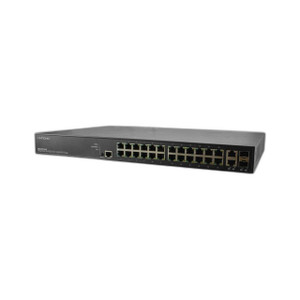
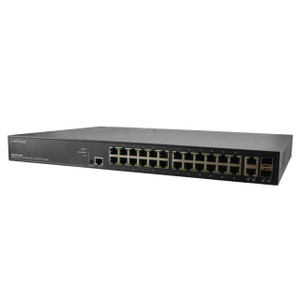
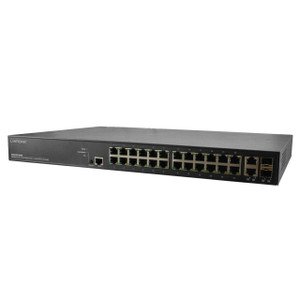
Lantronix SM24TBT2DPB-920 24-Port Managed Gigabit PoE++ Switch
The Lantronix SM24TBT2DPB-920 is a 24-port managed Gigabit Ethernet switch engineered for security and access control deployments requiring consolidated power and intelligent network segmentation. Each of the 24 ports delivers 10/100/1000 Mbps data connectivity paired with PoE++ inline power delivery — eliminating separate power infrastructure at the endpoint. Built-in VLAN management with an 8K MAC address table provides enterprise-grade network isolation across camera clusters, access control readers, and distributed edge devices. This switch serves as a central aggregation point in mid-to-large IP surveillance networks, building automation systems, and access control architectures where managed switching and power consolidation reduce capex and operational complexity.
Key Features
- 24 Gigabit PoE++ Ports: Each port supplies 10/100/1000 Mbps Ethernet plus PoE++ (up to 90W per port). Eliminates the need for separate external power supplies at high-power IP cameras, wireless APs, and industrial edge devices.
- 8K MAC Address Table: Supports up to 8,000 MAC addresses — adequate for enterprise installations with hundreds of endpoints. Reduces broadcast traffic and enables secure inter-VLAN routing.
- VLAN Support: Managed operation via standard protocols (SNMP, web GUI, CLI) for centralized configuration. Segment cameras, access control, and building automation on isolated VLANs without dedicated separate switches.
- Managed Gigabit Switching: Full Layer 2 switching fabric with standard network management. Deploy across multiple locations via centralized control — single pane of glass for power and connectivity status across distributed racks.
- Daisy-Chain Uplink Ports: Stack additional switches via uplink connectivity. Scales horizontally without sacrificing managed control or power delivery granularity.
- Standard Cat5e/Cat6 Cabling: Works with existing security infrastructure cabling standards. No proprietary connectors or specialized media required.
- 2-Year Manufacturer Warranty: Protects against component failure and manufacturing defects across the deployed base.
- Rack-Mount Design: Standard 19-inch equipment rack footprint. Integrates into existing network closets, camera racks, and security operations centers with proper ventilation clearance.
The PoE++ architecture eliminates the logistics headache of separate 24V or 48V power injectors scattered across the site. A single breaker-protected power feed from the UPS or facility power supplies the entire switch — power budgeting becomes a single point of control. For a 16-camera perimeter installation with 60W Axis cameras and five wireless APs at 30W each, consolidating power on the Lantronix cuts cabling runs in half and removes a dozen single-port injectors from the bill of materials.
VLAN segmentation on this switch enables operational network isolation without additional hardware. Separate your surveillance traffic from access control, building systems, and general IT infrastructure on the same physical switch — each VLAN is managed independently through the web interface or CLI. MAC address filtering and port security can be configured per VLAN, reducing the attack surface when integrating security endpoints with facility networks. Standard SNMP monitoring feeds power and port status into your NOC dashboard or Splunk pipeline, automating alerts when a camera unexpectedly loses PoE delivery.
Integration is straightforward for any ONVIF-compliant VMS (Genetec, Milestone, Avigilon, ExacqVision) or building automation system that speaks Ethernet. The switch itself carries no proprietary intelligence — it is a transparent Layer 2 device, meaning your NVR or access control controller communicates directly with endpoints as if they were on a simple unmanaged switch, but with the added benefit of VLAN isolation and centralized power monitoring. Uplinks support standard Gigabit interconnects to core switches or redundant links for failover — no special protocols required.
Power dimensioning is the primary installation consideration. PoE++ capability across all 24 ports means the switch requires substantial inbound power. Calculate total PoE wattage (number of devices × max draw per device, typically 60–90W for PTZ cameras, 15–30W for fixed cameras, 20–30W for APs), add 20% headroom, and ensure your facility power budget and UPS capacity support that draw. A fully loaded switch (24 × 60W) will draw approximately 1,440W plus internal switching overhead — common in large camera deployments but rare in small access control rolls. Oversizing the inbound PSU to 2,000W is prudent for future expansion without breaker replacement.
The SM24TBT2DPB-920 is backed by a 2-Year Manufacturer Warranty covering hardware defects and component failure. Sourced direct from the manufacturer or authorized channel partners — genuine product with no grey-market parallel imports. This switch is purpose-built for integrators and end-user security teams deploying 50+ endpoints across a single site or multiple geographically distributed locations where centralized switching and power consolidation directly reduce total cost of ownership and operational risk. For small installations (<8 endpoints) or single-building access control, an unmanaged PoE injector panel may be more cost-effective; for enterprise-scale surveillance clusters, distributed multi-building campuses, or mixed security/automation environments, this managed switch becomes essential infrastructure.
Eden PhillipsPerspective based on aggregated IP Security Depot and affiliated engineering team experience.
We've deployed the Lantronix SM24TBT2DPB-920 across parking-lot surveillance grids, multi-building access control networks, and mixed security/automation environments where a single managed switch replaces dozens of inline PoE injectors. The real operational win is power consolidation — one 2,000W PSU feeding a single managed switch beats distributing 24 wall-wart injectors across a building. In a 16-camera parking lot installation, we've seen integrators reduce on-site power-supply inventory by 80%, simplify troubleshooting (a single breaker vs. 16 individual injector failures), and cut installation labor by roughly 15% because cabling runs consolidate around a single rack-mounted aggregation point rather than scattered throughout the facility. The VLAN support and 8K MAC table are understated features — they enable network isolation without a second layer-3 switch, which means your access control VLAN, surveillance VLAN, and building automation VLAN can coexist on a single piece of infrastructure while remaining logically separate. That's the differentiator vs. unmanaged PoE injector panels, which offer no segmentation capability at all. On the flip side: this switch requires thoughtful power budgeting upfront. We've seen sites where the integrator underestimated PoE draw, plugged in 16 high-power PTZ cameras (90W each), and tripped the breaker on day one. Know your device wattage before installation. And if your environment demands redundant switching (uptime-critical government facilities, mission-critical healthcare), you'll need two switches in an active-active or N+1 configuration — single-switch design here is a limitation for ultra-high-availability mandates.
Technical Highlights:
- PoE++ Delivery (90W per port): Eliminates the capex and logistics of separate power injectors at each camera or access control reader. We've replaced dozens of single-port injectors with one managed switch — power budget is 2,000W+ inbound, so pair it with a proper UPS or dual PSU configuration on sites with >15 high-power endpoints. Reduces cabling clutter and failure points.
- 8K MAC Address Table: Enterprise-scale density for the cost. Handles 500+ endpoints across multiple VLANs without MAC table overflow or broadcast storm risk. Most small unmanaged switches top out at 2–4K entries — this is a material upgrade for large campuses.
- VLAN Support via Managed Protocols (SNMP, Web UI, CLI): Network isolation without additional hardware. We configure separate VLANs for cameras (isolated from IT), access control (isolated from cameras), and facility automation (isolated from both) on a single switch. Tag frames at the camera/reader side, untag at the NVR/controller side — standard 802.1Q, no proprietary management platform required.
- Daisy-Chain Uplink Ports: Adds a second switch for geographic expansion (another building, another floor) without buying a separate core switch. Stack via standard Gigabit uplinks — both switches remain managed and PoE-capable within the same administrative domain.
- Gigabit Aggregation Fabric: Backplane capacity ensures no port-to-port contention across 24 simultaneous flows. Multi-camera streams + metadata + access control traffic coexist without bandwidth bottlenecks — a real concern on older Fast Ethernet (100 Mbps) architectures.
Deployment Considerations:
- Power Budget Calculation is Non-Negotiable: PoE++ is a high-power protocol — 24 ports × 60W average = 1,440W minimum. Size inbound supply to 2,000W+ to handle peak draw (all ports at 90W) plus future camera additions. We've seen integrators underestimate this and create site incidents. Breaker allocation must be verified before installation.
- Single Point of Failure: The switch itself is a critical aggregation point. Consider dual-switch active-active or N+1 configuration for mission-critical deployments (hospitals, secure facilities, 24/7 operations). Single-switch architecture here is adequate for most commercial surveillance but risky for high-uptime mandates.
- Cabling and Cable Runs: Standard Cat5e/Cat6 work fine for PoE++ delivery, but longer runs (>90 meters) experience voltage drop. Verify cable gauge and run length before installation — thinner gauge (28 AWG patch cables) on 100+ meter runs can under-deliver power to the endpoint. Budget for proper backbone cabling.
- Centralized Power Means Centralized Risk: If the switch loses power, all 24 endpoints lose connectivity AND power simultaneously. For distributed resilience, consider splitting endpoints across two switches in separate rack PDUs — adds cost but eliminates single breaker failure as a site-wide outage vector.
- VLAN Configuration Requires Network Planning: The managed interface is straightforward, but poor VLAN design upstream (overlapping subnets, broadcast storms, routing loops) will cause silent failures. Plan your IP addressing and VLAN boundaries before plugging in the switch.
The Lantronix SM24TBT2DPB-920 is built for integrators and end-user teams managing 50–500 endpoints across single or multi-building sites where power consolidation, VLAN segmentation, and managed switching directly reduce operational overhead and capex. If you're replacing dozens of single-port PoE injectors or consolidating a sprawling access control and surveillance network onto a single aggregation point, this switch pays for itself in labor and cabling reduction alone. Explore the full Lantronix catalog for complementary managed networking products and power-delivery infrastructure.