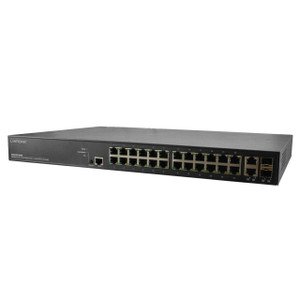
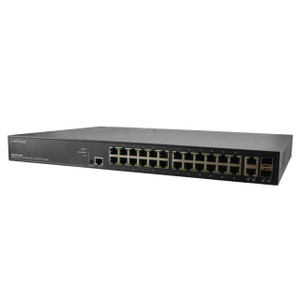
Transition Networks SM24TBT2DPB-2XPS 24-Port PoE++ Switch
The Transition Networks SM24TBT2DPB-2XPS is a 24-port managed Gigabit Ethernet switch purpose-built for distributed security and industrial network deployments requiring high-density Power over Ethernet++ capacity. All 24 ports deliver up to 90W per port—sufficient for simultaneous high-power PTZ cameras, heated dome enclosures, and dual-feed configurations—while single-mode fiber uplinks extend network reach across campus and outdoor installations without signal degradation. The managed architecture, DIN rail form factor, and lifetime warranty position this switch as a central hub for mid-to-large security systems that demand deterministic power budgeting and flexible topology expansion.
Key Features
- PoE++ Power Delivery: All 24 ports support up to 90W per port. Eliminates the need for separate power injectors or external UPS units per camera—total switch power budget supports mixed high-demand and standard-draw devices across the full port count.
- Managed Switching Architecture: VLAN support, 8,000 MAC address table, and configurable port prioritization. Enables isolation of camera traffic from operational networks and prioritization of critical streams in bandwidth-constrained environments.
- Single-Mode Fiber Uplinks: Single-mode fiber connectivity for distant network segments (10+ km reach) without intermediate hubs or signal repeaters. Ideal for multi-building campuses, parking-lot perimeter networks, and outdoor wireless bridges.
- Gigabit Copper Ports: 24 × 1000 Mbps RJ45 ports. Sufficient aggregate backhaul for 16-24 high-bitrate cameras (4K, H.265 encoding) or mixed HD/4K deployments without port congestion.
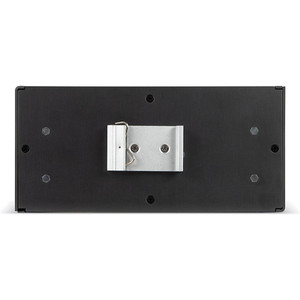
- DIN Rail Mount: Compact footprint for control enclosures, electrical panels, and pole-mounted junction boxes. No cabinet rack space required; fits standard 35mm DIN rails in industrial and outdoor deployments.
- Managed Port Control: Per-port power cycling, status monitoring, and uptime reporting. Troubleshoot disconnected cameras remotely; reset problematic devices without physical site visits.
- Lifetime Warranty: Factory warranty covers the product lifespan, reducing hardware replacement capex and simplifying long-term cost modeling for multi-year integrations.
In real-world security deployments, power budgeting is a critical design variable. A 24-port PoE++ switch capable of delivering 90W per port means you can mix high-demand devices—such as PTZ cameras with 50W+ draw and heated enclosures—without the overhead of segmenting the network into smaller switches or adding external power supply racks. The single-mode fiber uplinks solve a common integration bottleneck: extending a network beyond the 100-meter copper limit without introducing separate fiber-to-Ethernet converters at each end. In a parking-lot or perimeter deployment spanning multiple buildings, one set of single-mode fiber connections (typically already trenched or aerial on utility poles) connects the main switch to remote camera clusters, each fed by a smaller PoE+ injector or additional managed switch at the edge. The managed features—VLAN tagging and MAC table capacity—allow you to segregate camera traffic from guest Wi-Fi or back-office networks, reducing broadcast storms and improving overall network stability.
The 8,000-entry MAC address table is sufficient for most enterprise-class security deployments. In highly distributed systems with 50+ cameras across multiple subnets, VLANs and managed routing become essential; this switch provides the foundation without requiring a full-featured core router. Port-level power monitoring and management features (typically accessed via Telnet, SSH, or web-based console) enable rapid troubleshooting when a camera goes offline—reboot the offending port remotely rather than dispatching a technician to perform a manual power-cycle at the site. For integrators managing 10-100 camera installations across multiple locations, this remote power control translates to measurable labor savings and faster mean-time-to-recovery.
DIN rail mounting is critical in industrial and outdoor environments where traditional server-rack real estate is unavailable. A pole-mounted or wall-mounted equipment enclosure at a parking lot, warehouse entrance, or campus perimeter can house the switch, a UPS module, and a cellular modem in a compact footprint. The lifetime warranty reduces the risk of mid-life hardware failure requiring emergency replacement during a critical deployment phase. For system architects specifying networks for schools, hospitals, manufacturing facilities, or government buildings, the combination of managed switching, high PoE++ density, fiber scalability, and industrial form factor delivers both technical resilience and operational cost control over a 7-10 year installation lifespan.
Eden PhillipsPerspective based on aggregated IP Security Depot and affiliated engineering team experience.
We've deployed the SM24TBT2DPB-2XPS across parking-lot, perimeter, and multi-building campus networks where power density and fiber reach are non-negotiable. The real operational advantage isn't just that all 24 ports deliver 90W—it's that you can actually do it without external injectors or separate PoE power supplies clogging an equipment rack. In a typical 20-camera deployment with a mix of Axis P33-series PTZ domes (40-50W), fixed turrets (13-20W), and a few thermal imaging units (35W), the SM24TBT2DPB-2XPS absorbs the entire load from a single pair of redundant AC inputs. The single-mode fiber uplinks are a game-changer for distributed sites: instead of running four Cat6A cables 300 meters across a parking lot (and dealing with copper interference and distance limitations), you run two single-mode fibers and a pair of transceivers at each end. Cost-wise, fiber becomes cheaper at 150+ meters anyway. The managed architecture—VLANs, MAC table, per-port monitoring—gives you visibility into network health that unmanaged PoE switches simply don't provide. A camera acting as a broadcast storm source, or a rogue DHCP server on a guest network, gets isolated in a VLAN rather than degrading the entire switch. In our experience, that feature pays for itself the first time a misconfigured device nearly brings down a 50-camera installation.
Technical Highlights:
- 90W Per-Port PoE++ Budget: Supports simultaneous high-demand devices without segmentation or external injectors. On a 24-port switch, that translates to a total PoE capacity of 1,440W under ideal conditions—more than enough for a complete mid-sized deployment. Pair it with a redundant AC supply, and you have a self-contained power hub that eliminates the need for distributed power supplies at each camera location.
- Single-Mode Fiber Uplinks: Eliminates copper distance limitations and ground-loop interference common in sprawling outdoor installations. A single fiber pair can span 10+ km without signal degradation, making it ideal for multi-building campuses, perimeter security across large parking lots, or connecting a main control center to a remote network segment without intermediate repeaters.
- Managed VLAN Architecture: Enables traffic segmentation and broadcast containment. Camera streams on one VLAN, office data on another, guest Wi-Fi on a third—reduces latency and improves fault isolation. A malfunctioning device no longer cascades problems across the entire network.
- 8K MAC Address Table: Sufficient for complex multi-subnet deployments with 50-100+ edge devices. Avoids MAC table exhaustion and performance degradation that occurs on smaller tables when you add printers, wireless APs, IoT sensors, and other network nodes typical in large installations.
- DIN Rail Form Factor: Fits outdoor enclosures, pole-mount cabinets, and equipment racks without consuming valuable rack space. Especially valuable in distributed architectures where you deploy smaller managed switches at each site cluster rather than centralizing everything in a main NOC.
Deployment Considerations:
- Single-mode fiber uplinks require fiber-to-Ethernet transceivers (SFP or XFP modules) at both ends—not included in the base switch. Budget for a pair of matching transceivers (typically $200-400 per pair) and confirm they're compatible with your existing fiber infrastructure before ordering.
- PoE++ power delivery requires a robust AC supply. If you're powering the switch from a standard 120V outlet, confirm branch-circuit capacity and consider adding a small UPS (500VA–1kVA) to protect against brief outages. In outdoor installations, pole-mounted AC distribution or a solar + battery backup setup is standard practice.
- The managed interface is typically accessed via serial console or SSH. If your integrators or end-user IT staff are accustomed to unmanaged PoE switches, budget for brief training on VLAN configuration and port management. Most tasks (power cycling a port, viewing port status) are straightforward, but advanced features (loop prevention, storm control) require familiarity with managed switching concepts.
- In high-EMI environments (industrial plants, parking-lot lighting control systems), run separate cable trays for copper Ethernet and AC power lines. Although PoE is relatively robust, poor cable management can introduce noise into sensitive analog signals in older mixed-technology sites.
- The lifetime warranty covers manufacturing defects but not physical damage. Outdoor enclosures should include surge protection (Ethernet surge suppressors on the copper ports) and proper grounding to the cabinet frame to avoid damage from nearby lightning strikes or utility spikes.
This switch is the right choice for mid-to-large security integrators and end-user IT teams managing distributed camera networks where power density, deterministic budgeting, and remote manageability are critical. It's also ideal for system architects designing new campuses or retrofit projects where copper PoE limitations have been a bottleneck in the past. Explore the full range of managed switching and fiber infrastructure solutions in the Transition Networks catalog.