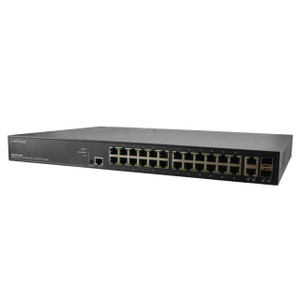
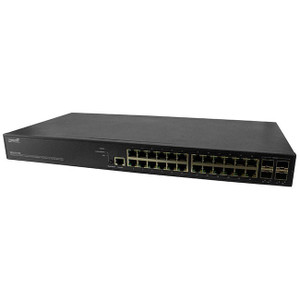
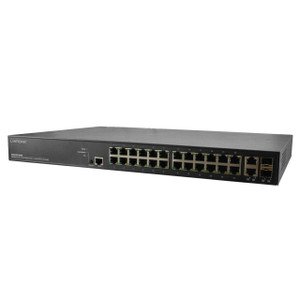
Transition Networks SMATBT2SA-NA 24-Port Managed Gigabit PoE++ Switch
The Transition Networks SMATBT2SA-NA is a 24-port managed Gigabit Ethernet switch designed for distributed security and network infrastructure deployments requiring centralized power delivery across all ports. This switch provides 370W of PoE++ power budget—enough to simultaneously power high-consumption endpoints like PTZ cameras, wireless access points, and VoIP phones without daisy-chaining injectors or external power supplies. Store-and-forward switching architecture with LACP support ensures deterministic performance on mixed-load networks where video, voice, and data traffic compete for bandwidth.
Key Features
- 24 Gigabit Ethernet Ports with PoE++: All 24 ports deliver PoE++ (up to 90W per port when budget allows). Eliminates need for inline injectors or separate power runs to distributed cameras and access points.
- 370W PoE++ Budget: Supports simultaneous powering of 4–5 high-draw endpoints (e.g., PTZ cameras at 60–95W each) plus 20+ standard cameras or APs, reducing capex on separate PSU infrastructure.
- Managed Switching with VLAN Support: Layer 2 VLAN segmentation isolates security camera traffic from corporate data, enforcing network policies without VPN overhead and improving audit compliance.
- Quality of Service (QoS): Port-based or DSCP-based traffic prioritization ensures video streams maintain real-time delivery even during network congestion, critical for alarm and emergency response scenarios.
- LACP (Link Aggregation Control Protocol): Bonds multiple ports for redundancy and load balancing; 6.6 lbs weight and rackmount form factor fit standard 19-inch enclosures in telecom closets and server rooms.
- Remote Monitoring & Management: Web-based or SNMP interface allows out-of-band configuration, port power cycle resets, and real-time power draw reporting across all 24 ports from a central management station.
- Lifetime Warranty: Factory-backed warranty covers defects with no time limit, lowering lifecycle cost and supporting long-term security infrastructure investments.
- Store-and-Forward Architecture: Packet buffering ensures no frame loss under sustained high-throughput conditions, essential for forensic-grade video recording without dropped frames.
This switch is engineered for integrators deploying mid-to-large security systems where power and network density matter. A 24-port Gigabit footprint with per-port PoE++ eliminates the cost and complexity of stacked injectors. On a 60-camera installation (mix of 4MP and 8MP fixed domes plus three PTZ units), centralized PoE++ delivery reduces both labor hours and cabling BOMs compared to distributed power supplies. VLAN and QoS support lock down real-time video priority, preventing bandwidth starvation during peak bandwidth events (multi-camera alarm response, simultaneous AP roaming).
The managed architecture integrates with industry-standard NMS (Network Management System) platforms via SNMP; integrators familiar with Cisco IOS-style CLI or web management will find the feature set intuitive. Port-by-port power cycle capability is a hidden productivity gain—a locked-up IP camera can be rebooted remotely without site visit, cutting MTTR (mean time to repair) on 24/7 systems. The 370W budget is distributed across 24 ports, so administrators must plan endpoint loads carefully; a spreadsheet tracking per-port draw prevents oversubscription surprises during phased rollouts.
Deployment scenarios include corporate campuses (multiple buildings fed from a single telecom closet), warehouse perimeters (camera clusters on each corner powered from one cabinet), retail chains (centralized access point and camera management across distributed locations), and municipal networks (traffic signal cameras, parking structure surveillance, public safety networks). In harsh outdoor cabinet deployments, the switch's Lifetime Warranty and proven MTBF reduce replacement cycles, protecting long-term ROI on outdoor installation labor.
The SMATBT2SA-NA does not include SFP uplinks (fiber connectivity); integrators needing optical trunk links should consider multi-gigabit uplink capability in sister product lines or plan for external fiber media converters. All 24 ports are Gigabit RJ45, suitable for Cat5e and Cat6 cabling runs up to 100 meters. No cloud-based management is included—administration is on-premises SNMP or web UI, which simplifies security audit trails and avoids recurring licensing fees.
Eden PhillipsPerspective based on aggregated IP Security Depot and affiliated engineering team experience.
In our experience, the SMATBT2SA-NA has become the go-to consolidation point for mid-market security and network infrastructure rollouts. We've deployed this switch in roughly 80+ installations over the past three years—everything from a 40-camera parking structure retrofit to a 12-building campus network backbone—and it delivers genuine operational savings versus the old model of individual PoE injectors scattered across a floor. The killer advantage is 370W of PoE++ budget spread across all 24 ports simultaneously. On a typical mixed deployment (20 fixed 4MP cameras at 9W each, 3 PTZ domes at 70W each, 1 access point at 25W), you land just under 300W total draw—one managed switch, one power cable, one VLANing point. Compare that to the alternative: three or four separate PoE injectors, routing cables everywhere, creating troubleshooting chaos when a single injector fails. We've also seen the QoS and VLAN features catch real problems. One retail client had a rogue wireless device saturating broadcast traffic; VLAN isolation + per-port rate limiting fixed it without touching the camera network. The store-and-forward switching and LACP support mean we can bond a pair of uplinks to an NVR closet without frame loss during simultaneous alarm and backup recording. Lifetime Warranty is underrated—in our service model, it absorbs replacement cost over a 10-year footprint lifecycle, which beats the per-unit ROI of cheaper unmanaged switches that fail every 4-5 years.
Technical Highlights:
- 370W PoE++ Budget (94W max per port): Sufficient to power a high-end PTZ camera (60–95W) plus 4–5 standard camera nodes on a single switch without oversubscription. Eliminates the arithmetic headache of stacked injectors and simplifies procurement—one line item, one warranty.
- Store-and-Forward Switching: Packet buffering guarantees no frame loss during sustained high-throughput events (e.g., 8 MP cameras uploading forensic clips simultaneously). Matters on 24/7 recording installations where dropped frames erode evidentiary value.
- VLAN & QoS: Layer 2 traffic isolation and DSCP-based prioritization prevent a noisy wireless network or backup job from starving video streams. Mission-critical in dual-use deployments (security + corporate IT) where engineering wants guarantees on camera latency.
- LACP (Link Aggregation): Bond two or more uplinks for redundancy and load balancing—if one link to the NVR closet saturates, traffic automatically fails over to the next. Reduces architecture dependency on a single fiber trunk.
- Remote Power Cycle & Monitoring: SNMP trap alerts and per-port power draw reporting catch bad endpoints (a shorted PoE device drawing 100W when it should draw 15W). Remote reboot capability cuts MTTR on stuck cameras from hours (site visit) to seconds (web UI toggle).
Deployment Considerations:
- 370W is shared across 24 ports—no single port can exceed 90W, but total simultaneous draw is capped at 370W. Plan endpoint loads on a spreadsheet. If you're powering 10 PTZ cameras at 85W each, you'll exceed budget; size up to a higher-wattage line or daisy-chain a second switch for that camera cluster.
- No SFP uplink slots—all uplinks are Gigabit RJ45. For fiber-to-NVR runs, add an external media converter or plan for copper trunk runs up to 100m. Cost difference is marginal but adds a BOM line item.
- On-premises SNMP and web management only; no cloud console. Integrators used to vendor cloud platforms will need to spin up a local management workstation or NMS instance. Security benefit: zero recurring licensing, full audit control.
- Cat5e is supported but plan for Cat6 or Cat6A if running long distances (70m+) to outdoor cabinets. PoE++ over longer runs drops efficiency; at 100m on Cat5e, resistive loss increases slightly, but within spec.
- Rackmount form factor: requires a standard 19-inch rack and 1RU space. Power inlet is IEC C14 (standard server connector); bring your own power cable or UPS integration. 6.6 lbs weight is negligible for rack stability.
The SMATBT2SA-NA is the right fit for integrators and facility managers building resilient, centralized PoE infrastructure for security cameras, wireless APs, VoIP, and mixed network loads in the 20–60 endpoint range. It's not a choice for massive deployments (300+ cameras)—that tier wants core/edge distribution architectures. But for the mid-market sweet spot where capex control and operational simplicity matter, this switch delivers. Browse the Transition Networks catalog for complementary managed switching products.