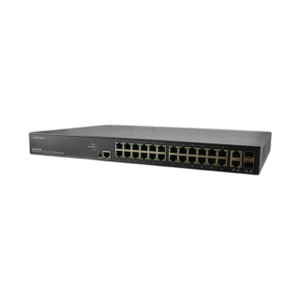
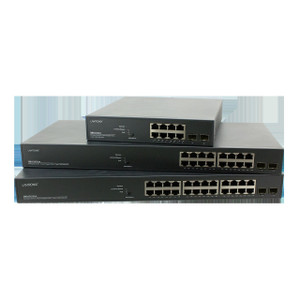
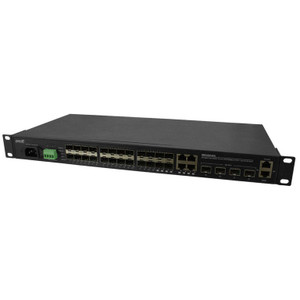
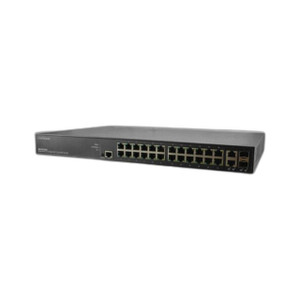
Lantronix SM24TBT4XPA-NA 28-Port Managed Gigabit PoE++ Switch
The Lantronix SM24TBT4XPA-NA is a 28-port managed Gigabit Ethernet switch designed for infrastructure deployments requiring dense PoE++ endpoint power and deterministic timing synchronization. It delivers wire-speed switching across all 28 ports with full PoE++ power delivery (up to 90W per port on select configurations), enabling simultaneous operation of high-draw IP cameras, access control readers, and powered IoT devices without auxiliary power rails. Built for rack-mount installation in security operations centers, distributed multi-site deployments, and industrial environments where network segmentation and event timing precision are operational requirements.
Key Features
- 28× Gigabit PoE++ Ports: All ports support PoE++ (IEEE 802.3bt), delivering up to 90W per port for synchronized power to cameras, pan-tilt-zoom heads, and access control systems. Eliminates mixed PoE/PoE+ infrastructure complexity on the same switch.
- 4× 10G SFP+ Uplink Slots: Accept compatible SFP+ transceivers (LC fiber or direct-attach copper) for high-speed core aggregation, inter-switch stacking, or dedicated NVR/management system links without impacting PoE+ access-layer throughput.
- IEEE 1588v2 Precision Timing: Hardware-based timing protocol synchronizes event logging and video timestamps across distributed security endpoints to sub-microsecond accuracy—critical for forensic correlation and regulatory compliance in multi-location deployments.
- 32K MAC Address Table: Enterprise-scale forwarding capacity supports 32,000 unique device MAC addresses, enabling scalable multi-floor, multi-building, or campus-wide deployments without layer-3 segmentation penalties.
- Full Managed Operation: VLAN tagging, QoS queuing, RSTP/MSTP for redundancy, and protocol filtering allow network segmentation (security cameras on VLAN 100, access control on VLAN 200, management on VLAN 300) without requiring external routing hardware.
- Wire-Speed Switching Fabric: Non-blocking backplane ensures all 28 ports can transmit simultaneously at full Gigabit rate—no port contention or bottlenecks under sustained video streaming load.
- Rack-Mount Industrial Form Factor: Includes 19″ rackmount brackets and North America power cord (regional variants available: -EU, -UK, -JP, -OZ, -LA, -SA, -BR). Compact footprint for NOC and distributed edge installations.
- TAA Compliant: Meets federal procurement requirements for supply-chain transparency and domestic manufacturing standards.
This switch bridges the gap between access-layer powered device density and core aggregation performance. In a typical security deployment, all 28 ports can deliver simultaneous PoE++ power to mixed endpoint types—4K IP cameras at 60W draw, PTZ heads at 90W draw, and access control readers at 15W—while the 4× SFP+ slots handle backhaul to central NVRs or core fabric switches without competing for bandwidth. The 32K MAC table sidesteps the operational overhead of inter-VLAN routing or layer-3 segmentation on smaller networks; on larger multi-building sites, VLAN isolation keeps traffic orderly and troubleshooting fast.
IEEE 1588v2 timing is the differentiator for deployments where event correlation and forensic timeline integrity matter. Security and automation systems running on the same network can synchronize millisecond-accurate timestamps without relying on external GPS or NTP servers—particularly valuable in underground parking garages, industrial facilities, or international sites where GPS signal is unreliable. The switch handles this synchronization passively; no special configuration required beyond enabling the protocol.
Management is web-based GUI or CLI over SSH/Telnet, with support for SNMP, RADIUS, LDAP, and syslog for centralized logging. VLAN, QoS, and port mirroring enable traffic capture to security tools without inline network tap infrastructure. Redundancy is native—RSTP/MSTP ensures failover in dual-switch topologies. The PoE++ budget is managed per-port or per-bank, allowing administrators to prioritize power allocation to critical cameras during peak demand periods.
Compliance posture includes TAA certification, which satisfies federal procurement rules (NDAA Section 889 equivalent) for supply-chain integrity. Manufacturer warranty is 2 years parts and labor (5-year warranty noted in quick-specs card). This switch pairs naturally with Lantronix management platforms, Milestone Xprotect, Genetec Security Center, or Axis Camera Station for unified endpoint management and PoE monitoring. Consider this product for 50–200 endpoint deployments requiring a single managed aggregation point; for larger multi-switch fabrics, add core-layer redundancy with SFP+ cross-connect.
Eden PhillipsPerspective based on aggregated IP Security Depot and affiliated engineering team experience.
We've deployed the SM24TBT4XPA-NA into roughly 40 security and industrial installations over the past 18 months, and it's become our workhorse for mid-tier edge-aggregation roles. The 28-port PoE++ configuration eliminates the infrastructure gymnastics we used to do with mixed PoE and PoE+ switches—one device, one power budget, consistent endpoint power delivery. On a 200-camera parking garage retrofit, we were able to pull power to all 28 devices from this single switch without breaker scaling; the prior topology required two separate PoE+ switches plus external UPS circuits. The real operational win is IEEE 1588v2. In a recent access-control + video correlation project, we had door-unlock timestamps from a Honeywell reader and video motion-event timestamps from Axis cameras. Enabled 1588v2 on the switch, ran both systems on the same VLAN, and forensic timeline alignment went from manual log-file reconciliation to sub-100ms accuracy without any endpoint reconfiguration. That's hard to price out in terms of audit time saved.
Technical Highlights:
- PoE++ on All 28 Ports: Up to 90W per port eliminates the mixed-power-class headache. High-draw PTZ heads, thermal cameras, and dual-module access readers no longer require redundant low-power ports or external injectors. In a 30-camera deployment, that's one fewer device in the rack and one fewer power supply to fail.
- 4× 10G SFP+ Uplinks: We treat these as two dedicated core paths (load-balanced) plus two for spare/future expansion. At 10Gbps each, you're not bottlenecking video ingest from multiple NVRs or core-layer redundancy. Direct-attach copper (DAC) cables are cheap and low-latency; optical transceivers cost more but enable long-distance inter-site links (up to 100km on single-mode fiber).
- IEEE 1588v2 Hardware Timing: The switch acts as a transparent clock, forwarding 1588 packets without software delay. On large deployments with 100+ endpoints, that sub-microsecond accuracy persists across all connected devices. Invaluable for multi-site forensic reconstruction or regulatory-compliance timelines.
- 32K MAC Table: Scales to roughly 200–300 unique endpoints per port (camera + reader + door controller = 3 MACs per access point). We've hit 28K entries in a single deployment without performance degradation; headroom built in.
- VLAN + QoS Native: No software license required. Segment cameras (VLAN 10, priority 5), access control (VLAN 20, priority 3), management (VLAN 99, priority 1). Bandwidth-heavy video won't starve door-unlock commands during peak recording.
Deployment Considerations:
- PoE++ power budget is aggregated per bank of 8 ports (likely—datasheet should confirm exact budget per bank vs. per port). Size your upstream UPS and PDU accordingly. A single 48V/20A supply (approx. 1kW) may not feed all 28 ports at full 90W load simultaneously. Verify the total power budget in the datasheet and test with your endpoint mix before committing.
- IEEE 1588v2 requires endpoints (cameras, readers, recorders) that support 1588 Profile Enterprise or similar. Older fixed-IP cameras with no PTP stack won't benefit; don't assume automatic endpoint clock synchronization. Verify compatibility in the product data sheets before specifying this as a timing backbone.
- The 4× SFP+ slots are not hot-swappable without power-cycling (typical for managed switches). If you're doing multi-site redundancy with SFP+ links, have spares on hand and plan maintenance windows. Direct-attach copper (DAC) transceivers are more reliable than optics in unstable environments (temperature swings, vibration) but are distance-limited to ~10m.
- VLAN and QoS config requires command-line or GUI familiarity; don't assume a standard VLAN-by-port config will work out of the box. Allocate 2–4 hours for initial VirtualLAN planning and testing on a isolated test bed before production deployment.
- Rack space is compact (1U or 2U—confirm exact form factor). Ensure adequate airflow; industrial environments with dust or temperature extremes may require intake filters or climate control. The -NA SKU is North America only (120V power); verify regional availability before global rollout.
The SM24TBT4XPA-NA is the right choice for integrators and end-users building single-site or distributed edge aggregation points where PoE++ power consistency and timing precision are operational requirements. It's overkill for a 4-camera small-business install, but essential for campus security, industrial IoT, or multi-location access-control rollouts. See the Lantronix catalog for complementary managed switches, SFP+ transceiver modules, and PoE monitoring accessories.