
TP-Link DS108G vs Lantronix S2220-1014-NA: Specification Comparison
Both the TP-Link DS108G and the Lantronix S2220-1014-NA are 8-port network switches positioned for small-to-medium security and office infrastructure deployments. The DS108G is an unmanaged 2.5G multi-gigabit desktop switch, while the S2220-1014-NA is a Layer 2 managed gigabit switch with fiber uplink capability. This comparison examines port speed and throughput, management and fiber connectivity, and physical deployment characteristics to help integrators and IT buyers determine which switch best fits their cabling, control, and bandwidth requirements.

In This Guide
Which switch delivers higher port speed and aggregate throughput?
The TP-Link DS108G provides 8 ports running at 2.5 Gbps each, with auto-negotiation supporting 2.5G, 1G, and 100 Mbps per port. Its switching capacity is specified at 40 Gbps, making it well-suited for bandwidth-intensive endpoints such as Wi-Fi 6 access points, multi-gigabit NAS devices, or high-resolution IP cameras that can leverage speeds above standard gigabit.
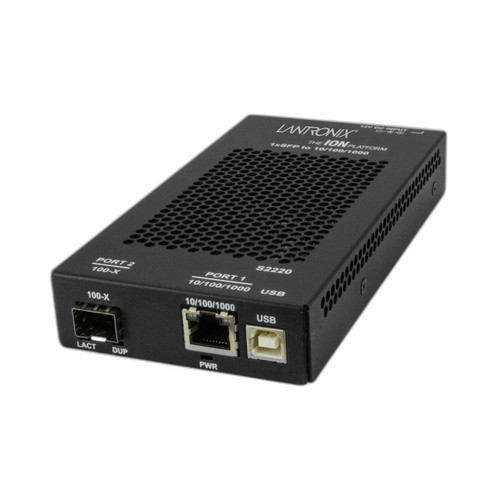
The Lantronix S2220-1014-NA offers 8 copper ports rated at 10/100/1000BASE-T (maximum 1 Gbps per port). No aggregate switching capacity figure is provided in the available specifications. The S2220-1014-NA adds a 100BASE-LX10 single-mode fiber uplink capable of spanning up to 10 km via SC connector — a connectivity tier absent from the DS108G's spec sheet. For installations where per-port speed beyond 1 Gbps is required, the DS108G holds a clear advantage; where a long-reach fiber backbone is needed, the S2220-1014-NA is the only option of the two.
Which switch offers greater control and network integration capability?
The TP-Link DS108G is explicitly unmanaged. It operates via auto-negotiation and AUTO MDI/MDIX with no configuration interface, VLAN support, traffic prioritization, or remote monitoring capability. This makes deployment plug-and-play but eliminates any network segmentation or QoS control at the switch level.
The Lantronix S2220-1014-NA is a Layer 2 managed switch. Its specifications cite VLAN support, traffic prioritization, and remote monitoring as management features. This allows network administrators to segment traffic (e.g., separating camera VLANs from user traffic), apply port-level policies, and monitor switch status remotely — capabilities that are essential in security infrastructure deployments requiring network isolation or compliance with segmentation best practices. The S2220-1014-NA also provides a 100BASE-LX10 single-mode fiber port with up to 10 km range via SC connector, enabling long-distance uplink to a core switch or head-end location without a media converter.
How do the two switches compare on physical form, power draw, and compliance?
The TP-Link DS108G measures 6.2 × 4.0 × 1.0 in (158 × 100.7 × 25.4 mm) and is designed for wall-mount or desktop installation. Maximum power consumption is specified at 8.679 W. It carries FCC, CE, and RoHS certifications. Operating temperature is rated 0–40°C (32–104°F). Package contents include the switch, power adapter, installation guide, and rubber feet.
Physical dimensions, power consumption, operating temperature range, mounting options, and regulatory certifications are not provided in the available specifications for the Lantronix S2220-1014-NA. The product carries a stated 2-year warranty. Buyers requiring detailed environmental or compliance data for the S2220-1014-NA should consult the manufacturer's datasheet directly. The absence of these specs from the provided data makes a direct physical or power-draw comparison impossible.
Which should you choose: the DS108G or the S2220-1014-NA?
Our take: The DS108G is the stronger choice when maximum per-port throughput and zero-configuration deployment are the priorities: its 2.5 Gbps per-port speed and 40 Gbps switching capacity directly outperform the S2220-1014-NA's 1 Gbps copper ports, and its 8.679 W power draw and RoHS/FCC/CE certifications are fully documented. The S2220-1014-NA is the stronger choice when network control and long-distance fiber connectivity are required: it provides Layer 2 management with VLAN segmentation, traffic prioritization, and remote monitoring — none of which the unmanaged DS108G supports — plus a 100BASE-LX10 single-mode fiber uplink reaching up to 10 km. Integrators deploying high-bandwidth endpoints (Wi-Fi 6 APs, multi-gig NAS) in a flat, unmanaged network should favor the DS108G; those building segmented security networks with fiber backbone runs to a head-end or IDF should favor the S2220-1014-NA.
Side-by-Side Comparison
Spec-for-spec, from manufacturer data.
| Specification | TP-Link DS108G | Lantronix S2220-1014-NA |
|---|---|---|
| Product Type | Unmanaged Desktop Switch | Layer 2 Managed Switch |
| Managed | No | Yes (Layer 2) |
| Number of Ports | 8 | 8 |
| Copper Port Speed | 2.5G / 1G / 100 Mbps (auto-neg) | 10/100/1000BASE-T (1 Gbps max) |
| Switching Capacity | 40 Gbps | — |
| Fiber Uplink | — | 100BASE-LX10 single-mode, SC |
| Fiber Range | — | Up to 10 km |
| VLAN Support | No | Yes |
| Traffic Prioritization | No | Yes |
| Remote Monitoring | No | Yes |
| Connector Types | RJ45 | RJ45 + SC |
| Mount Type | Wall / Desktop | — |
| Dimensions | 6.2 × 4.0 × 1.0 in (158 × 100.7 × 25.4 mm) | — |
| Max Power Consumption | 8.679 W | — |
| Operating Temperature | 0–40°C (32–104°F) | — |
| Certifications | FCC, CE, RoHS | — |
| Warranty | — | 2 Years |
Frequently Asked Questions
Which should you choose: the DS108G or the S2220-1014-NA?
The DS108G is the stronger choice when maximum per-port throughput and zero-configuration deployment are the priorities: its 2.5 Gbps per-port speed and 40 Gbps switching capacity directly outperform the S2220-1014-NA's 1 Gbps copper ports, and its 8.679 W power draw and RoHS/FCC/CE certifications are fully documented. The S2220-1014-NA is the stronger choice when network control and long-distance fiber connectivity are required: it provides Layer 2 management with VLAN segmentation, traffic prioritization, and remote monitoring — none of which the unmanaged DS108G supports — plus a 100BASE-LX10 single-mode fiber uplink reaching up to 10 km. Integrators deploying high-bandwidth endpoints (Wi-Fi 6 APs, multi-gig NAS) in a flat, unmanaged network should favor the DS108G; those building segmented security networks with fiber backbone runs to a head-end or IDF should favor the S2220-1014-NA.
Can either switch support VLANs for separating camera traffic from office traffic?
Only the Lantronix S2220-1014-NA supports VLANs. It is a Layer 2 managed switch with documented VLAN support and traffic prioritization. The TP-Link DS108G is unmanaged and provides no VLAN or QoS capability.
Which switch is better for connecting Wi-Fi 6 access points or multi-gigabit NAS devices?
The TP-Link DS108G is better suited for this use case. Its ports support 2.5 Gbps per port with auto-negotiation down to 1G and 100 Mbps, and its 40 Gbps switching capacity accommodates the higher throughput that Wi-Fi 6 APs and multi-gigabit NAS devices can generate. The Lantronix S2220-1014-NA maxes out at 1 Gbps per copper port.
Does either switch include a fiber uplink for connecting to a distant core switch or IDF?
Yes — the Lantronix S2220-1014-NA includes a 100BASE-LX10 single-mode fiber port via SC connector with a specified range of up to 10 km. The TP-Link DS108G provides only RJ45 copper ports and has no fiber uplink capability per its available specifications.
More Network Switch Comparisons
- TP-Link SG2210XMP-M2 vs Ubiquiti USW-FLEX-2.5G-8
- TP-Link SG2210XMP-M2 vs Comnet CNGE8MS
- TP-Link SG2210XMP-M2 vs Lantronix S2220-1014-NA
- TP-Link SG2210XMP-M2 vs TP-Link S4500-8GP
- TP-Link SG2210XMP-M2 vs TP-Link SG2008P
- TP-Link S4500-8GP vs Ubiquiti USW-FLEX-2.5G-8
Network Switch Buying Guides
Get a Second Opinion on Your Camera Choice
Share your site layout, coverage goals, and budget. Our team will validate the camera selection, flag anything we would change, and recommend products that match the use case.