
Vivotek IHT-1000 vs TP-Link SG3210XHP-M2: Specification Comparison
Both the Vivotek AW-IHT-1000 and the TP-Link SG3210XHP-M2 are 8-port PoE network switches with 240W total power budgets and dual fiber/SFP uplink slots, placing them in the same general purchasing category for IP camera and access-control edge deployments. The comparison turns on three meaningful axes: port speed and switching throughput, operating environment and physical hardening, and management depth with uplink capability—each of which differentiates these two switches substantially for different installation contexts.
In This Guide
- Which switch delivers higher port speeds and switching throughput?
- Which switch is better suited to harsh or outdoor industrial environments?
- Which switch offers deeper management capabilities and broader PoE device compatibility?
- Which should you choose: the IHT-1000 or the SG3210XHP-M2?
- Side-by-Side Specs
- FAQ
Which switch delivers higher port speeds and switching throughput?
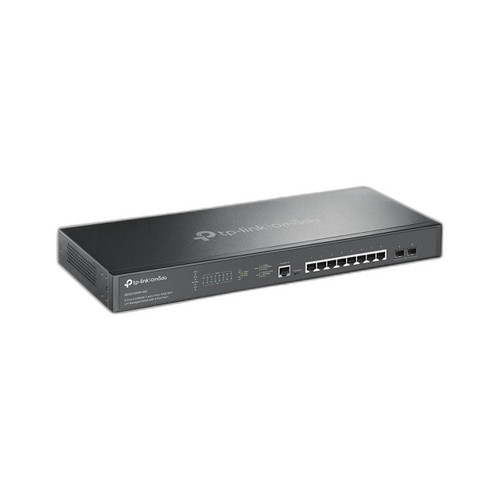
The TP-Link SG3210XHP-M2 operates its eight data ports at 2.5GBASE-T, delivering up to 2.5 Gbps per RJ45 port, and its two SFP+ uplinks run at 10G each. Its switching capacity is specified at 80 Gbps. The Vivotek AW-IHT-1000, by contrast, runs all eight RJ45 ports at Gigabit Ethernet (1000BASE-T) and its two SFP slots at 1000BASE-X (1 Gbps fiber). Its switching bandwidth is specified at 20 Gbps with a forwarding capacity of 14.88 Mpps.
For installations requiring high-throughput edge aggregation—4K multi-stream cameras, NVRs pulling simultaneous high-bitrate feeds, or Wi-Fi 6 access points demanding more than 1 Gbps—the SG3210XHP-M2's 2.5G ports and 10G uplinks represent a meaningful throughput advantage. The AW-IHT-1000's 1G ports are adequate for standard HD and most 4MP/8MP camera streams but will bottleneck aggregated multi-camera NVR uplinks sooner.
Which switch is better suited to harsh or outdoor industrial environments?
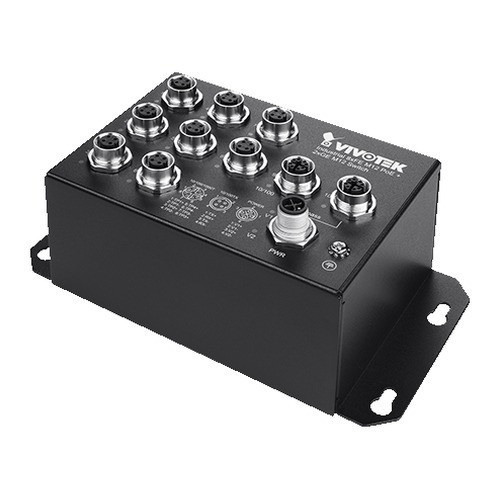
The Vivotek AW-IHT-1000 is explicitly positioned as an industrial switch. Its operating temperature range is -40°C to 75°C (-40°F to 167°F), covering extreme cold and high-heat enclosure conditions. It carries IEC 60068-2-6 vibration, IEC 60068-2-27 shock, and IEC 60068-2-32 freefall ratings, along with EMS compliance to EN61000-4-2/3/4/5/6/8. Per-port surge protection is specified at 12 kV. Its redundant dual DC power inputs (PW1 and PW2, each 48–56 VDC) provide power-source redundancy without an external UPS.
The TP-Link SG3210XHP-M2's operating temperature is specified at 0°C to 50°C (32°F to 122°F) and its power supply is 100–240 V AC. No surge protection rating per port, vibration/shock/freefall certifications, or redundant power input specifications are provided in the supplied spec data. For indoor, climate-controlled IDF closets or rack rooms, this is typically sufficient. For outdoor enclosures, transportation, manufacturing floors, or any site with sub-zero temperatures, the AW-IHT-1000's environmental hardening is directly specified; the SG3210XHP-M2's is not.
Which switch offers deeper management capabilities and broader PoE device compatibility?
The TP-Link SG3210XHP-M2 is an L2+ managed switch supporting CLI, SNMP v1/v2c/v3, RMON, 802.1x with RADIUS/TACACS+, VLANs, QoS, ACL, STP/RSTP/MSTP, IGMP snooping, LACP, and static routing. It is part of TP-Link's Omada SDN ecosystem. Its PoE implementation includes 802.3bt (PoE++), enabling up to 90W per port for high-draw devices such as PTZ cameras with heaters, outdoor Wi-Fi 6E access points, or video intercoms—though the supplied spec data notes 802.3af/at as the primary PoE standard listing, with 802.3bt referenced in marketing bullets.
The Vivotek AW-IHT-1000's management feature set is not detailed in the supplied specifications beyond Auto-MDI/MDI-X, auto-negotiation, IEEE 802.3x flow control, and store-and-forward transmission. No SNMP, VLAN, STP, or CLI management capabilities are specified in the provided data. Its PoE is specified at IEEE 802.3af/at only, with a maximum of 30W per port. For deployments requiring per-port PoE scheduling, traffic segmentation by VLAN, or centralized SDN controller integration, the SG3210XHP-M2 has documented feature support; the AW-IHT-1000 does not, based on available specs.
Which should you choose: the IHT-1000 or the SG3210XHP-M2?
Our take: The AW-IHT-1000 is the stronger choice when the installation environment is the primary constraint: its -40°C to 75°C operating range, 12 kV per-port surge protection, IEC vibration/shock/freefall ratings, and redundant 48–56 VDC dual power inputs directly address outdoor enclosures, transportation, or industrial sites where the SG3210XHP-M2's 0–50°C AC-only spec falls short. Conversely, the SG3210XHP-M2 outperforms on throughput—80 Gbps switching capacity versus 20 Gbps, 2.5G data ports versus 1G, and 10G SFP+ uplinks versus 1G SFP—and offers documented L2+ management including SNMP v3, VLAN, LACP, and Omada SDN integration that the AW-IHT-1000's published specs do not address. Both carry a 240W total PoE budget. Choose the AW-IHT-1000 for hardened edge deployments in harsh environments; choose the SG3210XHP-M2 for rack-mounted, climate-controlled installations demanding higher throughput and managed-network feature depth.
Side-by-Side Comparison
Spec-for-spec, from manufacturer data.
| Specification | Vivotek IHT-1000 | TP-Link SG3210XHP-M2 |
|---|---|---|
| Model | AW-IHT-1000 | SG3210XHP-M2 |
| RJ45 Data Port Count | 8 × Gigabit (1000BASE-T) | 8 × 2.5GBASE-T |
| Uplink/SFP Slots | 2 × SFP 1000BASE-X (1G) | 2 × SFP+ 10G |
| Switching Bandwidth / Capacity | 20 Gbps | 80 Gbps |
| Forwarding Capacity | 14.88 Mpps | — |
| PoE Standard | IEEE 802.3af / 802.3at | 802.3af / 802.3at / 802.3bt (referenced) |
| Max PoE per Port | 30W | Up to 90W (802.3bt referenced) |
| Total PoE Power Budget | 240W | 240W |
| Operating Temperature | -40°C to 75°C | 0°C to 50°C |
| Per-Port Surge Protection | 12 kV | — |
| Vibration / Shock / Freefall | IEC 60068-2-6 / -27 / -32 | — |
| Power Input | 48–56 VDC (dual redundant) | 100–240 V AC, 50/60 Hz |
| Management Level | — (not specified) | L2+ Managed (CLI, SNMP v1/v2c/v3, RMON, Omada SDN) |
| MAC Address Table | 4K | — |
| Buffer Memory / Storage Memory | 128 KB | 32 MB |
| Jumbo Frame Support | 9,216 Bytes | — |
Frequently Asked Questions
Which should you choose: the IHT-1000 or the SG3210XHP-M2?
The AW-IHT-1000 is the stronger choice when the installation environment is the primary constraint: its -40°C to 75°C operating range, 12 kV per-port surge protection, IEC vibration/shock/freefall ratings, and redundant 48–56 VDC dual power inputs directly address outdoor enclosures, transportation, or industrial sites where the SG3210XHP-M2's 0–50°C AC-only spec falls short. Conversely, the SG3210XHP-M2 outperforms on throughput—80 Gbps switching capacity versus 20 Gbps, 2.5G data ports versus 1G, and 10G SFP+ uplinks versus 1G SFP—and offers documented L2+ management including SNMP v3, VLAN, LACP, and Omada SDN integration that the AW-IHT-1000's published specs do not address. Both carry a 240W total PoE budget. Choose the AW-IHT-1000 for hardened edge deployments in harsh environments; choose the SG3210XHP-M2 for rack-mounted, climate-controlled installations demanding higher throughput and managed-network feature depth.
Can the AW-IHT-1000 or SG3210XHP-M2 power high-wattage devices like PTZ cameras with heaters?
The AW-IHT-1000 is specified at a maximum of 30W per port under IEEE 802.3at (PoE+), which covers most PTZ cameras and IP intercoms but not devices requiring more than 30W. The SG3210XHP-M2's marketing bullets reference 802.3bt (PoE++) at up to 90W per port, though its primary spec listing also cites 802.3af/at. If your device specifically requires more than 30W, the SG3210XHP-M2's 802.3bt support is documented; the AW-IHT-1000's is not. Verify your PD's power class against the switch's confirmed PoE standard before specifying either unit.
Is the AW-IHT-1000 or SG3210XHP-M2 better for an outdoor or unheated enclosure installation?
Based on the provided specifications, the AW-IHT-1000 is the only one of the two with a published operating temperature range covering sub-zero conditions (-40°C to 75°C) and with IEC 60068 vibration, shock, and freefall certifications plus 12 kV per-port surge protection. The SG3210XHP-M2's operating temperature floor is 0°C. No equivalent hardening certifications are listed in its provided spec data. For outdoor or unheated enclosures in climates that drop below freezing, the AW-IHT-1000 has the directly relevant specifications.
Which switch integrates better with a managed network using VLANs and centralized monitoring?
The SG3210XHP-M2 is an L2+ managed switch with documented support for SNMP v1/v2c/v3, RMON, CLI, 802.1x/RADIUS/TACACS+, VLANs, QoS, ACL, STP/RSTP/MSTP, IGMP snooping, LACP, and TP-Link's Omada SDN controller platform. The AW-IHT-1000's supplied specifications do not list SNMP, VLAN, STP, or SDN controller support. If managed-network integration, traffic segmentation, or centralized switch monitoring is a requirement, the SG3210XHP-M2 has those capabilities documented; the AW-IHT-1000 does not based on the available spec data.
More Network Switch Comparisons
- Vivotek IHT-1271 vs TP-Link SG3210XHP-M2
- Vivotek IHT-1271 vs TP-Link S4500-8GP2F
- Vivotek IHT-1271 vs TP-Link SG1210P
- Vivotek IHT-1271 vs Allied Telesis AT-x530L-10GHXm-10
- Vivotek IHT-1271 vs Vivotek GEV-108A-130
- Vivotek IHT-1271 vs Vivotek IHT-1000
Network Switch Buying Guides
Get a Second Opinion on Your Camera Choice
Share your site layout, coverage goals, and budget. Our team will validate the camera selection, flag anything we would change, and recommend products that match the use case.