
Vivotek IHT-1271 vs Allied Telesis AT-x530L-10GHXm-10: Specification Comparison
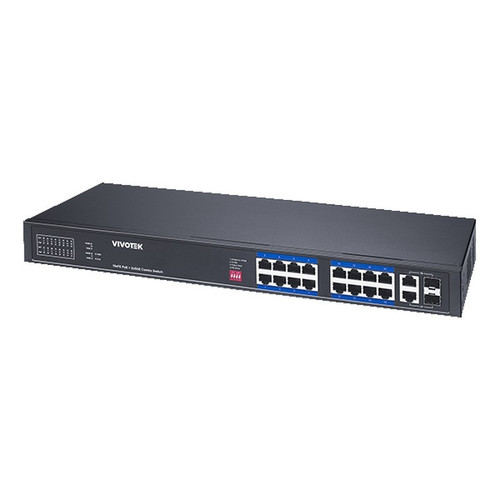
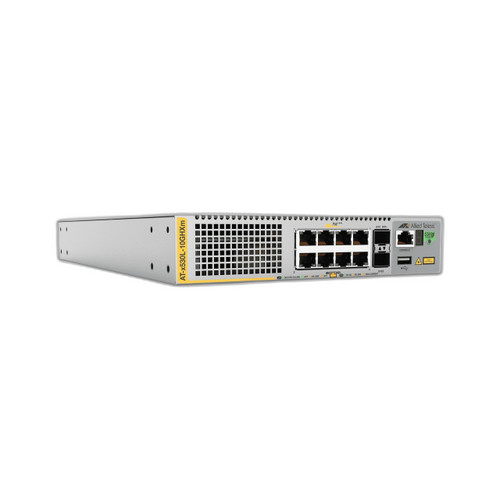
Both the Vivotek AW-IHT-1271 and the Allied Telesis AT-x530L-10GHXm-10 are 8-port managed PoE switches, but they target meaningfully different deployment contexts. The IHT-1271 is a compact, wall-mount industrial switch engineered for harsh outdoor or edge environments, with a 240 W PoE budget and deep Vivotek surveillance ecosystem integration. The AT-x530L-10GHXm-10 is a 1U rack-mount enterprise-class switch with a 500 W PoE++ budget, multi-gigabit copper ports, and 10 G SFP+ uplinks. Buyers comparing these are typically choosing between industrial ruggedization and surveillance-platform integration versus higher bandwidth, PoE++ device support, and data-center-grade throughput.
In This Guide
Which switch delivers more bandwidth and port flexibility?
The AT-x530L-10GHXm-10 leads on raw throughput by a wide margin. Its 8 data ports run at variable speeds of 100 M / 1 / 2.5 / 5 Gbps per port, backed by a 120 Gbps switching fabric and an 89.2 Mpps forwarding rate. Two dedicated 1/10 G SFP+ uplinks are included alongside two stacking ports, enabling high-bandwidth aggregation and chassis-level scalability. Latency at 10 Gbps is specified at 2.12 µs.
The AW-IHT-1271 offers 8 × 10/100/1000 Mbps RJ-45 PoE ports and 4 × 100 M/1 G SFP uplink slots, with a 24 Gbps switching fabric and 17.856 Mpps forwarding rate. These figures are appropriate for standard-definition to multi-megapixel IP camera streams but are outclassed by the AT-x530L-10GHXm-10 in environments demanding multi-gigabit or 10 G connectivity. The IHT-1271 specifies no multi-gigabit copper capability; its SFP ports top out at 1 G.
Which switch better supports high-watt PoE devices and challenging operating environments?
On PoE power, the AT-x530L-10GHXm-10 is the higher-capacity unit. Its 500 W total PoE budget supports up to 90 W per port on 5 ports and 60 W (PoE++ / 802.3bt) on all 8 ports, making it compatible with high-draw devices such as PTZ cameras with heaters, Wi-Fi 6E access points, and video analytics appliances. Maximum system power consumption is 605 W.
The AW-IHT-1271 delivers 240 W total across 8 ports at a maximum of 30 W per port (PoE+ / 802.3at), which covers the majority of fixed IP cameras and access-control readers but cannot power PoE++ devices. Its strength is environmental hardening: an operating range of -40 °C to 75 °C and 6 KV surge protection per PoE port, IEC 60068-2-6 vibration, IEC 60068-2-27 shock, and IEC 60068-2-32 freefall compliance. Dual 48–57 VDC redundant power inputs further reinforce uptime in field installations. The AT-x530L-10GHXm-10 specifies no operating temperature range, no vibration/shock/freefall ratings, and no IP or ingress-protection rating in the provided specifications.
Which switch offers deeper management and ecosystem integration?
The AW-IHT-1271 is purpose-built for Vivotek surveillance deployments. It auto-discovers up to 256 Vivotek devices and up to 250 ONVIF cameras, supports topology, floor-plan, and Google Map views, and enables device-level operations such as reboot, restore, static IP assignment, account management, and configuration file export/import—all from a unified GUI. It also implements ITU-T G.8031/G.8032 Ethernet ring and linear protection switching with sub-20 ms convergence, IGMP snooping v1/v2/v3, IEEE 1588v2 PTP, dual-image firmware, and a full ACL/QoS stack including DiffServ, 8 hardware queues, and WRR scheduling.
The AT-x530L-10GHXm-10 specifications provided do not enumerate management software features, VLAN capabilities, spanning-tree protocols, QoS modes, or surveillance-platform integrations. Buyers requiring detailed management-feature comparisons for the Allied Telesis unit should consult the AT-x530L-10GHXm-10 datasheet directly. The IHT-1271's L2+ feature set—SNMP v1/v2c/v3, RMON, SSH v2, HTTPS/SSL, RADIUS, DDoS prevention, DHCP snooping, IP source guard, LLDP-MED, and IPv6 dual-stack—is fully documented in the provided specifications.
Which should you choose: the IHT-1271 or the AT-x530L-10GHXm-10?
Our take: The IHT-1271 is the stronger choice when the deployment is a harsh-environment Vivotek or ONVIF surveillance edge installation requiring industrial ruggedization, redundant DC power, and deep camera-management tooling. Its -40 °C to 75 °C rating, 6 KV per-port surge protection, IEC vibration/shock certifications, and native Vivotek auto-discovery of up to 256 devices directly address field-security use cases. The AT-x530L-10GHXm-10 is the stronger choice when the application demands higher bandwidth or PoE++ device support: its 120 Gbps fabric versus 24 Gbps, 500 W PoE budget versus 240 W, and per-port ceiling of 90 W versus 30 W are decisive advantages for high-watt PTZ cameras, Wi-Fi 6E APs, or future multi-gigabit edge devices. The IHT-1271 suits outdoor surveillance clusters and industrial cabinets; the AT-x530L-10GHXm-10 suits rack-mounted enterprise or advanced surveillance head-end closets where PoE++ loads and uplink speed matter most.
Side-by-Side Comparison
Spec-for-spec, from manufacturer data.
| Specification | Vivotek IHT-1271 | Allied Telesis AT-x530L-10GHXm-10 |
|---|---|---|
| Product Type | Industrial PoE+ Switch (Wall-mount) | Enterprise PoE++ Switch (Rack-mount, 1U) |
| PoE Data Ports | 8 × 10/100/1000 Mbps RJ-45 | 8 × 100M/1/2.5/5 Gbps RJ-45 |
| Uplink Ports | 4 × 100M/1G SFP | 2 × 1/10G SFP+ |
| Stacking Ports | — | 2 |
| Switching Fabric | 24 Gbps | 120 Gbps |
| Forwarding Rate | 17.856 Mpps | 89.2 Mpps |
| Max PoE Per Port | 30 W (PoE+ / 802.3at) | 90 W (PoE++ / 802.3bt) |
| Total PoE Budget | 240 W | 500 W |
| Max Power Consumption | — | 605 W |
| Operating Temperature | -40 °C to 75 °C | — |
| Surge Protection (PoE) | 6 KV per port | — |
| Vibration / Shock Rating | IEC 60068-2-6 / IEC 60068-2-27 | — |
| Power Input | Dual 48–57 VDC redundant | — |
| Noise Level | — | 64 dBA |
| Dimensions (W×D×H mm) | 62 × 130 × 135 | 210 × 362 × 42.5 |
| Warranty | 60 months | — |
Frequently Asked Questions
Which should you choose: the IHT-1271 or the AT-x530L-10GHXm-10?
The IHT-1271 is the stronger choice when the deployment is a harsh-environment Vivotek or ONVIF surveillance edge installation requiring industrial ruggedization, redundant DC power, and deep camera-management tooling. Its -40 °C to 75 °C rating, 6 KV per-port surge protection, IEC vibration/shock certifications, and native Vivotek auto-discovery of up to 256 devices directly address field-security use cases. The AT-x530L-10GHXm-10 is the stronger choice when the application demands higher bandwidth or PoE++ device support: its 120 Gbps fabric versus 24 Gbps, 500 W PoE budget versus 240 W, and per-port ceiling of 90 W versus 30 W are decisive advantages for high-watt PTZ cameras, Wi-Fi 6E APs, or future multi-gigabit edge devices. The IHT-1271 suits outdoor surveillance clusters and industrial cabinets; the AT-x530L-10GHXm-10 suits rack-mounted enterprise or advanced surveillance head-end closets where PoE++ loads and uplink speed matter most.
Can the AT-x530L-10GHXm-10 power a PTZ camera with a built-in heater that requires 60–90 W?
Yes. The AT-x530L-10GHXm-10 supports PoE++ (802.3bt) at up to 90 W on 5 ports and 60 W on all 8 ports, so it can drive high-watt PTZ cameras with integrated heaters or defrost systems. The AW-IHT-1271 is limited to 30 W per port (PoE+ / 802.3at) and cannot supply PoE++ power levels.
Is the IHT-1271 or AT-x530L-10GHXm-10 better suited for outdoor cabinet or pole-mount installation?
The IHT-1271 is specifically designed for outdoor and harsh industrial environments. It is rated for operation from -40 °C to 75 °C, carries IEC 60068-2-6 vibration and IEC 60068-2-27 shock certifications, offers 6 KV surge protection per PoE port, and supports dual redundant 48–57 VDC inputs. No comparable environmental ratings are provided in the AT-x530L-10GHXm-10 specifications, which lists a rack-mount form factor indicating an indoor, conditioned-space deployment.
Which switch is better for a large Vivotek camera deployment where centralized camera management is required?
The IHT-1271 is the clear choice. It integrates directly with Vivotek's management platform, auto-discovering up to 256 Vivotek devices and 250 ONVIF cameras, and supports topology views, floor-plan mapping, Google Map view, remote reboot/restore, static IP assignment, and configuration file management from a single interface. No surveillance-ecosystem integration features are enumerated in the AT-x530L-10GHXm-10 specifications provided.
More Network Switch Comparisons
- Vivotek IHT-1271 vs TP-Link SG3210XHP-M2
- Vivotek IHT-1271 vs TP-Link S4500-8GP2F
- Vivotek IHT-1271 vs TP-Link SG1210P
- Vivotek IHT-1271 vs Vivotek GEV-108A-130
- Vivotek IHT-1271 vs Vivotek IHT-1000
- Vivotek GEV-108A-130 vs TP-Link SG3210XHP-M2
Network Switch Buying Guides
Get a Second Opinion on Your Camera Choice
Share your site layout, coverage goals, and budget. Our team will validate the camera selection, flag anything we would change, and recommend products that match the use case.