
Vivotek GEV-108A-130 vs TP-Link S4500-8GP2F: Specification Comparison
Both the Vivotek AW-GEV-108A-130 and the TP-Link S4500-8GP2F are 8-port gigabit PoE smart switches with dual SFP uplinks, occupying the same product class in surveillance and SMB network deployments. This comparison evaluates them across PoE power delivery and port configuration, switching performance and physical specs, and management depth and feature set — the three dimensions that drive purchase decisions for installers sizing a switch to a camera deployment.
In This Guide
- Which switch delivers more PoE power, and how are watts distributed across ports?
- How do the two switches compare on throughput, physical footprint, and operating environment?
- Which switch offers deeper management and surveillance-specific integration features?
- Which should you choose: the GEV-108A-130 or the S4500-8GP2F?
- Side-by-Side Specs
- FAQ
Which switch delivers more PoE power, and how are watts distributed across ports?
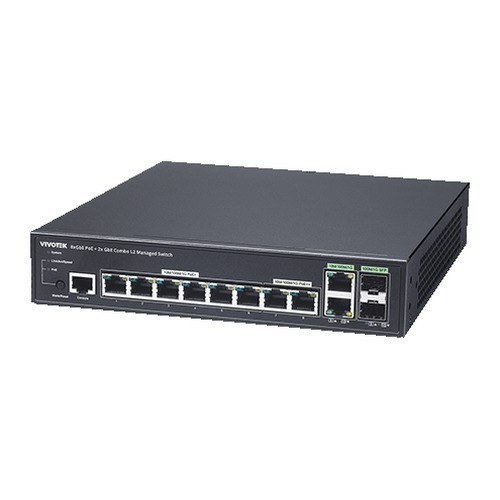
The Vivotek AW-GEV-108A-130 carries a 130W total PoE budget across 8 ports: 6 ports (1–6) deliver up to 30W each under IEEE 802.3af/at, and 2 ports (7–8) deliver up to 90W each under IEEE 802.3bt (4-pair). This makes it directly compatible with high-draw devices such as PTZ cameras, multi-sensor units, and powered access-control readers without an external injector. The PoE pin assignment on ports 7–8 is BT 4-pair, confirming true 802.3bt capability.
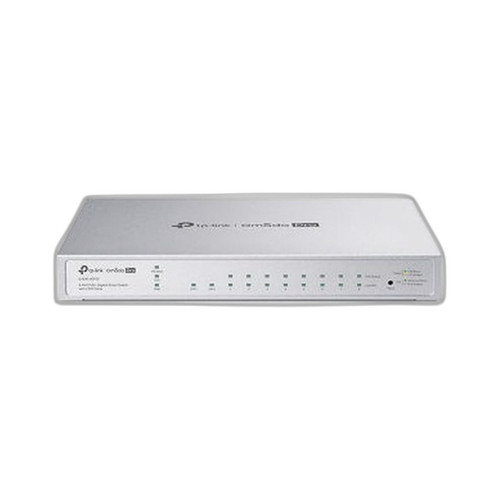
The TP-Link S4500-8GP2F is specified at 58W total PoE budget with 802.3at (PoE+) on all PoE ports, rated at up to 30W per port. No 802.3bt port is listed. The spec data for Product B contains conflicting budget figures (62W, 61W, 58W, and 30W appear across different fields), and no authoritative single-source resolution is available from the provided specifications. Buyers should verify the confirmed budget directly with TP-Link before sizing a deployment.
For installations requiring bt-class endpoints — pan-tilt-zoom cameras, heated dome housings, or wireless APs — the AW-GEV-108A-130's 90W ports and 130W aggregate budget provide headroom the S4500-8GP2F does not specify. The Vivotek unit also documents an Extended PoE Mode reaching up to 250m at 10 Mbps, a feature absent from the S4500-8GP2F specifications.
How do the two switches compare on throughput, physical footprint, and operating environment?
The Vivotek AW-GEV-108A-130 is rated at 20 Gbps switching bandwidth and 14.88 Mpps forwarding capacity. It supports Jumbo Frames up to 9,216 bytes and an 8K MAC address table. Physical dimensions are 220 × 44 × 242 mm (W×H×D) with a weight of 1.95 kg. AC input is universal 100–240V, 50–60 Hz. Operating temperature is specified at -10°C to 50°C.
The TP-Link S4500-8GP2F lists switching capacity values of '16 Gbps 16 Gbps 20 Gbps' across multiple spec fields without a single definitive figure; no forwarding rate in Mpps is provided. Memory is listed at 32 MB Flash. Physical dimensions are 11.6 × 7.1 × 1.7 inches (approximately 295 × 180 × 43 mm). Power supply is an external adapter at 53.5 VDC / 1.31 A rather than direct AC mains. No operating temperature range, MAC table size, or Jumbo Frame size is specified in the provided data.
The Vivotek unit's AC-direct input eliminates a failure point inherent in the S4500-8GP2F's external adapter approach, a relevant consideration for unattended IDF/closet installs. The S4500-8GP2F's larger footprint (295 × 180 mm vs. 220 × 242 mm) may affect rack-shelf or wall-mount planning; both units support rack and wall mounting per their listed mount types.
Which switch offers deeper management and surveillance-specific integration features?
The AW-GEV-108A-130 documents an extensive management feature set purpose-built for Vivotek surveillance deployments: auto-discovery of up to 256 Vivotek devices, PoE alive-checking with automatic PD reboot, PoE scheduling, power delay, Non-Stop PoE, topology view, floor view, and Google Map view. VLAN support covers 802.1Q (4,096 VLAN IDs), port-based, private VLAN edge, MAC-based, voice, IP subnet-based, protocol-based, Q-in-Q, GARP VLAN, and Multicast VLAN Registration. QoS offers 8 hardware queues with WRR, DSCP/CoS, 802.1p, and per-port controls. Security includes RADIUS/TACACS+, DHCP Snooping (up to 384 entries), IP Source Guard, Port Security, SSL, Storm Control, and Loop Detection. Management protocols include SNMP v1/v2c/v3, RMON (groups 1/2/3/9), LLDP, LLDP-MED, sFlow, NTP, UPnP, and Port Mirroring. STP/RSTP/MSTP and LACP are supported.
The S4500-8GP2F lists SNMP Trap/Inform and EEE (Energy Efficient Ethernet) under management; no further management protocol, VLAN, QoS, or security feature details are present in the provided specifications. The product is described as a 'smart' switch and positioned under the TP-Link Omada Pro ecosystem, which implies controller-based or cloud management, but no specifics are derivable from the supplied data.
For installations running exclusively on Vivotek cameras and NVRs, the AW-GEV-108A-130's native device-management features — including per-camera reboot, configuration export/import, and grouping-based VLAN assignment — materially reduce on-site management overhead. The S4500-8GP2F's management depth cannot be fully assessed from the available specifications.
Which should you choose: the GEV-108A-130 or the S4500-8GP2F?
Our take: The AW-GEV-108A-130 is the stronger choice when the deployment involves Vivotek cameras, requires 802.3bt (90W) port power, or demands a fully documented enterprise-grade feature set. Concretely: its 130W PoE budget exceeds the S4500-8GP2F's highest specified figure (62W) by at least 68W; its two 802.3bt ports at 90W each cover device classes the S4500-8GP2F's 802.3at-only ports cannot power; and its management stack — SNMP v1/v2c/v3, RMON, VLAN types (including 4,096-ID 802.1Q, Q-in-Q, and MVR), 8-queue QoS, and RADIUS/TACACS+ security — is fully specified, whereas the S4500-8GP2F's management features are largely undocumented in the provided data. The S4500-8GP2F may suit cost-sensitive, lower-density PoE+ deployments within the TP-Link Omada Pro ecosystem, but buyers should resolve the conflicting PoE budget figures before specifying it.
Side-by-Side Comparison
Spec-for-spec, from manufacturer data.
| Specification | Vivotek GEV-108A-130 | TP-Link S4500-8GP2F |
|---|---|---|
| Total PoE Ports | 8 | 8 |
| Total PoE Budget | 130 W | 58 W (conflicting figures in spec; verify with vendor) |
| Max PoE Per Port | 90 W (ports 7–8, 802.3bt); 30 W (ports 1–6, 802.3af/at) | 30 W (802.3at) |
| PoE Standard | IEEE 802.3af / at / bt | 802.3af / at |
| Uplink Ports | 2× GbE Combo (SFP) | 2× SFP |
| Total Ports | 10 (8 RJ45 + 2 Combo) | 10 (8 RJ45 + 2 SFP) — inferred |
| Switching Bandwidth | 20 Gbps | 16 Gbps (per primary throughput field; spec contains conflicting values) |
| Forwarding Capacity | 14.88 Mpps | — |
| MAC Address Table | 8K | — |
| Jumbo Frames | 9,216 bytes | — |
| VLAN Support | 802.1Q (4,096 IDs), port-based, MAC-based, voice, IP subnet, Q-in-Q, MVR, PVE, GARP | — |
| QoS Queues | 8 hardware queues (WRR, DSCP/CoS, 802.1p) | — |
| Security Protocols | RADIUS/TACACS+, DHCP Snooping (384 entries), IP Source Guard, Port Security, SSL, Storm Control | — |
| Management Protocols | SNMP v1/v2c/v3, RMON (groups 1/2/3/9), LLDP, LLDP-MED, sFlow, NTP, UPnP | SNMP Trap/Inform |
| Extended PoE Range | Up to 250 m at 10 Mbps | — |
| Operating Temperature | -10°C to 50°C | — |
| Power Input | AC 100–240V / 50–60 Hz (direct) | External adapter 53.5 VDC / 1.31 A |
| Dimensions (W×H×D) | 220 × 44 × 242 mm | 295 × 180 × 43 mm (converted from 11.6 × 7.1 × 1.7 in) |
| Weight | 1.95 kg | — |
| Warranty | 24 months | — |
Frequently Asked Questions
Which should you choose: the GEV-108A-130 or the S4500-8GP2F?
The AW-GEV-108A-130 is the stronger choice when the deployment involves Vivotek cameras, requires 802.3bt (90W) port power, or demands a fully documented enterprise-grade feature set. Concretely: its 130W PoE budget exceeds the S4500-8GP2F's highest specified figure (62W) by at least 68W; its two 802.3bt ports at 90W each cover device classes the S4500-8GP2F's 802.3at-only ports cannot power; and its management stack — SNMP v1/v2c/v3, RMON, VLAN types (including 4,096-ID 802.1Q, Q-in-Q, and MVR), 8-queue QoS, and RADIUS/TACACS+ security — is fully specified, whereas the S4500-8GP2F's management features are largely undocumented in the provided data. The S4500-8GP2F may suit cost-sensitive, lower-density PoE+ deployments within the TP-Link Omada Pro ecosystem, but buyers should resolve the conflicting PoE budget figures before specifying it.
Is the AW-GEV-108A-130 or S4500-8GP2F better for powering high-wattage PTZ cameras or heated domes?
The AW-GEV-108A-130 is specified for this use case. Ports 7 and 8 deliver up to 90W each under IEEE 802.3bt (4-pair), which covers high-draw PTZ cameras, heated housing units, and multi-sensor cameras. The S4500-8GP2F is specified only to 802.3at (PoE+, 30W per port maximum), which is insufficient for 802.3bt-class devices.
Can either switch integrate with a third-party NVR or VMS, or are they locked to a specific ecosystem?
The AW-GEV-108A-130's surveillance-specific auto-discovery, reboot, and VLAN-grouping features are documented for Vivotek devices. Its standard management protocols (SNMP v1/v2c/v3, LLDP, RMON, sFlow) are vendor-neutral and compatible with most NMS/VMS platforms. The S4500-8GP2F is positioned within the TP-Link Omada Pro ecosystem; the provided specifications do not detail third-party VMS or NVR integration beyond basic SNMP Trap/Inform support.
Which switch is easier to deploy and manage without dedicated IT staff on site?
Based on the provided specifications, the AW-GEV-108A-130 documents more granular remote-management features relevant to unattended surveillance sites: PoE alive-checking with automatic PD reboot, PoE scheduling, Non-Stop PoE during firmware upgrades, topology and floor-map views, and per-camera configuration export/import. These reduce the need for truck rolls to reboot hung cameras. The S4500-8GP2F's on-site management capabilities cannot be fully assessed from the available spec data.
More Network Switch Comparisons
- Vivotek IHT-1271 vs TP-Link SG3210XHP-M2
- Vivotek IHT-1271 vs TP-Link S4500-8GP2F
- Vivotek IHT-1271 vs TP-Link SG1210P
- Vivotek IHT-1271 vs Allied Telesis AT-x530L-10GHXm-10
- Vivotek IHT-1271 vs Vivotek GEV-108A-130
- Vivotek IHT-1271 vs Vivotek IHT-1000
Network Switch Buying Guides
Get a Second Opinion on Your Camera Choice
Share your site layout, coverage goals, and budget. Our team will validate the camera selection, flag anything we would change, and recommend products that match the use case.