
Ubiquiti USW-PRO-MAX-16 vs TP-Link DS1016GE: Specification Comparison
Both the Ubiquiti USW-PRO-MAX-16 and the TP-Link DS1016GE are 16-port gigabit managed network switches targeting small-to-medium deployments where VLANs, QoS, and traffic segmentation matter. The comparison covers switching performance and throughput, physical build and operating environment, and management depth and ecosystem integration — the three axes that most directly drive purchasing decisions in this switch class.

In This Guide
- Which switch delivers more headroom for switching capacity and forwarding throughput?
- How do the two switches compare on physical build quality, power requirements, and operating environment?
- What management capabilities and ecosystem integration does each switch offer?
- Which should you choose: the USW-PRO-MAX-16 or the DS1016GE?
- Side-by-Side Specs
- FAQ
Which switch delivers more headroom for switching capacity and forwarding throughput?
The USW-PRO-MAX-16 specifies a switching capacity of 84 Gbps and a forwarding rate of 62 Mpps. These figures are explicitly stated in the provided specifications and represent the upper bound of traffic the fabric can handle before congestion occurs.
The DS1016GE specifications do not include a switching capacity figure or a forwarding rate (Mpps). Buyers who need to validate throughput headroom — for example, in deployments mixing high-bitrate IP camera feeds, VoIP, and data — cannot confirm comparable numbers from the available DS1016GE spec sheet. Both switches offer 16 × 1 Gbps ports, but only the USW-PRO-MAX-16 publishes fabric-level performance data.
How do the two switches compare on physical build quality, power requirements, and operating environment?
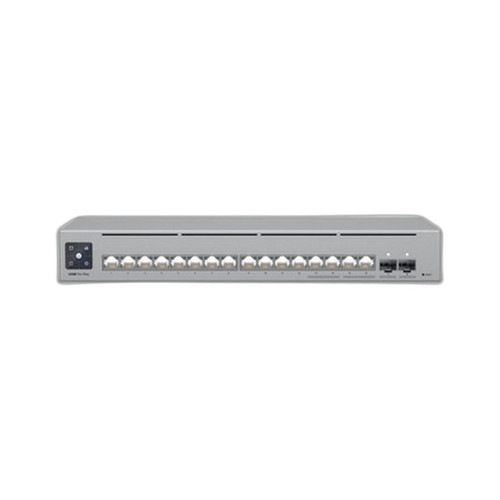
The USW-PRO-MAX-16 specifies an SGCC steel enclosure, dimensions of 325.1 × 160 × 43.7 mm, a weight of 1.95 kg, and a rated operating temperature range of −5 to 40°C (23 to 104°F). Power is supplied via an included AC/DC external adapter rated at 25W with a DC input of 4.8–5.2V. The unit is NDAA Section 889 compliant and carries CE, FCC, IC, and Anatel certifications.
The DS1016GE is described as a 1U 19-inch rack-mount form factor with wall-mount capability and RJ45 connectors. The provided specifications do not include enclosure material, weight, operating temperature range, power consumption, or compliance certifications. The spec data also contains an apparent data-entry artifact in the Technology field (an address string) and a hide_reason flag of 'pricing_violation_2026-05-06', which buyers and installers should note as a potential catalog status concern.
What management capabilities and ecosystem integration does each switch offer?
The USW-PRO-MAX-16 lists Ethernet-based management. It is part of the Ubiquiti UniFi ecosystem, which typically provides centralized controller-based management, though the specific software platform and features (cloud key, self-hosted controller, mobile app) are not enumerated in the provided specifications.
The DS1016GE specifies web interface management with support for VLAN, QoS, and IGMP snooping, and is labeled as part of TP-Link's Omada product line. The Omada designation indicates compatibility with TP-Link's Omada SDN controller ecosystem, though controller requirements, cloud management options, and feature depth are not detailed in the provided specifications. Both switches support VLAN and QoS at the feature-label level; deeper CLI, SNMP, or API management capabilities are not confirmed for either unit from the available data.
Which should you choose: the USW-PRO-MAX-16 or the DS1016GE?
Our take: The USW-PRO-MAX-16 is the stronger choice when verifiable switching performance, regulatory compliance, and environmental ratings are required. It publishes an 84 Gbps switching capacity and 62 Mpps forwarding rate — figures absent from the DS1016GE spec sheet — giving network designers a concrete basis for capacity planning. It also specifies a −5 to 40°C operating range, an SGCC steel enclosure, and NDAA Section 889 compliance, none of which are confirmed in the DS1016GE data. The DS1016GE lists VLAN, QoS, and IGMP snooping via a web interface and carries an Omada ecosystem designation, but its spec sheet omits switching capacity, power draw, operating temperature, weight, and certifications, making side-by-side validation difficult. Additionally, the DS1016GE carries a catalog hide flag related to a pricing violation as of May 2026, which procurement teams should verify before specifying. Buyers standardized on the Ubiquiti UniFi platform or requiring NDAA compliance should select the USW-PRO-MAX-16.
Side-by-Side Comparison
Spec-for-spec, from manufacturer data.
| Specification | Ubiquiti USW-PRO-MAX-16 | TP-Link DS1016GE |
|---|---|---|
| Device Type | Managed Network Switch | Managed Network Switch |
| Total Ports | 16 × 1 Gbps Ethernet | 16 × 1 Gbps (RJ45) |
| Switching Capacity | 84 Gbps | — |
| Forwarding Rate | 62 Mpps | — |
| PoE Output | Not specified | Not confirmed (tag present, no spec) |
| Power Consumption | 25W | — |
| Power Input | 4.8–5.2V DC via included AC/DC adapter | — |
| Form Factor | 325.1 × 160 × 43.7 mm | 1U 19-inch rack-mount / wall-mount |
| Weight | 1.95 kg (4.3 lb) | — |
| Enclosure Material | SGCC steel | — |
| Operating Temperature | −5 to 40°C (23 to 104°F) | — |
| NDAA Section 889 Compliant | Yes | — |
| Certifications | CE, FCC, IC, Anatel | — |
| Management Interface | Ethernet / UniFi ecosystem | Web interface / Omada SDN |
| VLAN Support | Not explicitly listed in specs | Yes |
| QoS Support | Not explicitly listed in specs | Yes |
| IGMP Snooping | Not explicitly listed in specs | Yes |
| Catalog Status | Active | Hidden — pricing_violation_2026-05-06 |
Frequently Asked Questions
Which should you choose: the USW-PRO-MAX-16 or the DS1016GE?
The USW-PRO-MAX-16 is the stronger choice when verifiable switching performance, regulatory compliance, and environmental ratings are required. It publishes an 84 Gbps switching capacity and 62 Mpps forwarding rate — figures absent from the DS1016GE spec sheet — giving network designers a concrete basis for capacity planning. It also specifies a −5 to 40°C operating range, an SGCC steel enclosure, and NDAA Section 889 compliance, none of which are confirmed in the DS1016GE data. The DS1016GE lists VLAN, QoS, and IGMP snooping via a web interface and carries an Omada ecosystem designation, but its spec sheet omits switching capacity, power draw, operating temperature, weight, and certifications, making side-by-side validation difficult. Additionally, the DS1016GE carries a catalog hide flag related to a pricing violation as of May 2026, which procurement teams should verify before specifying. Buyers standardized on the Ubiquiti UniFi platform or requiring NDAA compliance should select the USW-PRO-MAX-16.
Is the USW-PRO-MAX-16 or DS1016GE better for larger deployments with high camera counts?
The USW-PRO-MAX-16 specifies an 84 Gbps switching capacity and 62 Mpps forwarding rate, providing documented headroom for high-bitrate traffic across all 16 ports. The DS1016GE does not publish equivalent fabric performance figures in the available specifications, so its capacity ceiling under sustained multi-camera load cannot be confirmed from spec data alone.
Does either switch support PoE for powering IP cameras directly?
Neither switch is confirmed as a PoE-capable model in the provided specifications. The DS1016GE spec data contains a 'PoE' tag, but this appears inconsistent with its designation as a non-PoE easy smart switch and may be a data entry error; it is not substantiated by a wattage budget or PoE standard reference. The USW-PRO-MAX-16 specifications make no mention of PoE output. Buyers requiring PoE should verify with the manufacturer before specifying either unit.
Which switch is easier to manage without dedicated IT staff?
The DS1016GE is described as an 'Easy Smart Switch' with browser-based management of VLAN, QoS, and IGMP snooping — positioning it for lighter-touch administration. The USW-PRO-MAX-16 is a fully managed switch within the Ubiquiti UniFi ecosystem, which offers centralized management but typically requires controller setup. The depth of each platform's ease-of-use features beyond these labels is not fully detailed in the provided specifications.
More Network Switch Comparisons
- TP-Link SG3218XP-M2 vs Ubiquiti USW-PRO-MAX-16
- TP-Link SG3218XP-M2 vs TP-Link DS1016G
- TP-Link SG3218XP-M2 vs TP-Link SG2218
- TP-Link DS1016G vs Ubiquiti USW-PRO-MAX-16
- TP-Link DS1016G vs TP-Link SG2218
- TP-Link SG2218 vs Ubiquiti USW-PRO-MAX-16
Network Switch Buying Guides
Get a Second Opinion on Your Camera Choice
Share your site layout, coverage goals, and budget. Our team will validate the camera selection, flag anything we would change, and recommend products that match the use case.