
TP-Link SG3218XP-M2 vs TP-Link SG2218: Specification Comparison
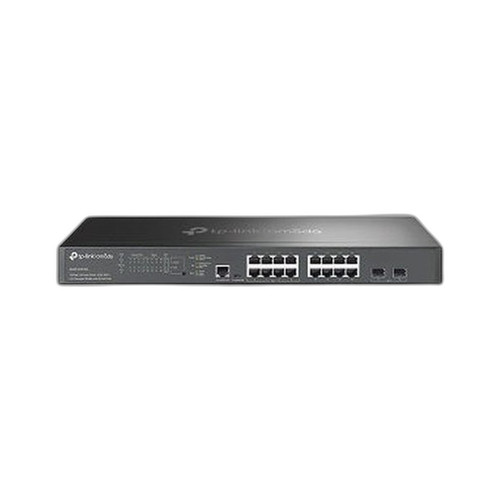
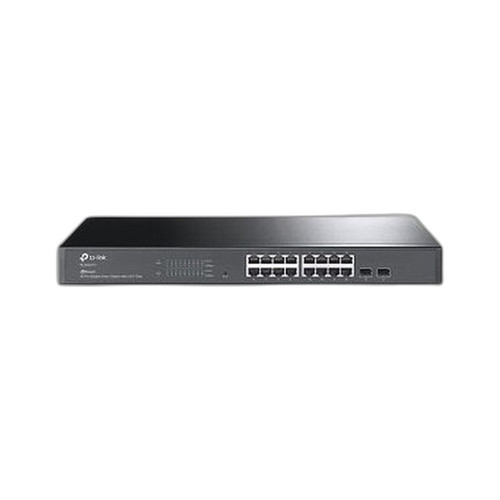
Both the TP-Link SG3218XP-M2 and the TL-SG2218 are rack-mountable, 16-port managed switches with 2 SFP uplink slots in the same physical 1U form factor, making them credible cross-shop candidates for installers sizing out a wired LAN backbone. The comparison turns on access-layer speed (2.5G vs 1G), PoE delivery class and budget, and management depth — three axes that directly affect camera and VoIP deployments where bandwidth headroom and powered-port budgets matter.
In This Guide
- Which switch delivers more bandwidth per port and total switching capacity?
- How do the PoE budgets, power delivery standards, and operating environments compare?
- What management depth and protocol support does each switch offer?
- Which should you choose: the SG3218XP-M2 or the SG2218?
- Side-by-Side Specs
- FAQ
Which switch delivers more bandwidth per port and total switching capacity?
The SG3218XP-M2 provides 16 access ports running at 2.5GBASE-T, each capable of up to 2.5 Gbps, with 2 × 10G SFP+ uplinks and a total switching capacity of 80 Gbps. This makes every access port 2.5× faster than gigabit and the uplinks capable of aggregating or linking to a 10G core without bottlenecking.
The TL-SG2218 offers 16 access ports at 1 Gbps with 2 × 1G SFP uplinks. Its switching capacity is listed in the specs as 16 Gbps (with a secondary figure of 20 Gbps also appearing in the spec data). The SFP slots support both multi-mode and single-mode transceivers sold separately, providing fiber flexibility at 1G speeds only.
For any deployment where cameras, NVRs, or workstations are beginning to saturate gigabit links — or where future-proofing to 2.5G NICs is planned — the SG3218XP-M2's 80 Gbps fabric versus the TL-SG2218's 16–20 Gbps is a decisive gap.
How do the PoE budgets, power delivery standards, and operating environments compare?
The SG3218XP-M2 carries a 240 W total PoE budget and supports IEEE 802.3bt (PoE++), which allows up to 60 W per port on compatible devices. The specs note 802.3af/at support as well, so it is backward-compatible with lower-draw devices. The switch is powered directly from 100–240 V AC (50/60 Hz) with an internal power supply rated at 240 W, and it dissipates a maximum of 51.18 BTU/hr. Operating temperature is 0°C to 50°C.
The TL-SG2218 is specified with a PoE budget of 62 W (a secondary figure of 61 W also appears in the spec data) and supports 802.3af only, capping each port at 15.4 W. It is powered by an external 53.5 VDC / 1.31 A adapter. No maximum heat dissipation or BTU figure is provided in the supplied specs. Operating temperature range is not stated in the provided data.
For deployments powering PTZ cameras, multi-radio APs, or video intercoms that draw 30–60 W, the SG3218XP-M2's 802.3bt support and 240 W budget are required. The TL-SG2218's 62 W aggregate budget and 802.3af ceiling limit it to low-draw 802.3af devices and constrain how many powered endpoints can be active simultaneously.
What management depth and protocol support does each switch offer?
The SG3218XP-M2 is classified as L2+ Managed and is part of TP-Link's Omada SDN ecosystem. The specs confirm CLI access, SNMP v1/v2c/v3, and RMON support. Operating modes include Static Routing, VLAN, QoS, ACL, and STP/RSTP/MSTP. L2+ denotes limited Layer 3 functionality (static routing), which is relevant for VLAN inter-routing without a dedicated router.
The TL-SG2218 is classified as a Smart Managed (JetStream) switch. The specs confirm managed functionality and Ethernet connectivity. Specific management protocols (SNMP version, CLI availability, RMON) are not enumerated in the provided spec data. No L3 or static routing capability is indicated.
Installers using Omada Controller software for centralized policy management will find the SG3218XP-M2 natively integrated. The TL-SG2218 sits in TP-Link's JetStream smart-managed tier, which supports web GUI management but is not confirmed in the provided specs to support SNMP v3 or CLI — relevant for NOC/MSP environments requiring SNMP polling or scripted configuration.
Which should you choose: the SG3218XP-M2 or the SG2218?
Our take: The SG3218XP-M2 is the stronger choice when access-layer bandwidth, high-wattage PoE, or Omada SDN integration are requirements. Concretely: its switching capacity is 80 Gbps versus the TL-SG2218's 16–20 Gbps; its PoE budget is 240 W versus 62 W; and it supports 802.3bt (up to 60 W per port) while the TL-SG2218 tops out at 802.3af (15.4 W per port). The TL-SG2218 is a cost-appropriate option for small deployments of standard 802.3af devices — IP cameras, VoIP phones, and lightweight APs — where total PoE draw stays well under 62 W and gigabit access is sufficient. It also offers wall-mount as an alternative to rack-mount, which the SG3218XP-M2 does not list. Buyers on the Omada platform or anticipating 2.5G-capable endpoints should specify the SG3218XP-M2; buyers equipping a small branch with legacy 802.3af devices on a tighter budget may find the TL-SG2218 adequate.
Side-by-Side Comparison
Spec-for-spec, from manufacturer data.
| Specification | TP-Link SG3218XP-M2 | TP-Link SG2218 |
|---|---|---|
| Product Line | Omada (L2+ Managed) | JetStream (Smart Managed) |
| Access Port Count | 16 | 16 |
| Access Port Speed | 2.5GBASE-T | 1 Gbps |
| Uplink Slots | 2 × 10G SFP+ | 2 × 1G SFP |
| Fiber Uplink Type | SFP+ dual-mode | Multi-mode and single-mode (SFP) |
| Switching Capacity | 80 Gbps | 16–20 Gbps |
| PoE Standard | 802.3bt (PoE++), backward-compatible 802.3af/at | 802.3af |
| PoE Budget | 240 W | 62 W |
| Mount Type | Rack | Rack; Wall |
| Power Supply | 100–240 V AC, 50/60 Hz (internal) | 53.5 VDC / 1.31 A external adapter |
| Max Power Consumption | 240 W | — |
| Max Heat Dissipation | 51.18 BTU/hr | — |
| Operating Temperature | 0°C to 50°C (32°F to 122°F) | — |
| Management Protocols | CLI, SNMP v1/v2c/v3, RMON | — |
| L3 / Static Routing | Yes (L2+) | Not specified |
| Flash / Storage | 32 MB | 32 MB |
Frequently Asked Questions
Which should you choose: the SG3218XP-M2 or the SG2218?
The SG3218XP-M2 is the stronger choice when access-layer bandwidth, high-wattage PoE, or Omada SDN integration are requirements. Concretely: its switching capacity is 80 Gbps versus the TL-SG2218's 16–20 Gbps; its PoE budget is 240 W versus 62 W; and it supports 802.3bt (up to 60 W per port) while the TL-SG2218 tops out at 802.3af (15.4 W per port). The TL-SG2218 is a cost-appropriate option for small deployments of standard 802.3af devices — IP cameras, VoIP phones, and lightweight APs — where total PoE draw stays well under 62 W and gigabit access is sufficient. It also offers wall-mount as an alternative to rack-mount, which the SG3218XP-M2 does not list. Buyers on the Omada platform or anticipating 2.5G-capable endpoints should specify the SG3218XP-M2; buyers equipping a small branch with legacy 802.3af devices on a tighter budget may find the TL-SG2218 adequate.
Can the TL-SG2218 power the same cameras as the SG3218XP-M2?
Not equivalently. The TL-SG2218 supports 802.3af only, capping each port at 15.4 W with a 62 W total PoE budget. The SG3218XP-M2 supports 802.3bt (PoE++), delivering up to 60 W per port with a 240 W total budget. Cameras or devices requiring 802.3at (30 W) or 802.3bt (60 W) will not receive full power from the TL-SG2218.
Is the SG3218XP-M2 or TL-SG2218 better for larger security deployments?
The SG3218XP-M2 is better suited to larger or higher-density deployments. Its 80 Gbps switching fabric, 2.5GBASE-T access ports, and 10G SFP+ uplinks accommodate bandwidth-intensive endpoints and high-throughput uplinks. The TL-SG2218's 16–20 Gbps capacity and 1G access ports are more appropriate for smaller or lower-bandwidth environments.
Do both switches fit in a standard 1U rack space?
Both switches share identical listed dimensions of 11.6 × 7.1 × 1.7 in (294 × 180 × 44 mm) and are both specified as rack-mountable. The TL-SG2218 additionally lists wall-mount as an option; the SG3218XP-M2 specs do not include wall-mount as a listed mount type.
More Network Switch Comparisons
- TP-Link SG3218XP-M2 vs Ubiquiti USW-PRO-MAX-16
- TP-Link SG3218XP-M2 vs TP-Link DS1016G
- TP-Link DS1016G vs Ubiquiti USW-PRO-MAX-16
- TP-Link DS1016G vs TP-Link SG2218
- TP-Link SG2218 vs Ubiquiti USW-PRO-MAX-16
- Ubiquiti USW-PRO-MAX-16 vs TP-Link DS1016GE
Network Switch Buying Guides
Get a Second Opinion on Your Camera Choice
Share your site layout, coverage goals, and budget. Our team will validate the camera selection, flag anything we would change, and recommend products that match the use case.