
TP-Link SG2218 vs Ubiquiti USW-PRO-MAX-16: Specification Comparison
Both the TP-Link TL-SG2218 and the Ubiquiti USW-PRO-MAX-16 are 16-port managed Gigabit Ethernet switches aimed at small-to-medium business and branch-office deployments. Each delivers 16 × 1 Gbps copper ports in a rack-mountable form factor under centralized management. The comparison examines switching throughput and port density, power architecture and environmental ratings, and management ecosystem fit — the three dimensions most likely to separate them for a security-systems integrator or IT buyer evaluating a converged IP-surveillance or enterprise LAN installation.
In This Guide
- Which switch delivers more headroom for 16-port throughput and uplink capacity?
- How do the two switches compare on PoE capability, power consumption, and environmental tolerance?
- Which switch offers stronger compliance credentials and management integration for enterprise or regulated deployments?
- Which should you choose: the SG2218 or the USW-PRO-MAX-16?
- Side-by-Side Specs
- FAQ
Which switch delivers more headroom for 16-port throughput and uplink capacity?
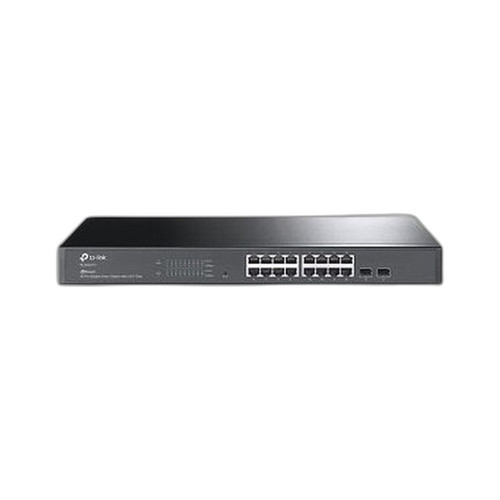
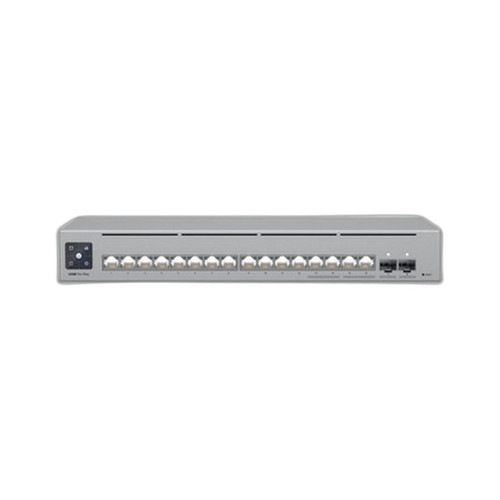
The TL-SG2218 specifies a switching capacity of 16–20 Gbps (spec field shows both figures; highest stated value is 20 Gbps) across its 16 RJ45 ports plus 2 SFP uplink slots, giving a total of 18 physical ports. The USW-PRO-MAX-16 specifies 84 Gbps switching capacity and a 62 Mpps forwarding rate across its 16 × 1 Gbps Ethernet ports; SFP or uplink slot count is not stated in the provided specs.
The USW-PRO-MAX-16's 84 Gbps fabric is 4–5× larger than the TL-SG2218's highest stated 20 Gbps figure, providing substantially more non-blocking headroom for burst traffic — directly relevant in converged deployments carrying simultaneous HD-video streams, VoIP, and data. The TL-SG2218 adds two SFP uplinks (multi-mode and single-mode transceivers supported, sold separately), which the USW-PRO-MAX-16 datasheet does not confirm. A forwarding rate is not provided for the TL-SG2218, so direct Mpps comparison cannot be made.
How do the two switches compare on PoE capability, power consumption, and environmental tolerance?
The TL-SG2218 spec lists PoE support (802.3af/at) with a stated PoE budget of 61–62 W, powered via a 53.5 VDC / 1.31 A external adapter. The USW-PRO-MAX-16 specifies a total power consumption of 25 W with a 4.8–5.2 V DC / USB-type external AC/DC adapter; no PoE output capability is stated in the provided specs.
If PoE is required to power IP cameras or access-control readers directly from the switch, the TL-SG2218 is the only model in this comparison with confirmed PoE delivery (up to 62 W budget across 802.3af/at-compliant ports). The USW-PRO-MAX-16 operating temperature range is explicitly documented at −5 to 40 °C (23 to 104 °F) with an SGCC steel enclosure and a weight of 1.95 kg. The TL-SG2218 does not include an operating temperature specification in the provided data, which is a gap for deployments in non-climate-controlled environments.
Which switch offers stronger compliance credentials and management integration for enterprise or regulated deployments?
The USW-PRO-MAX-16 is explicitly listed as NDAA Section 889 compliant and carries CE, FCC, IC, and Anatel certifications. Management interface is listed as Ethernet. The TL-SG2218 is described as a JetStream Smart Managed switch with centralized management capability; specific compliance certifications (NDAA, FCC, CE) are not present in the provided spec data.
NDAA Section 889 compliance is a hard procurement requirement for U.S. federal, state, and many enterprise customers. The USW-PRO-MAX-16 meets that bar by spec; the TL-SG2218 does not confirm it. Both switches target centralized management, but the USW-PRO-MAX-16 is designed for the UniFi ecosystem (implied by brand/SKU convention), while the TL-SG2218 is designed for TP-Link's JetStream/Omada ecosystem. Buyers already invested in one vendor's controller platform will face integration friction when mixing ecosystems. Storage of 32 MB is noted only for the TL-SG2218; no equivalent figure is provided for the USW-PRO-MAX-16.
Which should you choose: the SG2218 or the USW-PRO-MAX-16?
Our take: The USW-PRO-MAX-16 is the stronger choice when switching headroom, NDAA compliance, and a documented operating environment are the primary criteria. Its 84 Gbps switching capacity is 4–5× the TL-SG2218's highest stated 20 Gbps figure, and its 62 Mpps forwarding rate is unmatched in this comparison because no equivalent figure exists for the TL-SG2218. It is explicitly NDAA Section 889 compliant — a non-negotiable requirement for many U.S. public-sector and enterprise bids — while the TL-SG2218 does not confirm NDAA status in the provided specs. Conversely, the TL-SG2218 is the only model here with confirmed PoE output (802.3af/at, up to 62 W), making it the appropriate choice when the switch must directly power IP cameras or access-control devices without a separate PoE injector. Choose the TL-SG2218 for PoE-dependent physical-security edge deployments on a JetStream/Omada platform; choose the USW-PRO-MAX-16 for non-PoE converged LAN deployments inside the UniFi ecosystem where NDAA compliance is required.
Side-by-Side Comparison
Spec-for-spec, from manufacturer data.
| Specification | TP-Link SG2218 | Ubiquiti USW-PRO-MAX-16 |
|---|---|---|
| Product Type | Smart Managed Gigabit Switch | Managed Network Switch |
| Total Ports | 16 RJ45 + 2 SFP (18 total) | 16 × 1 Gbps Ethernet |
| SFP Uplink Slots | 2 (multi-mode & single-mode supported) | — |
| Switching Capacity | 16–20 Gbps (spec lists both) | 84 Gbps |
| Forwarding Rate | — | 62 Mpps |
| PoE Standard | 802.3af/at | — |
| PoE Budget | 61–62 W | — |
| Total Power Consumption | — | 25 W |
| Power Supply | 53.5 VDC / 1.31 A external adapter | AC/DC external adapter, 4.8–5.2 V DC |
| Operating Temperature | — | −5 to 40 °C (23 to 104 °F) |
| Enclosure Material | — | SGCC steel |
| Weight | — | 1.95 kg (4.3 lb) |
| Dimensions | 17.3 × 7.1–8.7 × 1.7 in (multiple values in spec) | 325.1 × 160 × 43.7 mm |
| NDAA Section 889 Compliant | — | Yes |
| Certifications | — | CE, FCC, IC, Anatel |
| Onboard Storage | 32 MB | — |
Frequently Asked Questions
Which should you choose: the SG2218 or the USW-PRO-MAX-16?
The USW-PRO-MAX-16 is the stronger choice when switching headroom, NDAA compliance, and a documented operating environment are the primary criteria. Its 84 Gbps switching capacity is 4–5× the TL-SG2218's highest stated 20 Gbps figure, and its 62 Mpps forwarding rate is unmatched in this comparison because no equivalent figure exists for the TL-SG2218. It is explicitly NDAA Section 889 compliant — a non-negotiable requirement for many U.S. public-sector and enterprise bids — while the TL-SG2218 does not confirm NDAA status in the provided specs. Conversely, the TL-SG2218 is the only model here with confirmed PoE output (802.3af/at, up to 62 W), making it the appropriate choice when the switch must directly power IP cameras or access-control devices without a separate PoE injector. Choose the TL-SG2218 for PoE-dependent physical-security edge deployments on a JetStream/Omada platform; choose the USW-PRO-MAX-16 for non-PoE converged LAN deployments inside the UniFi ecosystem where NDAA compliance is required.
Is the TL-SG2218 or the USW-PRO-MAX-16 better for powering IP cameras directly from the switch?
The TL-SG2218 is the only model with confirmed PoE capability in these specs — it supports 802.3af/at with a stated budget of 61–62 W across its 16 ports. The USW-PRO-MAX-16 specs provided do not list any PoE output, so it cannot be confirmed to power cameras or other PoE devices directly. If PoE delivery is required, the TL-SG2218 is the specified choice; if PoE is not needed, other factors should drive the decision.
Which switch is required for NDAA-compliant federal or government deployments?
The USW-PRO-MAX-16 is explicitly listed as NDAA Section 889 compliant in its provided specs. The TL-SG2218 specs do not include any NDAA compliance statement. For any procurement where NDAA Section 889 compliance is a contractual or regulatory requirement, only the USW-PRO-MAX-16 can be confirmed compliant based on the data provided.
Which switch handles heavier traffic loads better in a converged voice, video, and data environment?
Based on the provided specs, the USW-PRO-MAX-16 offers significantly more switching headroom: 84 Gbps capacity and a 62 Mpps forwarding rate versus the TL-SG2218's highest stated 20 Gbps capacity (no forwarding rate is specified for the TL-SG2218). For high-density IP-video or converged deployments where burst traffic is a concern, the USW-PRO-MAX-16's fabric is substantially larger by the numbers provided.
More Network Switch Comparisons
- TP-Link SG3218XP-M2 vs Ubiquiti USW-PRO-MAX-16
- TP-Link SG3218XP-M2 vs TP-Link DS1016G
- TP-Link SG3218XP-M2 vs TP-Link SG2218
- TP-Link DS1016G vs Ubiquiti USW-PRO-MAX-16
- TP-Link DS1016G vs TP-Link SG2218
- Ubiquiti USW-PRO-MAX-16 vs TP-Link DS1016GE
Network Switch Buying Guides
Get a Second Opinion on Your Camera Choice
Share your site layout, coverage goals, and budget. Our team will validate the camera selection, flag anything we would change, and recommend products that match the use case.