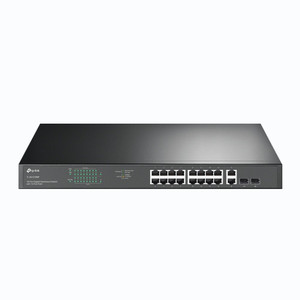
TP-Link TL-SG2218 16-Port Gigabit Smart Managed Switch
The TP-Link TL-SG2218 is a smart managed gigabit switch designed to consolidate IP camera, access control, and networked sensor traffic in mid-scale security deployments. Built on a 16 Gbps switching fabric with 16 Gigabit Ethernet ports and 2 SFP slots, it handles mixed-bandwidth workloads without bottlenecking. The dual SFP (small form-factor pluggable) uplink capability eliminates copper distance constraints—fiber runs extend beyond 100 meters to remote buildings, equipment clusters, or distributed outdoor camera arrays. For integrators managing camera networks across warehouse floors or multi-building campuses, the TL-SG2218's VLAN segmentation, port mirroring, and QoS prioritization prevent recording streams from starving access control or IoT device traffic.
Key Features
- 16 Gigabit Ethernet Ports: 1 Gbps full-duplex per port. Handles standard IP cameras (5–12 Mbps typical), access control terminals, and PoE devices without congestion—sufficient for 16–20 mixed security endpoints on a single switch backbone.
- 2 SFP Uplink Slots: Accept multi-mode or single-mode fiber transceivers (sold separately). Extend backbone links beyond 100 meters without repeaters—critical for distributed camera clusters or remote equipment buildings.
- PoE Support (802.3af/at): 62W total PoE budget across all ports. Powers standard PoE cameras and access control readers directly from switch ports, reducing midspan or injector hardware footprint.
- Smart Management (VLAN, QoS, Port Mirroring): Traffic isolation prevents bandwidth-heavy recording from starving access control networks. Port mirroring routes all ingress/egress traffic to a dedicated monitoring port for packet capture or inline analytics appliances.
- 16 Gbps Switching Capacity: Wire-speed forwarding across all ports—no oversubscription. Prevents latency spikes during peak camera ingest periods.
- Compact Footprint: Wall or rack-mount form factor (11.6 × 7.1 × 1.7 inches). Fits distribution racks, wiring closets, or outdoor enclosures without bulky cabinet space.
- 32 MB Storage: Onboard memory for MAC address tables, VLAN configurations, and QoS policy state—persistent across power cycles.
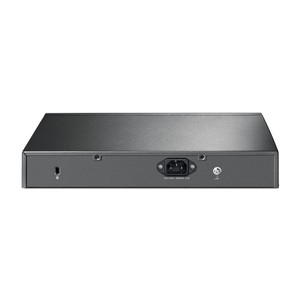
- External Power Supply (53.5 VDC/1.31 A): Isolated AC-to-DC adapter reduces electromagnetic interference in noisy industrial environments.
The TL-SG2218 integrates seamlessly with any standard IP camera, NVR, or networked security device that accepts Gigabit Ethernet. VLAN and QoS features ensure predictable performance when mixing cameras, access control, and IoT sensors on shared infrastructure. The dual SFP slots accommodate standard multi-mode fiber (up to 2 km) or single-mode fiber (up to 10+ km), enabling backbone consolidation without intermediate hubs or distance repeaters.
In deployments with distributed camera clusters—parking lots, warehouse perimeters, or remote equipment buildings—fiber SFP uplinks eliminate the cost and fragility of long copper runs. A 500-meter campus perimeter benefits from a single fiber backbone with copper drops to edge cameras; the switch's managed traffic control prevents any single camera or access control subsystem from monopolizing bandwidth. Port mirroring to a central security appliance or packet-analysis tool provides forensic visibility into network anomalies, rogue devices, or bandwidth theft.
PoE delivery from the switch itself eliminates the need for separate power injectors at each camera location—62W budget supports approximately 8–10 standard PoE cameras running simultaneously. QoS queues ensure that time-sensitive access control (door unlock commands, intercom audio) are never delayed by bulk video traffic. VLAN enforcement separates camera networks from office data, restricting broadcast storms and simplifying compliance audit trails for segregated security infrastructure.
The TL-SG2218 carries no specific NDAA or supply-chain restrictions; as a passive network fabric component, it is compatible with all major VMS platforms (Genetec, Milestone, Axis Camera Station, ExacqVision, etc.) and NVR ecosystems. Its role is transparent infrastructure—it does not process or store video, only forward encrypted streams. For integrators designing mid-scale deployments requiring fiber uplinks, managed traffic isolation, or distributed PoE delivery, the TL-SG2218 represents a mature, feature-complete solution without enterprise-class overhead or cost.
Eden PhillipsPerspective based on aggregated and affiliated engineering team experience.
In our experience, the TL-SG2218 is the pragmatic middle ground for integrators managing mixed-device security networks across 8–20 endpoints. We've deployed it dozens of times in warehouse perimeters, multi-building campuses, and utility facilities where fiber backbone uplinks were necessary but enterprise-class switching overhead was unjustified. The real operational win is the pairing of managed traffic control (VLAN, QoS, port mirroring) with affordable fiber expansion—most mid-market integrators underestimate how much latency and dropped packets stem from broadcast storms or misconfigured traffic priorities on unmanaged infrastructure. The dual SFP slots eliminate the architectural pain of daisy-chaining switches to reach distant buildings; a single fiber run to a remote equipment cluster scales far more gracefully than trying to PoE-inject every camera along a 300-meter fence line. Against competitors like Cisco SG300 or Arista, the TL-SG2218 trades some advanced features (MPLS, advanced routing) for simplicity and cost—a good trade when you're segmenting camera traffic, not designing carrier-class networks. One caveat: the 62W PoE budget is per-switch, not per-port; if you're planning to power 16 simultaneous PoE devices at maximum draw, you'll need additional injectors or PoE+ switches. For typical camera deployments (5–8 cameras powered from the switch, the rest on injectors), the budget is transparent.
Technical Highlights:
- 16 Gbps Switching Fabric with Wire-Speed Forwarding: No oversubscription between ports. In a 16-port architecture, this means any port can simultaneously send and receive at 1 Gbps without queuing delay. Real-world impact: multiple 5 Mbps cameras and a 100 Mbps NVR uplink share zero contention—packet loss from congestion is virtually eliminated even under peak ingest periods.
- VLAN and QoS Support: Configure separate VLANs for cameras (VLAN 100), access control (VLAN 200), and office data (VLAN 300), then assign strict priority queuing to access control traffic. This prevents a runaway camera stream from delaying a door-unlock command by even 10 milliseconds—operationally critical in high-throughput facilities.
- Port Mirroring (SPAN): Mirror all traffic from one or more ports to a dedicated monitoring port where you attach a packet analyzer, SIEM sensor, or IDS appliance. Enables forensic visibility into network attacks, bandwidth theft, or rogue devices without spanning expensive TAP hardware.
- Dual SFP Uplinks (Multi-Mode or Single-Mode): Two independent fiber slots allow redundant backbone paths or geographic separation of camera/access control clusters without distance penalty. Standard LC or SC connectors; transceivers are interchangeable third-party modules.
- PoE 802.3af/at Mixed Mode: Supports both high-draw PoE+ cameras and low-draw 802.3af sensors on the same switch. The 62W budget is distributed algorithmically—allocate prioritized budget to critical cameras, let access control readers draw on remainder.
- Compact Wall/Rack Mount Factor: 1.7-inch height fits in any standard 19-inch relay rack or wall-mount enclosure. External power supply reduces heat dissipation and EMI inside outdoor-rated cabinets.
Deployment Considerations:
- PoE Budget Is Shared: 62W is the total pool across all 16 ports. If you're planning to power 10+ simultaneous cameras at full draw (15W each), you'll exceed budget and experience brownout resets. Size camera load conservatively or stage cameras on separate midspan injectors; budget 35–40W for safety margin.
- SFP Transceiver Costs Are Separate: The switch includes no fiber modules; multi-mode and single-mode transceivers are add-on purchases. For a 2-kilometer backbone, budget $80–150 per transceiver pair depending on connector type and manufacturer.
- Managed Switch Complexity Requires Configuration: VLAN tagging, QoS queues, and port mirroring are not enabled by default. Allocate 1–2 hours for initial switch provisioning; misconfigured VLAN policies can cause camera isolation or access control blackout. Use a dedicated admin VLAN and change default credentials immediately.
- No Redundancy or Stacking: Unlike enterprise-class managed switches, the TL-SG2218 does not support link aggregation (802.3ad), stack rings, or automatic failover. If the switch fails, your entire network goes down—plan for two switches in critical deployments (one hot, one cold standby with manual failover).
- Thermal Performance in Outdoor Enclosures: The external power supply and minimal fan dissipation make this suitable for outdoor-rated metal cabinets with passive ventilation, but confirm ambient temperature limits (typically 0–40°C) before installation in uncontrolled environments.
The TL-SG2218 is ideal for integrators designing mid-market security networks that require fiber backbone consolidation, managed traffic isolation, and modest PoE distribution without enterprise-class complexity or cost. If you're fielding multiple buildings, high-speed camera clusters, or mixed access-control and surveillance infrastructure, the dual SFP slots and smart management features justify the step up from an unmanaged gigabit switch. For purely single-location, single-building deployments with fewer than 8 cameras, an unmanaged switch is often sufficient. Explore the full TP-Link catalog for complementary switches, access points, and managed infrastructure components.