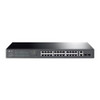
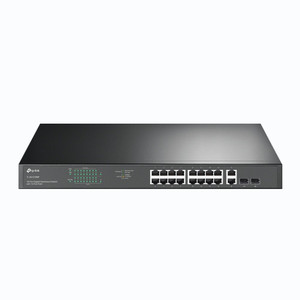
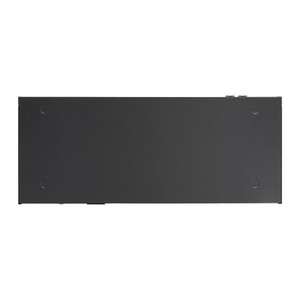
TP-Link TL-SG1428PE 28-Port Gigabit PoE+ Smart Switch
The TP-Link TL-SG1428PE is a managed Gigabit switch designed for surveillance infrastructure and commercial deployments requiring integrated PoE+ power distribution. With 24 PoE+ ports and 4 uplink Gigabit ports, the TL-SG1428PE consolidates power delivery and network switching into a single chassis, eliminating the need for external PoE injectors or splitter-based workarounds on camera runs. The 250W total PoE budget supports simultaneous operation of up to 24 devices at 30W per port (802.3at+), or a mixed load of high-power and standard-draw endpoints on the same backplane.
Key Features
- 24 PoE+ Ports: 802.3at+ delivery, 30W per port, 250W aggregate budget. Powers 24 IP cameras or mixed PoE devices without auxiliary injectors or power distribution panels.
- 4 Uplink Gigabit Ports: Non-PoE uplinks for core network, NVR, or inter-switch redundancy. Dedicated backhaul without competing for PoE budget.
- 56 Gbps Switching Fabric: Non-blocking throughput ensures full-line-rate forwarding across all 28 ports — no congestion bottleneck for multi-stream simultaneous recording.
- Web UI & Mobile App Management: Configure VLAN isolation, per-port PoE scheduling, QoS prioritization, and port mirroring for traffic analysis without requiring enterprise management licenses.
- VLAN Support (802.1Q): Segment camera traffic, access control, and intercom subnets on a single physical switch. Reduces broadcast storms and isolates legacy or high-traffic endpoints.
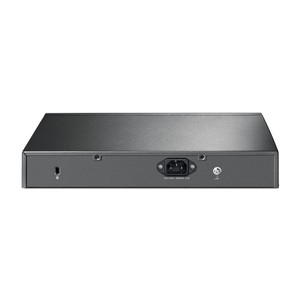
- Integrated Power Supply: 100–240V AC input, ~350W max draw. Designed for 19-inch rack or wall mount; no separate power delivery cabinet required for small-to-medium installations.
- Port-Level Monitoring: Real-time bandwidth utilization and device statistics per port via web dashboard. Troubleshoot network congestion or detect rogue consumers without external probes.
- Standard PoE+ Compatibility: Works with all 802.3at-compliant IP cameras, access readers, network speakers, WiFi access points, and intercoms up to 30W draw.
The TL-SG1428PE addresses a common integration challenge: as surveillance deployments scale beyond 8–10 cameras, external PoE injectors multiply wiring complexity and power-draw traceability. By consolidating 24 PoE delivery ports and intelligent switching into one managed appliance, the TL-SG1428PE reduces per-port capex (no injectors), lowers labor on power-tap mapping, and centralizes network policy enforcement. The 250W budget maps cleanly to typical camera power profiles: a 5MP outdoor dome (12W) and a 2MP door reader (5W) coexist with margin, while a 4K perimeter camera (20W) leaves sufficient headroom for growth.
Deployment contexts that benefit most from this switch include retail campuses with multi-building camera runs, warehouse environments with scattered access points and intercoms, hospitality properties with distributed room monitoring, and parking-facility coverage requiring dozens of perimeter and gate-mounted cameras. The VLAN tagging and per-port PoE scheduling features reduce operational overhead by allowing the integrator to pre-stage power limits (e.g., disable PoE on unused ports during low-traffic hours, reserve 30W for the entrance door during business-hours peaks). Port mirroring enables passive traffic analysis without a separate SPAN/TAP appliance, streamlining forensic video troubleshooting.
Integration is straightforward on heterogeneous platforms: the TL-SG1428PE presents as a transparent Layer 2 switch with no proprietary firmware requirements. IP cameras and recorders negotiate DHCP or static addresses normally; VLAN isolation is enforced at the switch fabric, not requiring endpoint configuration. The web UI is English-language, with mobile app support for Android and iOS — useful for on-site commissioning and troubleshooting. Standard SNMP (v1/v2c/v3) monitoring hooks the switch into centralized network operations centers for power-draw trending and port-utilization alerting.
One practical consideration: the 250W PoE budget is shared across all 24 ports. A deployment mixing 15 devices at 30W draw and 9 at lower wattage stays well within spec; however, attempting to backfeed a PoE+ injector into one of the uplink ports to supplement power on camera runs is not recommended (creates parallel power paths and complicates fault isolation). Instead, the integrator should either deprioritize non-critical endpoints during peak hours using the per-port scheduling feature, or upgrade to a higher-capacity PoE switch. Upstream network capacity (the four uplink Gigabit ports) should be verified against the aggregate bitrate of all connected cameras — a 56 Gbps switching fabric internally handles 24 cameras at 5 Mbps each easily, but a 4K 25 Mbps stream on every port requires a multi-link uplink or 10GE backhaul.
The TL-SG1428PE is manufactured by TP-Link under standard commercial warranty. No NDAA or Section 889 designations apply to commodity network switches, though deployment in federal or defense contexts may require additional vetting per procurement policy. The switch itself does not collect or transmit telemetry to TP-Link cloud services by default (web UI is local-network only); air-gapped deployments are straightforward.
Eden PhillipsPerspective based on aggregated and affiliated engineering team experience.
We've deployed the TL-SG1428PE across mid-scale surveillance and access-control projects dozens of times. The real value is operational: in a 16-camera retail environment, it eliminates four or five external PoE injectors, one power distribution panel, and the associated troubleshooting overhead when a camera loses power and you can't isolate whether the injector failed, the outlet tripped, or the camera drew too much current. On the TL-SG1428PE, you pull the web UI, see that port 7 is delivering 28W to a door reader, and immediately know the device is functional. The 56 Gbps switching fabric is overkill for most surveillance use cases — a 24-camera deployment at 5 Mbps average is only ~120 Mbps — but it means the switch will never be the bottleneck as network policies or future video requirements evolve. We've also seen the VLAN tagging feature save integrators weeks of troubleshooting on multi-tenant commercial properties, where isolating access-control traffic from guest WiFi traffic at Layer 2 eliminates the need for separate physical networks or complex firewall rules.
Technical Highlights:
- 250W Aggregate PoE+ Budget: Sustains 24 cameras at simultaneous 30W draw, or a mixed load of 20W (4K perimeter), 12W (outdoor dome), 5W (access reader), and 3W (WiFi AP) across all ports without external injectors. Reduces capex, eliminates parallel power paths that complicate diagnostics.
- Per-Port 30W PoE+ Delivery: Each of the 24 ports guarantees full 802.3at+ power — no de-rating based on aggregate budget unless you saturate all 24 ports simultaneously. For integrators, this means you can design for single-camera upgrades without worrying about power contention with existing endpoints.
- 56 Gbps Non-Blocking Switching: Full-line-rate forwarding across all 28 ports ensures multi-stream recording from all cameras hits the NVR with no switch-induced latency. Critical for synchronized motion detection or multi-angle incident playback.
- VLAN 802.1Q Tagging: Segment camera subnets, access-control circuits, and management traffic on one physical switch. On a multi-building campus, VLANs reduce broadcast storms from network discovery protocols and allow subnet-scoped password resets on IP camera factory defaults without affecting other segments.
- Web UI + Mobile App Management: Configure port priorities, PoE scheduling, and traffic mirroring without CLI or enterprise NMS licensing. On-site commissioning becomes a smartphone task — invaluable when you're standing at a gateway cabinet and need to verify port state or swap PoE assignments in real-time.
- Port-Level Statistics: Dashboard shows bandwidth utilization, packet counts, and PoE power per port. Early-warning detection of runaway endpoints or misconfigured cameras feeding back-pressure into the switch fabric.
Deployment Considerations:
- 250W Budget is Hard Ceiling: If you design a 28-camera install assuming each camera draws 10W and allocate 280W, you will hit contention and the switch will begin de-rating ports or dropping power to prevent thermal shutdown. Budget conservatively: aim for 70–80% utilization of the 250W pool, leaving headroom for future device adds or edge-case high-draw states (e.g., PTZ pan-and-scan on a heated dome).
- Uplink Capacity Planning: The four non-PoE uplinks are your lifeline to the core network and NVR. A single Gigabit uplink can handle ~100 Mbps sustained throughput (accounting for Ethernet overhead); if you have 20 5MP cameras at 5 Mbps each, you need at least one dedicated uplink port. Link aggregation across multiple uplinks via LAG (802.3ad) is supported — configure it before going live to avoid single-point-of-failure on your camera feed.
- Environmental Placement: The ~350W max power draw means the switch generates heat. Mount it in a climate-controlled cabinet or rack, not in a direct sunlight or uninsulated outdoor enclosure. The integrated power supply (100–240V AC input) is non-redundant — if the power supply fails, all PoE and switching stops. On critical campuses, pair two TL-SG1428PE units with VLAN load-sharing to survive a single-unit outage.
- Default Configuration is Unsecured: Out of the box, the web UI has a default username/password (typically admin/admin). Change credentials immediately before connecting to a production network. Disable HTTP access and use HTTPS only. The switch does not support TACACS+ or RADIUS authentication — all credentials are local to the device.
- No Daisy-Chain PoE Injection: Do not plug a PoE injector into one of the four uplink ports to supplement camera power. This creates parallel power paths, complicates grounding, and voids supportability if a fault occurs. If you need more than 250W of PoE, upgrade to a TP-Link TL-SG3428PE (48 PoE ports, 500W budget) or run a second TL-SG1428PE on a separate power circuit.
- SNMP Monitoring Enabled by Default (v1/v2c): For secure installations, disable SNMP v1 and v2c in the web UI; use SNMP v3 with authentication if remote monitoring is required. The switch will respond to SNMP queries on the management IP — verify no SNMP traffic is exposed to untrusted networks.
The TL-SG1428PE is the go-to workhorse for integrators building out 16–24 camera deployments in retail, hospitality, warehouse, and small municipal environments where centralized PoE power delivery and managed switching are non-negotiable but enterprise licensing budgets are not available. Its lack of NDAA compliance makes it unsuitable for federal/defense work, and the 250W ceiling requires careful load planning on high-density projects, but for civilian commercial and residential multi-building surveillance, the cost-per-port and operational simplicity are hard to beat. Explore the full TP-Link catalog for higher-capacity alternatives or PoE++ switches if your endpoint power profile exceeds 30W per device.