
TP-Link DS1016G vs Ubiquiti USW-PRO-MAX-16: Specification Comparison
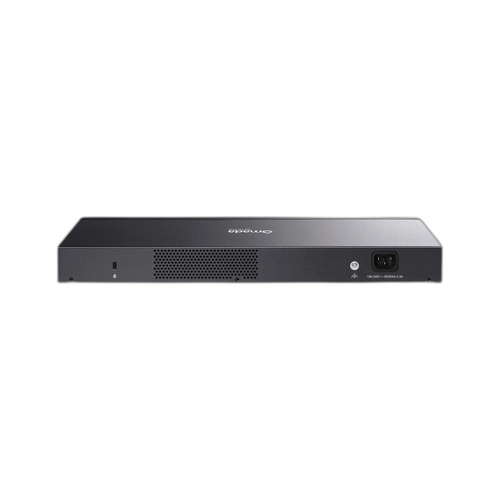
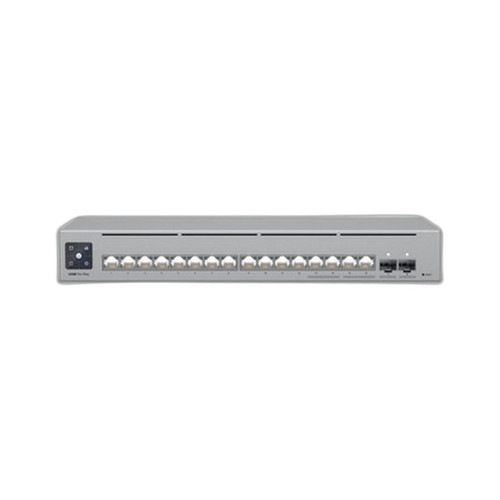
Both the TP-Link DS1016G and Ubiquiti USW-PRO-MAX-16 are 1U rack-mountable, 16-port Gigabit Ethernet switches in steel enclosures—products a buyer equipping a small camera network, branch office, or wiring closet would reasonably cross-shop. The core distinction is management tier: the DS1016G is an unmanaged plug-and-play device, while the USW-PRO-MAX-16 is a fully managed switch. Buyers must weigh whether the operational control and higher throughput of the managed unit justify its added complexity and cost over the simpler, lower-power TP-Link.
In This Guide
- Which switch delivers more switching capacity and forwarding throughput for a 16-port Gigabit deployment?
- How do management capabilities and traffic-control features differ between these two switches?
- How do power consumption, operating environment, and enclosure construction compare?
- Which should you choose: the DS1016G or the USW-PRO-MAX-16?
- Side-by-Side Specs
- FAQ
Which switch delivers more switching capacity and forwarding throughput for a 16-port Gigabit deployment?
The USW-PRO-MAX-16 is specified at 84 Gbps switching capacity and 62 Mpps forwarding rate. The DS1016G is specified at 32 Gbps switching capacity and 23.8 Mpps forwarding rate. Both switches provide 16 × 10/100/1000 Mbps RJ45 ports, so the line-rate port count is identical. However, the Ubiquiti unit offers 2.6× the switching capacity and approximately 2.6× the forwarding rate of the TP-Link. For environments where all 16 ports simultaneously carry high-bandwidth streams—such as multi-stream IP camera aggregation or converged voice, video, and data—the USW-PRO-MAX-16's headroom is materially larger. The DS1016G's 32 Gbps capacity is sufficient for non-simultaneous or moderate-utilization workloads across its 16 ports but leaves less overhead for burst traffic.
How do management capabilities and traffic-control features differ between these two switches?
The DS1016G is explicitly unmanaged (plug-and-play). Its documented feature set includes an Isolation Mode covering ports 1–14 and Loop Prevention across all ports, plus an 8K MAC address table. There is no VLAN configuration, QoS, SNMP, port mirroring, or remote management interface specified. The USW-PRO-MAX-16 is described as a managed switch with Ethernet-based management. No specific management software platform, VLAN depth, QoS classes, or CLI/GUI details are provided in the supplied specifications. Buyers requiring granular traffic segmentation, remote monitoring, or integration into a network management system should note that the Ubiquiti is the managed option, but must consult Ubiquiti's full documentation to confirm specific management feature support. The TP-Link's isolation and loop-prevention modes address two common unmanaged-deployment pain points without requiring configuration expertise.
How do power consumption, operating environment, and enclosure construction compare?
The DS1016G draws 10.68 W at 220 V/50 Hz and accepts 100–240 VAC, 50/60 Hz directly—no external adapter is required. The USW-PRO-MAX-16 consumes 25 W and is powered by an included external AC/DC adapter supplying 4.8–5.2 V DC; it does not accept universal mains voltage directly at the switch. The TP-Link's lower power draw may benefit deployments where rack power budgets or heat density are constrained. On operating temperature, the DS1016G is rated 0 °C to 40 °C; the USW-PRO-MAX-16 is rated −5 °C to 40 °C, offering a modest 5 °C advantage at the cold end—relevant for unconditioned wiring closets or outdoor-adjacent enclosures. Both chassis are steel; the Ubiquiti spec identifies SGCC steel explicitly, while the TP-Link spec does not name the steel grade. The DS1016G storage temperature range extends to −40 °C/70 °C; no storage temperature is specified for the USW-PRO-MAX-16. Weight is documented only for the Ubiquiti at 1.95 kg; the DS1016G weight is not provided in the supplied specs.
Which should you choose: the DS1016G or the USW-PRO-MAX-16?
Our take: The DS1016G is the stronger choice when a buyer needs a low-power, zero-configuration 16-port Gigabit switch with minimal rack-space overhead and a constrained power budget. At 10.68 W versus the USW-PRO-MAX-16's 25 W, it consumes less than half the power, and its direct 100–240 VAC input eliminates dependence on an external adapter. The USW-PRO-MAX-16 is the stronger choice when managed switching is required: it delivers 84 Gbps switching capacity and 62 Mpps forwarding rate—2.6× the DS1016G's 32 Gbps and 23.8 Mpps—and provides Ethernet-based management for traffic segmentation and monitoring. It also carries NDAA Section 889 compliance, which is a hard requirement for U.S. federal and many state/local government deployments. Buyers running unmanaged camera-only or simple LAN consolidation workloads who want plug-and-play simplicity will find the DS1016G adequate; buyers needing network visibility, policy enforcement, or NDAA compliance should select the USW-PRO-MAX-16.
Side-by-Side Comparison
Spec-for-spec, from manufacturer data.
| Specification | TP-Link DS1016G | Ubiquiti USW-PRO-MAX-16 |
|---|---|---|
| Product Type | Unmanaged Gigabit Switch | Managed Gigabit Switch |
| Total Ports | 16 × 10/100/1000 Mbps RJ45 | 16 × 1 Gbps Ethernet |
| Switching Capacity | 32 Gbps | 84 Gbps |
| Forwarding Rate | 23.8 Mpps | 62 Mpps |
| MAC Address Table | 8K entries | — |
| Management | Plug-and-play (unmanaged) | Ethernet-based management |
| Traffic Features | Isolation Mode (ports 1–14), Loop Prevention | — |
| Power Consumption | 10.68 W (220 V/50 Hz) | 25 W |
| Power Input | 100–240 VAC, 50/60 Hz (direct) | 4.8–5.2 V DC via external AC/DC adapter |
| Operating Temperature | 0 to 40 °C (32 to 104 °F) | −5 to 40 °C (23 to 104 °F) |
| Storage Temperature | −40 to 70 °C (−40 to 158 °F) | — |
| Enclosure | Rack-mountable steel (grade not specified) | SGCC steel |
| Dimensions (mm) | 440 × 140 × 44 | 325.1 × 160 × 43.7 |
| Weight | — | 1.95 kg (4.3 lb) |
| NDAA Section 889 | — | Compliant |
| Certifications | CE, FCC, RoHS | CE, FCC, IC, Anatel |
Frequently Asked Questions
Which should you choose: the DS1016G or the USW-PRO-MAX-16?
The DS1016G is the stronger choice when a buyer needs a low-power, zero-configuration 16-port Gigabit switch with minimal rack-space overhead and a constrained power budget. At 10.68 W versus the USW-PRO-MAX-16's 25 W, it consumes less than half the power, and its direct 100–240 VAC input eliminates dependence on an external adapter. The USW-PRO-MAX-16 is the stronger choice when managed switching is required: it delivers 84 Gbps switching capacity and 62 Mpps forwarding rate—2.6× the DS1016G's 32 Gbps and 23.8 Mpps—and provides Ethernet-based management for traffic segmentation and monitoring. It also carries NDAA Section 889 compliance, which is a hard requirement for U.S. federal and many state/local government deployments. Buyers running unmanaged camera-only or simple LAN consolidation workloads who want plug-and-play simplicity will find the DS1016G adequate; buyers needing network visibility, policy enforcement, or NDAA compliance should select the USW-PRO-MAX-16.
Is the DS1016G or USW-PRO-MAX-16 better for a small IP camera network that just needs to connect cameras to an NVR?
If no VLANs, QoS, or remote management are needed, the DS1016G's plug-and-play operation is sufficient for a straightforward camera-to-NVR aggregation role. Its Isolation Mode (ports 1–14) and Loop Prevention are built-in without configuration. The USW-PRO-MAX-16 adds managed capability and higher throughput but requires setup and a controller or management interface—overhead that may not be justified for a simple, closed camera segment.
Does either switch support PoE to power cameras directly?
Neither the DS1016G nor the USW-PRO-MAX-16 is specified with PoE output in the supplied specifications. Although the DS1016G spec sheet lists 'PoE' under a compatibility field, no PoE budget, PoE port count, or IEEE 802.3af/at standard is documented for either unit. Buyers who need to power cameras directly from the switch should verify PoE support against each manufacturer's full datasheet before purchasing.
Which switch is required for U.S. government or federally funded security projects?
The USW-PRO-MAX-16 is documented as NDAA Section 889 compliant. No NDAA compliance claim is made in the DS1016G specifications. Federal, state, or local government projects subject to NDAA Section 889 procurement restrictions should select the USW-PRO-MAX-16 or confirm the DS1016G's compliance status directly with TP-Link before specifying it.
More Network Switch Comparisons
- TP-Link SG3218XP-M2 vs Ubiquiti USW-PRO-MAX-16
- TP-Link SG3218XP-M2 vs TP-Link DS1016G
- TP-Link SG3218XP-M2 vs TP-Link SG2218
- TP-Link DS1016G vs TP-Link SG2218
- TP-Link SG2218 vs Ubiquiti USW-PRO-MAX-16
- Ubiquiti USW-PRO-MAX-16 vs TP-Link DS1016GE
Network Switch Buying Guides
Get a Second Opinion on Your Camera Choice
Share your site layout, coverage goals, and budget. Our team will validate the camera selection, flag anything we would change, and recommend products that match the use case.