
TP-Link SG3218XP-M2 vs TP-Link DS1016G: Specification Comparison
Both the TP-Link SG3218XP-M2 and DS1016G are 16-port, 1U rack-mount Ethernet switches from TP-Link's Omada line, making them direct cross-shop candidates for network infrastructure buildouts. However, they sit at very different capability tiers: the SG3218XP-M2 is a managed, multi-gig PoE++ switch targeting bandwidth-intensive and powered-device deployments, while the DS1016G is an unmanaged gigabit switch aimed at plug-and-play simplicity. This comparison evaluates port speed and throughput, PoE capability and power, and management depth.
In This Guide
Which switch delivers more bandwidth and forwarding capacity?
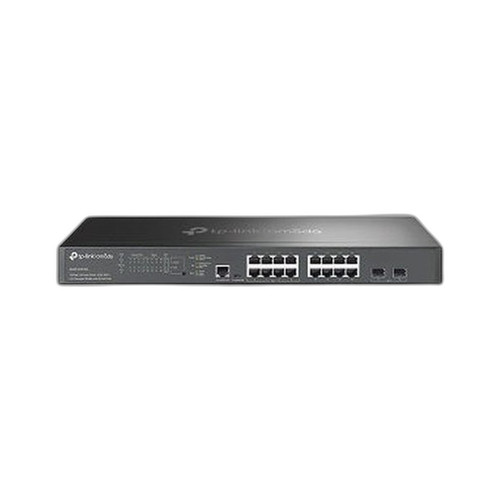
The SG3218XP-M2 provides 16 × 2.5GBASE-T RJ45 ports plus 2 × 10G SFP+ uplink slots, with a switching capacity of 80 Gbps. The DS1016G offers 16 × 10/100/1000 Mbps RJ45 ports with a switching capacity of 32 Gbps and a forwarding rate of 23.8 Mpps. Per-port bandwidth on the SG3218XP-M2 is 2.5× higher on access ports and 10× higher on uplink ports versus the DS1016G's gigabit ceiling. The DS1016G's throughput spec (23.8 Mpps forwarding) is provided in the source data; an equivalent forwarding rate is not stated for the SG3218XP-M2.
For deployments running high-resolution IP cameras, NVRs, or other devices that saturate gigabit links, the SG3218XP-M2's 2.5G access ports and 10G uplinks provide headroom the DS1016G cannot match. The DS1016G is sufficient for standard 1080p/4MP camera networks where per-stream bandwidth remains well below 1 Gbps.
Which switch can power connected devices, and how much budget does it provide?
The SG3218XP-M2 supports PoE++ (802.3bt) as well as 802.3af/at on its access ports, with a total PoE budget of 240 W. The spec notes 8 powered ports, implying PoE is not available on all 16 access ports—the exact per-port distribution is stated in the Card Bullets as '8 powered ports.' Maximum per-port delivery under 802.3bt is up to 90 W.
The DS1016G spec lists 'PoE' under its _PoE field, but no PoE budget, no IEEE PoE standard (802.3af/at/bt), and no powered-port count are provided in the supplied specifications. Given its stated power consumption of only 10.68 W total, it is not credible that the DS1016G sources meaningful PoE power to connected devices. Buyers requiring PoE for cameras, access points, or intercoms should treat the DS1016G's PoE notation as unverified and request clarification from the vendor before specifying it for powered endpoints.
How much control and network visibility does each switch provide?
The SG3218XP-M2 is an L2+ managed switch supporting CLI, SNMP v1/v2c/v3, RMON, Static Routing, VLAN, QoS, ACL, and STP/RSTP/MSTP. It is part of TP-Link's Omada SDN ecosystem, enabling centralized controller-based management. These features allow administrators to segment traffic with VLANs, prioritize video streams with QoS, and receive SNMP alerts—capabilities essential in multi-VLAN security or enterprise environments.
The DS1016G is unmanaged (plug-and-play). Its only documented network-intelligence features are Isolation Mode (ports 1–14) and Loop Prevention (all ports). There is no CLI, no SNMP, no VLAN, and no QoS. It provides no remote visibility or configuration interface. For small, flat networks where simplicity and low overhead are the priorities, this is adequate. For any deployment requiring traffic segmentation, monitoring, or access control, it is not suitable.
Which should you choose: the SG3218XP-M2 or the DS1016G?
Our take: The SG3218XP-M2 is the stronger choice when managed switching, multi-gig bandwidth, or verified PoE delivery are required. Its 2.5GBASE-T access ports and 10G SFP+ uplinks provide 2.5× and 10× more throughput per port respectively compared to the DS1016G's gigabit ceiling, and its 80 Gbps switching fabric is 2.5× the DS1016G's 32 Gbps. The 240 W PoE++ budget enables powering of high-wattage endpoints such as PTZ cameras or Wi-Fi 6 access points, while the DS1016G's PoE capability is unverified given its 10.68 W total power draw. The SG3218XP-M2 also adds VLAN, QoS, ACL, SNMP, and Omada SDN integration. The DS1016G is appropriate only for small, flat, unmanaged gigabit networks where plug-and-play simplicity, very low power consumption, and minimal cost are the overriding criteria.
Side-by-Side Comparison
Spec-for-spec, from manufacturer data.
| Specification | TP-Link SG3218XP-M2 | TP-Link DS1016G |
|---|---|---|
| Product Type | L2+ Managed Switch | Unmanaged Switch |
| Access Port Speed | 16 × 2.5GBASE-T RJ45 | 16 × 10/100/1000 Mbps RJ45 |
| Uplink Ports | 2 × 10G SFP+ | — |
| Switching Capacity | 80 Gbps | 32 Gbps |
| Forwarding Rate | — | 23.8 Mpps |
| PoE Standard | 802.3bt / 802.3at / 802.3af | Not specified in provided specs |
| PoE Budget | 240 W | — |
| Powered Ports | 8 (per Card Bullets) | — |
| Total Power Draw | 240 W (max) | 10.68 W (220 V / 50 Hz) |
| Power Supply | 100–240 V AC, 50/60 Hz | 100–240 VAC, 50/60 Hz |
| Management | CLI, SNMP v1/v2c/v3, RMON, Omada SDN | None (plug-and-play) |
| VLANs / QoS / ACL | Yes (VLAN, QoS, ACL, STP/RSTP/MSTP) | — |
| Operating Temp | 0 °C to 50 °C | 0 °C to 40 °C |
| Flash / Memory | 32 MB | 8K MAC address table |
| Dimensions | 294 × 180 × 44 mm | 440 × 140 × 44 mm |
| Certifications | — | CE, FCC, RoHS |
Frequently Asked Questions
Which should you choose: the SG3218XP-M2 or the DS1016G?
The SG3218XP-M2 is the stronger choice when managed switching, multi-gig bandwidth, or verified PoE delivery are required. Its 2.5GBASE-T access ports and 10G SFP+ uplinks provide 2.5× and 10× more throughput per port respectively compared to the DS1016G's gigabit ceiling, and its 80 Gbps switching fabric is 2.5× the DS1016G's 32 Gbps. The 240 W PoE++ budget enables powering of high-wattage endpoints such as PTZ cameras or Wi-Fi 6 access points, while the DS1016G's PoE capability is unverified given its 10.68 W total power draw. The SG3218XP-M2 also adds VLAN, QoS, ACL, SNMP, and Omada SDN integration. The DS1016G is appropriate only for small, flat, unmanaged gigabit networks where plug-and-play simplicity, very low power consumption, and minimal cost are the overriding criteria.
Is the SG3218XP-M2 or DS1016G better for powering IP cameras directly from the switch?
The SG3218XP-M2 is the documented choice: it specifies 802.3bt/at/af PoE++ with a 240 W budget across 8 ports. The DS1016G lists 'PoE' in its spec sheet but provides no PoE standard, no budget figure, and no powered-port count, and its total power consumption of 10.68 W makes substantial PoE sourcing implausible. Verify the DS1016G's PoE capability directly with TP-Link before using it to power any endpoint.
Can I manage VLANs or QoS on the DS1016G the way I can on the SG3218XP-M2?
No. The DS1016G is an unmanaged switch with no VLAN, QoS, ACL, SNMP, or CLI support. Its only traffic-shaping features are port isolation on ports 1–14 and loop prevention. The SG3218XP-M2 supports all of these management functions as an L2+ managed switch and integrates into TP-Link's Omada SDN platform.
Which switch is better suited for a small office or retail camera network with basic connectivity needs?
For a flat, unmanaged network with standard gigabit cameras and no requirement for PoE from the switch, traffic segmentation, or remote monitoring, the DS1016G offers plug-and-play simplicity and very low power consumption (10.68 W). Its 16 gigabit ports and 32 Gbps switching capacity are sufficient for typical 1080p or 4MP camera streams. The SG3218XP-M2's additional capabilities would go unused in that scenario, though its PoE and management features become necessary as the deployment scales or complexity increases.
More Network Switch Comparisons
- TP-Link SG3218XP-M2 vs Ubiquiti USW-PRO-MAX-16
- TP-Link SG3218XP-M2 vs TP-Link SG2218
- TP-Link DS1016G vs Ubiquiti USW-PRO-MAX-16
- TP-Link DS1016G vs TP-Link SG2218
- TP-Link SG2218 vs Ubiquiti USW-PRO-MAX-16
- Ubiquiti USW-PRO-MAX-16 vs TP-Link DS1016GE
Network Switch Buying Guides
Get a Second Opinion on Your Camera Choice
Share your site layout, coverage goals, and budget. Our team will validate the camera selection, flag anything we would change, and recommend products that match the use case.