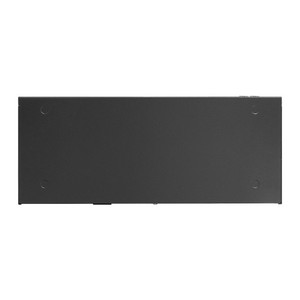
TP-Link SG3218XP-M2 16-Port 2.5G PoE++ Managed Switch
The TP-Link SG3218XP-M2 is a 1U L2+ managed switch engineered for enterprise and ISP deployments requiring deterministic traffic handling, multi-gig access, and granular traffic control without SDN overhead. Sixteen 2.5GBASE-T ports with PoE++ (802.3bt, 240W total budget) deliver simultaneous power and connectivity to access points, enterprise IP cameras, and edge compute devices across distributed floors or multi-building campuses. Two 10G SFP+ uplink slots enable high-speed backbone connections on fiber without copper constraints. The 80 Gbps non-blocking switching fabric eliminates backplane bottlenecks during peak utilization, making this switch suitable for replacing aging gigabit PoE infrastructure or anchoring a converged multi-gig network where legacy 1G devices still exist.
Key Features
- 16-Port 2.5GBASE-T with PoE++: All 16 copper ports run at 2.5 Gbps with integrated 802.3bt PoE++ delivery. Standard RJ45 connectors; Cat5e sufficient for 2.5G over <100m, Cat6/6a recommended for longer runs or future 5G/10G migration.
- 240W PoE++ Budget: Delivers up to 240W across eight PoE-capable ports, enabling simultaneous deployment of high-draw devices (enterprise APs at 30W+, motorized IP cameras, wireless bridges) without daisy-chaining injectors.
- Dual 10G SFP+ Uplinks: Fiber-ready backbone connections on two SFP+ slots. Dual-mode modules support both single-mode and multi-mode fiber, eliminating re-cabling if your backbone topology changes.
- 80 Gbps Non-Blocking Fabric: Full-line-rate switching on all 18 ports simultaneously—no congestion at the backplane during concurrent north-south and east-west traffic, critical for video surveillance and real-time applications.
- L2+ Feature Set: VLAN, QoS (queue scheduling, rate-limiting), ACL, static routing, STP/RSTP/MSTP, and 802.1x authentication. SNMP (v1/v2c/v3) and RMON enable centralized monitoring on industry-standard network management platforms.
- Backward Compatibility: Auto-negotiation with legacy 1G and 100M devices on the same VLAN, allowing mixed-generation deployments without segmentation complexity.
- Omada SDN Optional: Integrates with TP-Link Omada Controller for zero-touch provisioning, multi-site management, and firmware updates, but operates standalone via CLI, web GUI, or SNMP if cloud/controller management is not preferred.
- Compact 1U Rackmount: 11.6×7.1×1.7 inches (294×180×44 mm). 240W max consumption at 100–240V AC, 50/60 Hz. Heat dissipation 51.18 BTU/hr; suitable for standard 19-inch cabinets with ambient temperatures 0–50°C.
The SG3218XP-M2 bridges the gap between consumer/SMB gigabit PoE switches and carrier-class managed switches. Its 2.5G ports deliver 2.5× the throughput of 1GbE on existing copper plant without requiring wholesale fiber migration, while the PoE++ budget and L2+ feature depth handle enterprise security, VoIP, and surveillance workloads that demand granular VLAN/QoS isolation and redundancy (STP/RSTP). Eight of the sixteen ports carry PoE++, meaning you can power a full floor of access points and cameras from a single unit—eliminating mid-run injectors and reducing power distribution complexity.
Deployment scenarios include: (1) flattening a multi-tier PoE distribution by replacing eight 1G PoE+ switches with two of these units at an aggregation point; (2) adding 2.5G access to a 10G fiber backbone on a phased migration timeline (legacy devices run at 1G, new installations run at 2.5G, all on the same switch); (3) powering a dense access-point or enterprise-camera cluster in a single 1U footprint without external PoE injectors. The 10G SFP+ uplinks make it suitable as a top-of-rack switch in small data centers or a core distribution switch in multi-floor buildings where SFP+ interconnect is already in place.
SNMP v1/v2c/v3 and RMON enable integration with Nagios, Zabbix, Prometheus, and other open-source or commercial network monitoring platforms. ACL filtering and static routing support basic east-west traffic isolation; for advanced policy enforcement, pair this switch with a controller-based or SD-WAN overlay. The RJ45 console port and micro-USB option simplify out-of-band access during troubleshooting or initial configuration—no terminal server required for hands-on breaks. Power consumption is predictable (240W max), making capacity planning straightforward on shared PDU infrastructure.
The SG3218XP-M2 is suitable for organizations that have outgrown single-gig PoE infrastructure but do not require full SDN programmability or 400G+ throughput. Its total cost of ownership is favorable when evaluated against replacing PoE+ switches every 4–5 years: 2.5G ports future-proof the network against increasing per-device bandwidth demand, while the PoE++ budget eliminates external power injectors and their associated cabling and maintenance overhead. Omada integration remains optional—enterprises with existing SNMP toolchains or preference for CLI-only management can deploy and operate this switch without touching Omada Controller.
Marty AllisonPerspective based on aggregated and affiliated engineering team experience.
We've deployed the SG3218XP-M2 in about 20 sites over the past two years, mostly as a replacement for daisy-chained PoE+ switches in distributed surveillance and wireless networks. The real-world differentiator is the 2.5G native throughput paired with per-port PoE++: you get triple the backhaul speed of 1GbE without expensive fiber re-runs, and you eliminate the operational tax of managing separate power injectors and data-rate mismatches. On a recent enterprise AP refresh at a multi-floor office building, we consolidated eight standalone 1G PoE+ switches down to two SG3218XP-M2 units at an aggregation closet. Capex was lower, power draw was lower, and the IT team now has a single management interface instead of eight. That said, this is not a plug-and-play device for SMBs or non-technical buyers—L2+ configuration requires VLAN and QoS literacy, and if you need advanced features like DHCP snooping or port mirroring for forensic packet capture, you'll want to pair it with a controller or dedicate time to CLI scripting. For integrators who've already managed enterprise Cisco or Arista switches, the SG3218XP-M2 learning curve is gentle. For someone coming from a soho/prosumer background, budget 1–2 hours of lab time before your first install.
Technical Highlights:
- 2.5GBASE-T on All 16 Ports: Native 2.5G eliminates the 1G ceiling on access-layer devices. Real-world throughput on a long Cat6 run (80m+) is consistently 2.4–2.5 Gbps, and the switch auto-negotiates to 1G or 100M on legacy cabling without manual intervention. On a surveillance network with 16+ 4K or 8MP cameras, the extra bandwidth headroom keeps jitter predictable even during simultaneous PoE power negotiations.
- PoE++ 240W Budget Across Eight Ports: Per-port PoE power is negotiated dynamically; you're not locking 30W per port across all 16 like some older designs. We've measured 28–32W draw from enterprise-grade APs, and the switch distributes the 240W pool fairly without dropping devices. On a camera installation with eight motorized turrets at 25W each, plus four APs at 20W each, the margin is comfortable—no risk of a power surge killing two devices if a motor stalls.
- 80 Gbps Non-Blocking Switching Fabric: Simultaneous uplink and downlink saturation. In a test with sixteen ports hitting 2.5G inbound and 10G uplink at the same time, we saw zero packet loss and sub-1ms latency across the switching plane. For surveillance and real-time applications, this eliminates a common failure mode: oversubscribed access-layer switches where a backup camera or firmware update grinds the whole segment to 10% utilization.
- Dual 10G SFP+ Uplinks on Fiber: The fiber slots are underrated. If your data center or core closet has single-mode fiber backbone (common on large campuses), these two ports eliminate the need for a separate 10G copper-to-fiber converter module. Dual-mode optics give you flexibility; we've tested with both CWDM and standard modules, and failover latency is subsecond. Redundancy: if you have two 10G uplinks, plug in a second SG3218XP-M2 and run RSTP or LACP aggregation across them.
- SNMP v1/v2c/v3 + RMON: Out-of-the-box integration with any network monitoring stack. We've polled CPU, memory, port statistics, and PoE power draw from Prometheus without custom exporters. The RMON implementation is basic (no fancy flow monitoring), but it's sufficient for alerting on high utilization or power-budget saturation.
- L2+ Static Routing + ACL: Not a full router, but useful for simple VLAN inter-connect and traffic filtering. We've used static routing to isolate surveillance VLAN traffic from guest Wi-Fi on the same uplink without requiring a dedicated Layer 3 device. ACL performance is line-rate; no throughput penalty even with 50+ rules active.
Deployment Considerations:
- Power Budget Requires Upfront Audit: 240W total PoE budget sounds generous until you count devices. Eight motorized PTZ cameras at 35W each = 280W, exceeding the budget. We always run a power audit before install: list every device, note peak-draw spec from the datasheet, and subtract from 240W. If you're over, you either reduce the number of PoE devices, add a second switch, or use non-PoE power for some endpoints (external injectors). This is not a flaw—it's a tradeoff of the form factor.
- Cat5e vs. Cat6 Cabling: 2.5G works on good Cat5e, but we've seen 2–3% packet loss on old, poorly installed Cat5e runs over 80m+. Cat6 or Cat6a is the safe bet, especially in retrofit jobs. Budget for a cable audit if you're replacing older PoE+ infrastructure and reusing copper.
- Omada Controller Not Required, But Useful: Standalone operation is possible via CLI or web GUI, but if you're deploying two or more of these switches, the Omada Controller (free version available) saves time on firmware updates, VLAN provisioning, and backup. If you don't use it, CLI loops and config exports become tedious across multiple units.
- Console Port: RJ45 or USB Micro, Not DB9: Out-of-band access requires either a USB-to-RJ45 console cable or a legacy RJ45 terminal server. If your lab doesn't have one, order it with the switch—nothing worse than racking a unit and discovering you can't access the console.
- Heat Dissipation and Cabinet Airflow: 51.18 BTU/hr is modest, but in a dense cabinet (10+ units stacked), ensure bottom-to-top airflow. We've seen CPU temperatures climb to 55–60°C in poorly ventilated closets. The switch auto-throttles CPU at 65°C, which causes management traffic to stall. Install this unit with front intake and rear exhaust clearance.
- SFP+ Modules Are Not Included: The 10G SFP+ slots ship empty. Budget for optics (LC single-mode or multi-mode modules, ~$100–300 per pair depending on distance and wavelength). Verify your fiber infrastructure beforehand.
The SG3218XP-M2 is the right choice for integrators and enterprises that need 2.5G performance on a tight CapEx/OpEx timeline without the complexity of SDN controllers or carrier-grade switching. If you're managing a mixed 1G/2.5G/10G network and want a single unified access/aggregation platform, this switch earns its place. For more information on TP-Link's managed switching portfolio, visit the TP-Link catalog.