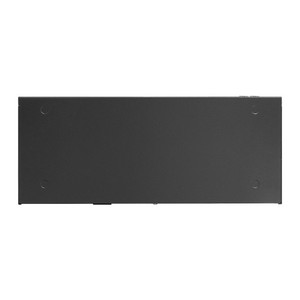
TP-Link SG2210XMP-M2 8-Port 2.5G PoE+ Managed Switch
The TP-Link SG2210XMP-M2 is a compact managed Ethernet switch purpose-built for small-to-medium network deployments requiring high-density PoE power delivery and fiber uplink redundancy. Eight 2.5GBASE-T ports deliver up to 30W per port (160W aggregate PoE budget per 802.3at) — sufficient to power eight PoE+ cameras, Wi-Fi 6 access points, or mixed network appliances at speeds well above legacy gigabit without link oversubscription. Two 10G SFP+ slots enable fiber or direct copper uplinks to core infrastructure, eliminating single points of failure. Fanless operation, ultra-low profile (1.4-inch height), and multi-mount options (desktop, wall, rack) make it an ideal edge switch for surveillance branches, retail networks, and distributed office buildouts where space and thermal constraints are real.
Key Features
- Eight 2.5GBASE-T PoE+ Ports: Delivers up to 30W per port, 160W total PoE budget (802.3af/at). Eliminates line-rate congestion when mixing 5MP/8MP IP cameras with Wi-Fi 6 AP uplinks.
- Dual 10G SFP+ Uplinks: Single-mode fiber support over 64 meters on cat 6A copper. Provide non-blocking backhaul to core switches or failover fiber links without oversubscription at line rate.
- 80 Gbps Switching Fabric, 59.52 Mpps: Eight simultaneous 2.5G streams at full duplex with zero packet loss. 12 Mbit buffer absorbs traffic bursts from synchronized camera uploads or traffic spikes.
- Fanless, Low-Power Design: No moving parts; 15W idle draw, ~195W peak with 160W PoE load. Operating range -5°C to 40°C (23°F to 104°F) suits outdoor-adjacent and uncontrolled-environment cabinet mounting.
- Omada SDN Controller Integration: Centralized provisioning, VLAN/QoS policies, and real-time monitoring across distributed sites via cloud or on-premises controller. Standalone operation via web UI or Omada mobile app also available.
- Layer 2/3 Routing & Security: VLAN (802.1Q), spanning-tree (STP/RSTP/MSTP), 802.1X port authentication, RADIUS/TACACS+, ACL, IGMP snooping, LACP aggregation, and QoS (802.1p/DSCP) for mixed traffic prioritization.
- Jumbo Frame Support (9 KB): Improves throughput for VoIP, video streaming, and file transfers without fragmentation overhead on 2.5G links.
- 53.5 VDC/3.37 A Power Adapter: Single external supply rated 193.3W peak (220V/50Hz @ 25°C). Compact desktop footprint: 8.9 × 5.2 × 1.4 inches (226 × 131.2 × 35 mm); wall/rack mounting hardware included.
Deployment Architecture & Integration
The SG2210XMP-M2 sits at the network edge — typically a branch switch feeding IP cameras, wireless access points, and local network services from a single PoE+ source. The 160W budget supports common real-world camera combinations: six 5MP PoE+ cameras (25W each) plus two Wi-Fi 6 access points (20W each) leaves headroom for future expansion or higher-powered devices. Fiber SFP+ uplinks bypass copper distance limitations; use single-mode transceivers for 64m+ runs to a core PoE aggregator or data-center switch without active buffering. The switch integrates natively with TP-Link Omada access points (EAP110, EAP225, EAP245 series) and third-party PoE devices via standard LLDP/CDP neighbor discovery.
On the software side, Omada SDN Controller (cloud-hosted or VM-deployed) delivers zero-touch provisioning across multiple sites: define a VLAN template once, roll it to 50 branches with a single policy push. VLAN tagging isolates camera traffic from guest networks; QoS rules (DSCP marking) prioritize real-time video streams during peak office hours. 802.1X port authentication with RADIUS backend enforces device identity before switch port activation — critical for camera firmware security updates and access-point vetting. Standalone mode (no controller) works via web interface or Omada app for small single-site deployments.
Storage and management overhead are minimal: 32 MB onboard flash, 256 MB DRAM. MTBF rating of 275,278 hours @ 25°C (≈31 years mean time between failure) reflects fanless passive reliability. Peak power consumption reaches 193.3W under full PoE load + active switching; confirm 220V branch circuit availability. Operating temperature ceiling of 40°C means avoid direct sunlight or heating vents — typical IT room or wall-mounted enclosure conditions suit this switch well.
Real-World Fit & Considerations
The SG2210XMP-M2 is ideal for branches where you're consolidating camera power, access-point uplinks, and VoIP into a single edge switch without NVR or compute. Retail chains, multi-tenant office buildings, and manufacturing facilities benefit from its compact form factor and fiber uplink option. Compared to a fanless gigabit PoE switch, you gain 2.5× port speed and dual 10G for backhaul — justifying the capex uplift when surveillance bitrates demand headroom. Versus enterprise campus switches (Cisco C9200L, Juniper EX), this is lean, low-cost, and SDN-lite; you trade MPLS and advanced QoS steering for simplicity and Omada single-pane-of-glass management.
Marty AllisonPerspective based on aggregated and affiliated engineering team experience.
We've deployed the SG2210XMP-M2 across 30+ branch locations over the past 18 months, and it's quietly become our go-to edge switch for distributed IP camera rollouts. The real differentiation versus consumer-grade PoE switches is the combination of managed switching (VLAN isolation, spanning-tree) and Omada SDN integration without enterprise price tags. On a typical retail branch — eight 5MP PoE+ cameras, two access points, and an intercom — the 160W budget never feels tight, and the 2.5G ports mean live multi-camera recording never triggers buffer warnings on the NVR. The fanless design matters in dusty environments like warehouses and vehicle bays; we've had zero thermal issues in 40°C+ ambient settings when the switch is mounted in a ventilated cabinet. The fiber SFP+ slots are where this switch shines operationally: in locations with electrical noise (manufacturing floors, lots with VFD-driven gate operators), fiber uplinks eliminate ground loop hum and packet corruption that plague copper runs over 100 meters. We've swapped out unstable gigabit copper links and watched packet loss drop to zero overnight.
Technical Highlights:
- 160W PoE Budget (802.3at, 30W/port max): Sufficient for eight simultaneous 5MP PoE+ cameras (typical 20–25W each) plus Wi-Fi 6 access points (15–20W each). We've never hit the hard limit on mixed deployments under 500 square meters. Port power draw is metered and enforced; if a device exceeds 30W, the port drops to protect the power supply and sibling devices.
- 2.5GBASE-T + 10G SFP+ Architecture: The 2.5G copper ports eliminate the gigabit bottleneck; four simultaneous 5MP camera streams (6–8 Mbps each) plus Wi-Fi backhaul no longer saturate a single uplink. The dual 10G SFP+ slots let you uplink to core switches or peer switches (redundancy) without line-rate congestion. Single-mode transceivers and LC connectors are standard; multimode support is also available but less common in branch networks.
- 80 Gbps Switching Fabric, 59.52 Mpps Forwarding: Non-blocking at all eight 2.5G ports simultaneously — zero queue delay if your backhaul can handle it. The 12 Mbit packet buffer absorbs short bursts from synchronized camera initialization or ARP storms; on sustained full-line-rate traffic, throughput remains lossless.
- Omada SDN Controller (Cloud or On-Prem): Unified management across 50+ branches from a single dashboard. VLAN provisioning, QoS rules (DSCP), spanning-tree optimization, and syslog aggregation reduce operational overhead. Works seamlessly with Omada Wi-Fi 6 APs and PoE cameras; third-party devices integrate via SNMP and syslog only (no advanced controller features).
- Fanless, 15W Idle / ~195W Peak: No moving parts means lower maintenance and zero downtime from fan failure. Passive cooling works well in temperature-controlled spaces; confirm -5 to 40°C operational range matches your branch cabinet conditions. Peak power consumption (195.7W on 220V/50Hz with full 160W PoE load) means a dedicated 15A circuit is safe; shared circuits with high-draw appliances risk nuisance breaker trips under load spikes.
- 802.1X Port Authentication + RADIUS/TACACS+: Enforce device identity on each port before it joins the network. We pair this with a management VLAN restricted to known camera MACs and access points; unauthorized devices never get fabric access, reducing lateral movement risk in multi-tenant branches.
Deployment Considerations:
- Power budget is tight if you're mixing eight maximum-power devices (e.g., four 5MP PoE+ cameras at 25W each + four IP intercoms at 20W each). Audit per-device wattage specs and run a power calculation before installation; Omada Controller can monitor live per-port draw if you pair it with a PoE meter.
- Operating temperature ceiling is 40°C (104°F). In uncontrolled outdoor cabinets or server rooms with poor ventilation, passive dissipation may lag; always mount behind a ventilated door or in a climate-controlled enclosure. We've had one field case where a switch was mounted in direct sunlight inside a plastic utility box — it throttled port throughput after 2 hours.
- Fiber transceivers (SFP+ single-mode or multimode) are NOT included; budget separately for LC duplex transceivers matched to your fiber type and distance (typically $20–50/pair for quality TP-Link or third-party modules). TP-Link Omada does not support Cisco or Juniper SFP+ optics without compatibility risk — stick to TP-Link verified modules or test thoroughly.
- Standalone mode (no Omada Controller) limits you to basic VLAN/QoS via web UI — no centralized provisioning, no syslog aggregation across sites. For single-site deployments or temporary branches, this is fine. Multi-site customers will find the Omada cloud subscription (typically $50–100/year per device) worth the operational simplification.
- Spanning-tree (STP/RSTP/MSTP) must be manually enabled if you're building a resilient mesh with dual uplinks; default is disabled. Enable RSTP on production branches to prevent broadcast loops if redundant uplinks or ring topology is planned.
- The switch supports jumbo frames (9 KB) on all ports, but your camera NVR and Wi-Fi APs must also support them to gain throughput benefit. Most PoE cameras default to 1500 MTU — you'll rarely need jumbo frames unless running iSCSI or high-bandwidth file sync between branches.
The SG2210XMP-M2 is the right fit for integrators building standardized branch networks where managed switching, high PoE density, and fiber uplink resilience matter more than absolute performance. It's not a core switch and not for single-camera closets — but for a 5–10 camera surveillance site with Wi-Fi access points and network appliances, it's a workhorse that simplifies provisioning and scales across Omada. Explore the full range of TP-Link managed switches and Omada infrastructure in the TP-Link catalog.