
Ubiquiti USW-48 vs Ubiquiti USW-PRO-48: Specification Comparison
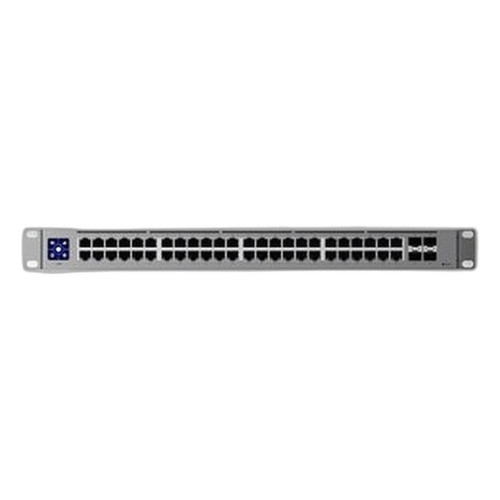
Both the USW-48 and USW-PRO-48 are Ubiquiti 48-port managed gigabit switches in identical 1U rack-mount steel enclosures, sharing the same physical footprint (442 × 285 × 44 mm) and targeting access-layer deployments in UniFi environments. They differ meaningfully in switching fabric capacity, forwarding rate, power draw, and minimum operating temperature—specs that matter when sizing for high-density traffic, cooler environments, or tighter power budgets. Neither model includes PoE, placing both squarely in the non-PoE 48-port access switch category a network installer would directly cross-shop.

In This Guide
- Which switch delivers more fabric capacity and forwarding throughput for dense access-layer traffic?
- How do power consumption and operating environment differ between these two models?
- Do port configuration, management interface, and compliance certifications differ between the two models?
- Which should you choose: the USW-48 or the USW-PRO-48?
- Side-by-Side Specs
- FAQ
Which switch delivers more fabric capacity and forwarding throughput for dense access-layer traffic?
The USW-PRO-48 leads on both core switching metrics. Its switching capacity is rated at 176 Gbps versus 104 Gbps for the USW-48—a 69% higher fabric. Forwarding rate follows the same gap: 131 Mpps on the PRO versus 77 Mpps on the USW-48, a delta of 54 Mpps. In practical terms, the PRO's larger fabric provides more headroom when all 48 ports are simultaneously active under bursty or multi-gigabit aggregated loads.
The USW-48 specifies non-blocking throughput explicitly at 52 Gbps. The USW-PRO-48 specs do not list a separate non-blocking throughput figure in the provided data—only the 176 Gbps switching capacity and 131 Mpps forwarding rate are stated. The USW-PRO-48's uplink configuration is also not specified in the provided specs; the USW-48 explicitly adds 4 × 1G SFP uplinks to its 48 copper ports, giving it a documented 52-port total port count.
How do power consumption and operating environment differ between these two models?
Power draw separates the two units by 20W at rated consumption: the USW-48 draws 40W while the USW-PRO-48 draws 60W. Both ship with internal 60W AC/DC supplies rated 100–240V AC, 50/60 Hz, so both run on universal mains without an external adapter. The USW-48's supply operates at the same 60W rating despite drawing only 40W at load, leaving 20W of headroom.
Minimum operating temperature is a meaningful environmental differentiator. The USW-48 is rated down to -15°C (5°F), while the USW-PRO-48's lower limit is -5°C (23°F). In deployments where the IDF or wiring closet is not climate-controlled—an outdoor-adjacent enclosure, a cold warehouse, or a northern climate mechanical room—the USW-48's wider cold tolerance is a concrete specification advantage. Upper operating temperature is identical at 40°C (104°F) for both.
Do port configuration, management interface, and compliance certifications differ between the two models?
Both switches are managed via Ethernet and share the same NDAA-compliant status and certification set: CE, FCC, IC, and Anatel (Anatel registration numbers differ: 17193-20-08356 for the USW-48 and 00469-21-08356 for the USW-PRO-48). NDAA compliance is confirmed for both, which matters for federal, state, and certain enterprise procurement requirements.
The USW-48 specs explicitly document 4 × 1G SFP uplink ports in addition to 48 copper ports, for a total of 52 ports. The USW-PRO-48 specs as provided do not list SFP or uplink port count—only '48 × 10/100/1000 Mbps Gigabit Ethernet' is stated. Buyers requiring confirmed SFP uplink count on the PRO-48 should consult the manufacturer datasheet directly, as that spec is absent from the data provided here. Both units weigh within 0.1 kg of each other (3.9 kg vs. 4.0 kg) and share identical steel enclosures.
Which should you choose: the USW-48 or the USW-PRO-48?
Our take: The USW-PRO-48 is the stronger choice when switching fabric and forwarding throughput are the primary decision drivers—its 176 Gbps capacity and 131 Mpps forwarding rate exceed the USW-48's 104 Gbps and 77 Mpps by 69% and 70% respectively, providing headroom for high-density or aggregated traffic scenarios. The USW-48 is the better fit when power efficiency or cold-environment tolerance matters: it draws 40W versus 60W (a 33% reduction) and is rated to -15°C versus -5°C, making it more suitable for unconditioned or cold-climate closets. The USW-48 also explicitly documents 4 × 1G SFP uplinks; the PRO-48's uplink configuration is not confirmed in the provided specifications. Both are NDAA-compliant, rack-mountable, and managed via Ethernet. Organizations running a UniFi environment with high port-utilization and ample power should favor the PRO-48; budget-constrained or cold-environment deployments favor the USW-48.
Side-by-Side Comparison
Spec-for-spec, from manufacturer data.
| Specification | Ubiquiti USW-48 | Ubiquiti USW-PRO-48 |
|---|---|---|
| Total Copper Ports | 48 × 1G | 48 × 10/100/1000 Mbps |
| SFP Uplink Ports | 4 × 1G SFP | — |
| Switching Capacity | 104 Gbps | 176 Gbps |
| Non-Blocking Throughput | 52 Gbps | — |
| Forwarding Rate | 77 Mpps | 131 Mpps |
| Power Consumption | 40W | 60W |
| Internal Power Supply | 60W AC/DC | 60W AC/DC |
| Voltage Range | 100–240V AC, 50/60 Hz | 100–240V AC |
| Min. Operating Temp | -15°C (5°F) | -5°C (23°F) |
| Max. Operating Temp | 40°C (104°F) | 40°C (104°F) |
| Form Factor | 1U Rack Mount | 1U Rack-Mountable |
| Dimensions (mm) | 442 × 285 × 44 | 442 × 285 × 44 |
| Weight (without brackets) | 3.9 kg (8.6 lb) | 4.0 kg (8.8 lb) |
| Enclosure Material | SGCC Steel | SGCC Steel |
| VLAN Support | Up to 1,000 VLANs | — |
| NDAA Compliant | Yes | Yes |
Frequently Asked Questions
Which should you choose: the USW-48 or the USW-PRO-48?
The USW-PRO-48 is the stronger choice when switching fabric and forwarding throughput are the primary decision drivers—its 176 Gbps capacity and 131 Mpps forwarding rate exceed the USW-48's 104 Gbps and 77 Mpps by 69% and 70% respectively, providing headroom for high-density or aggregated traffic scenarios. The USW-48 is the better fit when power efficiency or cold-environment tolerance matters: it draws 40W versus 60W (a 33% reduction) and is rated to -15°C versus -5°C, making it more suitable for unconditioned or cold-climate closets. The USW-48 also explicitly documents 4 × 1G SFP uplinks; the PRO-48's uplink configuration is not confirmed in the provided specifications. Both are NDAA-compliant, rack-mountable, and managed via Ethernet. Organizations running a UniFi environment with high port-utilization and ample power should favor the PRO-48; budget-constrained or cold-environment deployments favor the USW-48.
Is the USW-PRO-48 worth the step up from the USW-48 for a busy access layer?
Based on the provided specs, the USW-PRO-48 offers a 69% higher switching capacity (176 Gbps vs. 104 Gbps) and a 70% higher forwarding rate (131 Mpps vs. 77 Mpps). If your 48-port access layer sustains high simultaneous utilization—such as aggregating multiple PoE switches or running video surveillance with large frame bursts—the PRO-48's larger fabric provides documented headroom. For lightly loaded branches, the USW-48's 104 Gbps fabric may be sufficient.
Which switch is better for a cold or unconditioned wiring closet?
The USW-48 is specified to operate down to -15°C (5°F), while the USW-PRO-48's minimum rated temperature is -5°C (23°F). For deployments in outdoor-adjacent enclosures, cold-climate mechanical rooms, or warehouses that are not climate-controlled, the USW-48's wider cold tolerance is a concrete specification advantage per the data provided.
Do both switches include SFP uplink ports?
The USW-48 explicitly specifies 4 × 1G SFP uplinks in its provided specifications. The USW-PRO-48 specifications as provided here list only '48 × 10/100/1000 Mbps Gigabit Ethernet' with no SFP or uplink port count stated. Buyers who require confirmed SFP uplink details for the USW-PRO-48 should refer directly to the Ubiquiti USW-PRO-48 datasheet, as that information is absent from the specs provided for this comparison.
More Network Switch Comparisons
- TP-Link SG6654XHP vs Ubiquiti USW-PRO-MAX-48
- TP-Link SG6654XHP vs Ubiquiti USW-PRO-48
- TP-Link SG6654XHP vs TP-Link SG3452XMPP
- TP-Link SG6654XHP vs TP-Link SG3452XP
- TP-Link SG3452XMPP vs Ubiquiti USW-48
- TP-Link SG3452XMPP vs Ubiquiti USW-PRO-MAX-48
Network Switch Buying Guides
Get a Second Opinion on Your Camera Choice
Share your site layout, coverage goals, and budget. Our team will validate the camera selection, flag anything we would change, and recommend products that match the use case.