
TP-Link SG6654XHP vs Ubiquiti USW-PRO-MAX-48: Specification Comparison
The TP-Link SG6654XHP and Ubiquiti USW-PRO-MAX-48 are both 48-port, 1U rackmount managed switches positioned for enterprise LAN deployments, making them genuine cross-shop candidates for installers evaluating a wired-backbone upgrade. The core tradeoff is clear from the specs: the SG6654XHP is a PoE+ switch with a 1,440W power budget suited to powering edge devices, while the USW-PRO-MAX-48 is a non-PoE switch with a mixed-speed port matrix (1G/2.5G/10G) designed for throughput-sensitive, multi-tier wired networks. Buyers must decide whether PoE delivery or mixed-speed flexibility is the primary driver.
In This Guide
How do the port configurations and switching throughput compare?
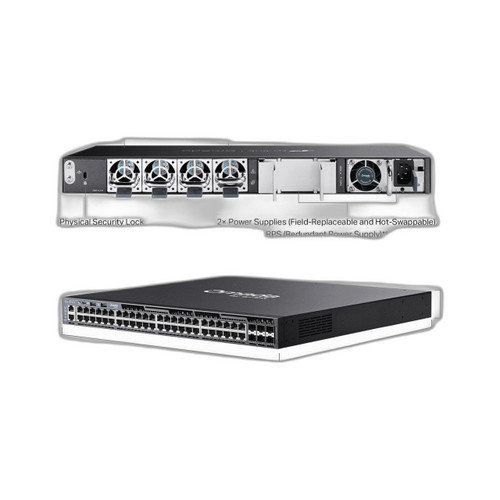
The SG6654XHP provides 48× 10/100/1000 Mbps PoE+ RJ45 ports and 6× 10G SFP+ uplink slots, yielding a switching capacity of 216 Gbps. All 48 downlink ports are capped at 1G; the 10G capability is confined to the six SFP+ uplinks only.
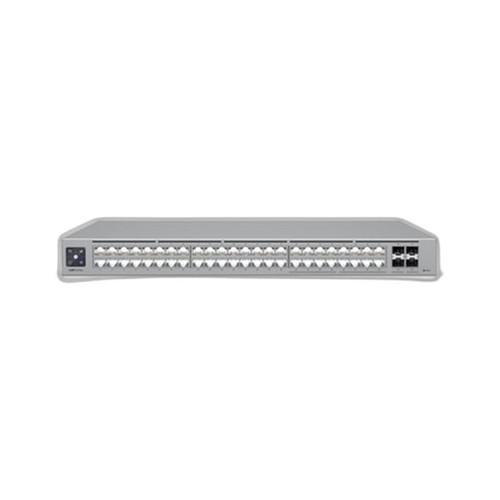
The USW-PRO-MAX-48 offers a heterogeneous port matrix: 32× 1G, 16× 2.5G, and 4× 10G SFP+ ports. Its switching capacity is 224 Gbps with a stated non-blocking throughput of 112 Gbps and a forwarding rate of 167 Mpps. The 16 native 2.5G ports are a meaningful differentiator for Wi-Fi 6/6E APs or NVRs that can saturate a 1G link.
On raw fabric size the USW-PRO-MAX-48 leads narrowly (224 Gbps vs. 216 Gbps). The SG6654XHP adds two extra SFP+ slots (6 vs. 4), providing more 10G uplink capacity for stacking or core aggregation. Forwarding rate is not specified in the SG6654XHP data provided; the USW-PRO-MAX-48's 167 Mpps figure cannot be compared directly.
Which switch wins on PoE delivery and power budget?
The SG6654XHP is a full PoE+ (802.3at, up to 30W per port) switch supporting 802.3af/at across all 48 ports, plus perpetual PoE and fast PoE features. The maximum PoE budget is stated as 1,440W when fitted with two PSM900-AC modules; a reduced budget of 812W applies with two PSM500-AC modules. The power supply accepts 100–240 V ~50/60 Hz.
The USW-PRO-MAX-48 is listed with 'PoE++ (802.3bt)' in its type field, but no PoE budget, per-port wattage, or powered-port count is provided in the supplied specifications. Its total power consumption is listed as 100W, which is consistent with a non-PoE or PoE-pass-through model rather than a switch actively supplying power to 48 ports. Buyers requiring confirmed PoE delivery figures for the USW-PRO-MAX-48 should consult Ubiquiti's official datasheet directly, as the spec data provided here is insufficient to confirm PoE capability or budget.
On PoE delivery, the SG6654XHP is the clearly specified choice: 1,440W budget, all-port 802.3at, and explicit per-port 30W maximum are documented. The USW-PRO-MAX-48's PoE status cannot be confirmed from the provided specifications.
How do management platforms, Layer 3 features, and environmental ratings compare?
The SG6654XHP is an L3 managed switch operable in standalone mode or under the Omada Software Defined Networking controller. It includes a dedicated out-of-band RJ45 management port, 802.1X port authentication, ACL, DoS defense, and egress rate limiting. The processor is a dual-core ARM at 1.5 GHz with 4 GB DDR4 RAM, 2×4 MB NOR flash, and 8 GB eMMC storage — specs that indicate a robust local control plane for L3 routing and stacking functions.
The USW-PRO-MAX-48 is managed via Ethernet and integrates with the Ubiquiti UniFi controller ecosystem. It supports up to 1,000 VLANs. Management CPU, RAM, and flash specifications are not provided in the supplied data. The switch is NDAA-compliant, which may be a mandatory qualifier for U.S. federal, SLED, or defense-adjacent deployments — the SG6654XHP has no NDAA compliance statement in its provided specs.
Operating temperature for the SG6654XHP is –5 °C to 45 °C (at up to 2,000 m altitude); the USW-PRO-MAX-48 is rated –5 °C to 40 °C with no altitude figure provided. The SG6654XHP therefore holds a 5 °C upper-temperature advantage. The USW-PRO-MAX-48 enclosure material (SGCC steel) is specified; the SG6654XHP's enclosure material is not stated.
Which should you choose: the SG6654XHP or the USW-PRO-MAX-48?
Our take: The SG6654XHP is the stronger choice when the deployment requires active PoE+ power delivery to edge devices across all 48 ports: it provides a documented 1,440W PoE budget versus no confirmed PoE budget for the USW-PRO-MAX-48, supports L3 routing on a dual-core 1.5 GHz ARM processor with 4 GB DDR4, and offers six 10G SFP+ uplinks versus four on the Ubiquiti. Conversely, the USW-PRO-MAX-48 is the stronger choice for mixed-speed wired LAN environments: its 16 native 2.5G ports — absent entirely on the SG6654XHP — serve Wi-Fi 6/6E APs and high-throughput clients without upgrading to 10G, and its NDAA compliance is a mandatory qualifier for U.S. government or regulated-sector installations. Platform lock-in is a real factor: the SG6654XHP requires Omada controller infrastructure; the USW-PRO-MAX-48 requires UniFi.
Side-by-Side Comparison
Spec-for-spec, from manufacturer data.
| Specification | TP-Link SG6654XHP | Ubiquiti USW-PRO-MAX-48 |
|---|---|---|
| Device Type | L3 Managed PoE+ Switch | L2/L3 Managed Switch |
| Form Factor | 1U Rackmount (440×420×44 mm) | 1U Rackmount (442×325×44 mm) |
| Downlink Ports | 48× 10/100/1000 Mbps RJ45 | 32× 1G + 16× 2.5G RJ45 |
| Uplink / SFP+ Slots | 6× 10G SFP+ | 4× 10G SFP+ |
| Switching Capacity | 216 Gbps | 224 Gbps |
| Non-Blocking Throughput | — | 112 Gbps |
| Forwarding Rate | — | 167 Mpps |
| PoE Standard | 802.3af/at (PoE+, 30W/port) | 802.3bt listed; budget not specified |
| PoE Budget | 1,440W (2× PSM900-AC) | — |
| Total Power Consumption | Not specified (varies with PoE load) | 100W |
| VLAN Support | — | 1,000 VLANs |
| Management Platform | Omada SDN / Standalone | UniFi Controller |
| Out-of-Band Mgmt Port | 1× RJ45 | — |
| Processor / RAM | Dual-core ARM 1.5 GHz / 4 GB DDR4 | — |
| Operating Temperature | -5°C to 45°C (at 2,000 m) | -5°C to 40°C |
| NDAA Compliant | — | Yes |
Frequently Asked Questions
Which should you choose: the SG6654XHP or the USW-PRO-MAX-48?
The SG6654XHP is the stronger choice when the deployment requires active PoE+ power delivery to edge devices across all 48 ports: it provides a documented 1,440W PoE budget versus no confirmed PoE budget for the USW-PRO-MAX-48, supports L3 routing on a dual-core 1.5 GHz ARM processor with 4 GB DDR4, and offers six 10G SFP+ uplinks versus four on the Ubiquiti. Conversely, the USW-PRO-MAX-48 is the stronger choice for mixed-speed wired LAN environments: its 16 native 2.5G ports — absent entirely on the SG6654XHP — serve Wi-Fi 6/6E APs and high-throughput clients without upgrading to 10G, and its NDAA compliance is a mandatory qualifier for U.S. government or regulated-sector installations. Platform lock-in is a real factor: the SG6654XHP requires Omada controller infrastructure; the USW-PRO-MAX-48 requires UniFi.
Is the SG6654XHP or USW-PRO-MAX-48 better for powering IP cameras and access control panels?
The SG6654XHP is the clearly documented option for powering edge devices: it provides 802.3at PoE+ on all 48 ports with a stated maximum budget of 1,440W. The USW-PRO-MAX-48's PoE budget and per-port wattage are not confirmed in the provided specifications, so it cannot be relied upon for a PoE-dependent deployment without consulting Ubiquiti's official datasheet.
Which switch handles higher-throughput clients like Wi-Fi 6 APs or multi-gig NVRs better?
The USW-PRO-MAX-48 is better suited here: 16 of its ports run natively at 2.5G, eliminating the bottleneck a 1G port imposes on Wi-Fi 6/6E APs (which can sustain 1.7–2.4 Gbps wireless aggregate). All 48 downlink ports on the SG6654XHP are 1G maximum; 10G is available only on the six SFP+ uplinks.
Does either switch qualify for U.S. federal or NDAA-restricted projects?
Yes — the USW-PRO-MAX-48 is listed as NDAA-compliant in the provided specifications. No NDAA compliance claim appears in the SG6654XHP specifications provided, so installers working on federal, SLED, or defense-adjacent projects should treat the USW-PRO-MAX-48 as the eligible option and verify currency of that compliance status directly with Ubiquiti.
More Network Switch Comparisons
- TP-Link SG6654XHP vs Ubiquiti USW-PRO-48
- TP-Link SG6654XHP vs TP-Link SG3452XMPP
- TP-Link SG6654XHP vs TP-Link SG3452XP
- TP-Link SG3452XMPP vs Ubiquiti USW-48
- TP-Link SG3452XMPP vs Ubiquiti USW-PRO-MAX-48
- TP-Link SG3452XMPP vs Ubiquiti USW-PRO-48
Network Switch Buying Guides
Get a Second Opinion on Your Camera Choice
Share your site layout, coverage goals, and budget. Our team will validate the camera selection, flag anything we would change, and recommend products that match the use case.