
TP-Link SG6654XHP vs TP-Link SG3452XMPP: Specification Comparison
The TP-Link SG6654XHP and SG3452XMPP are both 48-port gigabit rack-mount managed PoE switches in the Omada ecosystem, making them direct cross-shop candidates for installers deploying IP cameras, access control readers, and VoIP endpoints at scale. Both offer 10G SFP+ uplinks, universal AC power, and centralized Omada SDN management. The key divergence points are management layer (L3 versus L2+), PoE standard ceiling (PoE+ versus PoE++), uplink count, and memory architecture — dimensions that materially affect total cost, camera compatibility, and inter-VLAN routing needs.
In This Guide
How do port density and uplink throughput compare?
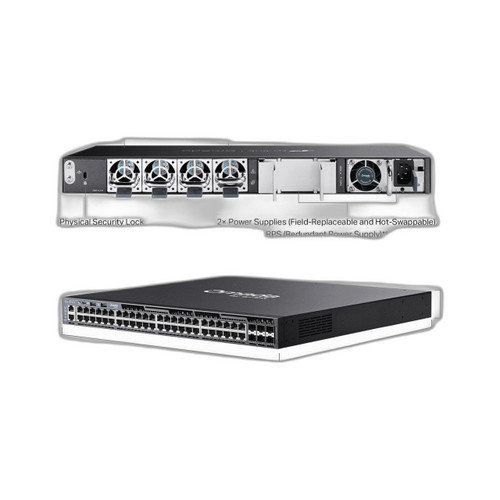
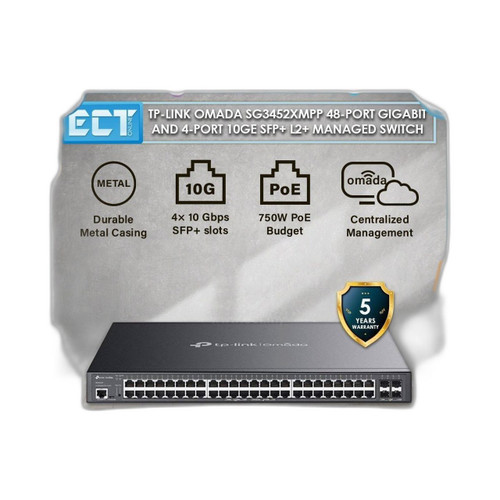
Both switches provide 48 × 10/100/1000 Mbps RJ45 PoE ports for edge devices. The SG6654XHP adds 6 × 10G SFP+ uplink slots, yielding a switching capacity of 216 Gbps. The SG3452XMPP provides 4 × 1/10GE SFP+ slots and a switching capacity of 176 Gbps with a packet forwarding rate of 130.94 Mpps — a spec not published for the SG6654XHP. The SG6654XHP's two additional 10G uplinks give it more aggregate uplink bandwidth, relevant when aggregating to a core switch in a multi-IDF deployment or when running multiple high-throughput NVR uplinks simultaneously.
What are the PoE architecture and total power budget differences?
The SG3452XMPP supports IEEE 802.3bt (PoE++), enabling up to 90W per port on 8 designated ports, with the remaining 40 ports delivering up to 30W each (802.3af/at). Its fixed PoE budget is 750W. The SG6654XHP is capped at 802.3af/at (PoE+, max 30W per port) and carries no 802.3bt support. Its PoE budget is configuration-dependent: 812W with two PSM500-AC power supplies or 1440W with two PSM900-AC units, versus the SG3452XMPP's non-expandable 750W. Installers powering 802.3bt devices such as multi-sensor panoramic cameras, Wi-Fi 6E APs, or high-power pan-tilt units must use the SG3452XMPP; the SG6654XHP cannot supply more than 30W to any single port.
How do the management tier and feature depth compare?
The SG6654XHP is a full L3 managed switch, supporting inter-VLAN routing, static and dynamic routing protocols, and advanced ACL and DoS defense features. It carries a dual-core ARM processor at 1.5 GHz, 4 GB DDR4 RAM, and 8 GB eMMC storage — a significantly more capable compute platform than the SG3452XMPP's 512 MB DRAM and 32 MB flash. The SG3452XMPP is L2+ managed, supporting Omada SDN with 802.1x, RADIUS, and TACACS+ authentication but no native inter-VLAN IP routing. Both operate standalone or under Omada controller. The SG6654XHP also lists perpetual PoE and fast PoE recovery as named features; the SG3452XMPP does not specify those capabilities. Operating temperature range differs: SG6654XHP supports −5°C to 45°C; SG3452XMPP is rated 0°C to 40°C, a narrower envelope for unconditioned IDF closets.
Which should you choose: the SG6654XHP or the SG3452XMPP?
Our take: The SG6654XHP is the stronger choice when the deployment requires inter-VLAN routing at the access layer, more than four 10G uplinks, or a wider operating temperature range down to −5°C. Concretely: it delivers 216 Gbps switching capacity versus 176 Gbps, supports up to six 10G SFP+ uplinks versus four, and scales PoE budget to 1440W with upgraded PSUs versus the SG3452XMPP's fixed 750W. However, the SG3452XMPP is the only option when any edge device demands more than 30W — its 8 × 802.3bt ports each supply up to 90W, covering high-power APs, multi-sensor cameras, and PoE++ intercoms that the SG6654XHP cannot power. Choose the SG6654XHP for routed, high-uplink-count Omada deployments; choose the SG3452XMPP for mixed PoE++ and PoE+ device populations where L2+ segmentation is sufficient.
Side-by-Side Comparison
Spec-for-spec, from manufacturer data.
| Specification | TP-Link SG6654XHP | TP-Link SG3452XMPP |
|---|---|---|
| Management Layer | L3 Managed | L2+ Managed |
| PoE Standard | 802.3af/at (PoE+, 30W max) | 802.3af/at/bt (PoE++, 90W max) |
| PoE Budget | 812W (2×PSM500-AC) / 1440W (2×PSM900-AC) | 750W (fixed) |
| High-Power PoE++ Ports | — | 8 × 90W (802.3bt) |
| Standard PoE Ports | 48 (30W max each) | 40 (30W max each) |
| Total RJ45 PoE Ports | 48 | 48 |
| SFP+ Uplink Slots | 6 × 10G SFP+ | 4 × 1/10GE SFP+ |
| Switching Capacity | 216 Gbps | 176 Gbps |
| Packet Forwarding Rate | — | 130.94 Mpps |
| Processor | Dual-core ARM 1.5 GHz | — |
| RAM | 4 GB DDR4 | 512 MB DRAM |
| Flash / Storage | 2×4 MB NOR + 8 GB eMMC | 32 MB Flash |
| Operating Temp | −5°C to 45°C | 0°C to 40°C |
| Dimensions (mm) | 440 × 420 × 44 | 440 × 330 × 44 |
| Form Factor | 1U Rack | 1U Rack |
| Omada SDN Compatible | Yes (Standalone or Controller) | Yes (Standalone or SDN) |
Frequently Asked Questions
Which should you choose: the SG6654XHP or the SG3452XMPP?
The SG6654XHP is the stronger choice when the deployment requires inter-VLAN routing at the access layer, more than four 10G uplinks, or a wider operating temperature range down to −5°C. Concretely: it delivers 216 Gbps switching capacity versus 176 Gbps, supports up to six 10G SFP+ uplinks versus four, and scales PoE budget to 1440W with upgraded PSUs versus the SG3452XMPP's fixed 750W. However, the SG3452XMPP is the only option when any edge device demands more than 30W — its 8 × 802.3bt ports each supply up to 90W, covering high-power APs, multi-sensor cameras, and PoE++ intercoms that the SG6654XHP cannot power. Choose the SG6654XHP for routed, high-uplink-count Omada deployments; choose the SG3452XMPP for mixed PoE++ and PoE+ device populations where L2+ segmentation is sufficient.
Can either switch power a 802.3bt (PoE++) device like a high-power Wi-Fi 6E access point?
Only the SG3452XMPP supports 802.3bt. It provides up to 90W on 8 designated ports, covering virtually all PoE++ devices. The SG6654XHP is limited to 802.3at (PoE+, 30W maximum) and cannot power 802.3bt devices regardless of power supply configuration.
Do I need a separate router if I use these switches for multiple VLANs?
With the SG6654XHP (L3 managed), inter-VLAN routing is handled on the switch itself — no separate router is required for VLAN-to-VLAN traffic. The SG3452XMPP is L2+ only; a separate L3 device (router or core switch) is needed to route between VLANs.
Can the PoE budget on either switch be expanded after purchase?
The SG6654XHP's PoE budget is determined by which PSU modules are installed: 812W with two PSM500-AC units or 1440W with two PSM900-AC units, so budget can be increased by upgrading the power supplies. The SG3452XMPP has a fixed 750W PoE budget with no published expansion option.
More Network Switch Comparisons
- TP-Link SG6654XHP vs Ubiquiti USW-PRO-MAX-48
- TP-Link SG6654XHP vs Ubiquiti USW-PRO-48
- TP-Link SG6654XHP vs TP-Link SG3452XP
- TP-Link SG3452XMPP vs Ubiquiti USW-48
- TP-Link SG3452XMPP vs Ubiquiti USW-PRO-MAX-48
- TP-Link SG3452XMPP vs Ubiquiti USW-PRO-48
Network Switch Buying Guides
Get a Second Opinion on Your Camera Choice
Share your site layout, coverage goals, and budget. Our team will validate the camera selection, flag anything we would change, and recommend products that match the use case.