
TP-Link SG3452XMPP vs Ubiquiti USW-PRO-MAX-48: Specification Comparison
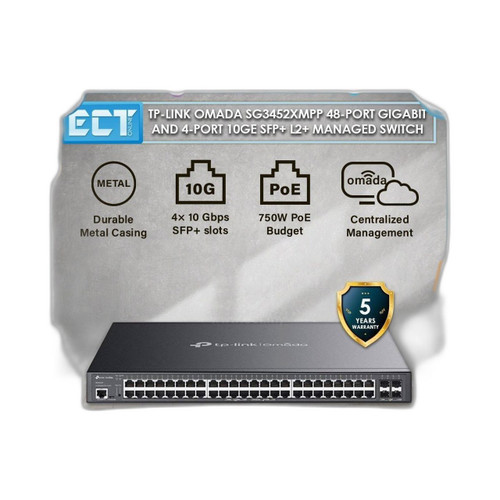
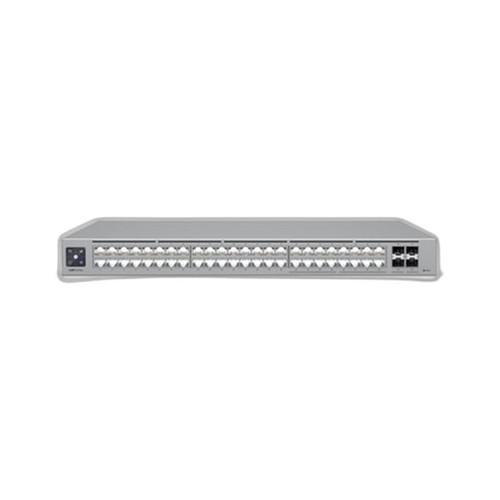
The TP-Link SG3452XMPP and Ubiquiti USW-PRO-MAX-48 are both 1U rackmount, L2+ managed 48-port switches targeting enterprise LAN and physical-security deployments. The key differentiator in this class comparison is PoE delivery: the SG3452XMPP is a PoE++ switch with a 750 W budget, while the USW-PRO-MAX-48 carries no PoE capability per its provided specifications. Buyers cross-shopping these models are choosing between powered-edge switching for cameras and APs versus a high-fabric, mixed-speed aggregation switch.
In This Guide
- How do port mix, switching fabric, and forwarding capacity compare?
- Which switch can power edge devices, and what are the real power budget constraints?
- How do management ecosystem, VLAN scale, environmental ratings, and compliance differ?
- Which should you choose: the SG3452XMPP or the USW-PRO-MAX-48?
- Side-by-Side Specs
- FAQ
How do port mix, switching fabric, and forwarding capacity compare?
The SG3452XMPP provides 48×1G RJ45 ports plus 4×1/10GE SFP+ uplinks, yielding a 176 Gbps switching capacity and a 130.94 Mpps packet forwarding rate. The USW-PRO-MAX-48 offers a mixed-speed access tier of 32×1G and 16×2.5G copper ports plus 4×10G SFP+ uplinks, with a 224 Gbps switching capacity and a 167 Mpps forwarding rate.
For pure gigabit-edge deployments — IP cameras, VoIP phones, thin clients — the TP-Link's 48 uniform 1G ports keep cabling and VLAN design simple. The Ubiquiti's 16 native 2.5G ports offer a meaningful throughput step-up for Wi-Fi 6/6E APs, workstations, or NVRs that have multi-gig NICs, without requiring a full 10G infrastructure investment. Neither unit's spec sheet discloses jumbo-frame size limits or buffer depth.
Which switch can power edge devices, and what are the real power budget constraints?
The SG3452XMPP supports IEEE 802.3af/at/bt (PoE/PoE+/PoE++) across all 48 copper ports. The spec sheet identifies 8 ports capable of 90 W per port (802.3bt) and 40 ports at 30 W per port (802.3at), with a total PoE budget of 750 W. Typical system power consumption is stated at 90 W.
The USW-PRO-MAX-48 spec set provided does not list any PoE standard compliance, per-port PoE wattage, or aggregate PoE budget. Its 100 W power supply is consistent with a non-PoE switch. A buyer who needs to power IP cameras, access control readers, or wireless APs from the switch itself cannot rely on the USW-PRO-MAX-48 based on available specifications; a separate PoE injector or mid-span would be required.
How do management ecosystem, VLAN scale, environmental ratings, and compliance differ?
The SG3452XMPP operates in standalone mode or under TP-Link's Omada SDN platform, supporting centralized configuration, monitoring, and zero-touch provisioning across Omada-family switches, APs, and gateways. Security features listed include 802.1X port authentication and RADIUS/TACACS+ support. Flash memory is 32 MB; DRAM is 512 MB. The spec sheet does not state a maximum VLAN count or NDAA compliance status. Operating temperature is 0 °C to 40 °C.
The USW-PRO-MAX-48 is managed under Ubiquiti's UniFi controller ecosystem and supports up to 1,000 VLANs per specification. It carries an SGCC steel enclosure, weighs 4.8 kg without brackets, and is rated for -5 °C to 40 °C — a 5-degree cold-side advantage over the TP-Link. It is listed as NDAA-compliant and holds CE, FCC, IC, and Anatel certifications. The SG3452XMPP's certifications are not listed in the provided specs.
Which should you choose: the SG3452XMPP or the USW-PRO-MAX-48?
Our take: The SG3452XMPP is the stronger choice when the deployment requires in-switch PoE power delivery — it provides a 750 W aggregate PoE budget with 802.3bt support on 8 ports at up to 90 W each and 802.3at on the remaining 40, while the USW-PRO-MAX-48 lists no PoE capability in its provided specifications. However, the USW-PRO-MAX-48 leads on switching fabric (224 Gbps vs. 176 Gbps), forwarding rate (167 Mpps vs. 130.94 Mpps), and port flexibility (16 native 2.5G ports vs. uniform 1G copper). It also extends the cold-side operating range to -5 °C and carries NDAA compliance — relevant for federally funded projects. Choose the SG3452XMPP for powered-edge physical-security builds on the Omada platform; choose the USW-PRO-MAX-48 for non-PoE aggregation or mixed-speed enterprise LAN deployments within the UniFi ecosystem where NDAA compliance or multi-gig access tiers are requirements.
Side-by-Side Comparison
Spec-for-spec, from manufacturer data.
| Specification | TP-Link SG3452XMPP | Ubiquiti USW-PRO-MAX-48 |
|---|---|---|
| Product Type | L2+ Managed Switch | L2+ Managed Switch |
| Form Factor | 1U Rackmount | 1U Rackmount |
| Dimensions (mm) | 440 × 330 × 44 | 442 × 325 × 44 |
| Copper Ports | 48 × 1G RJ45 | 32 × 1G + 16 × 2.5G |
| Uplink Ports | 4 × 1/10GE SFP+ | 4 × 10G SFP+ |
| Switching Capacity | 176 Gbps | 224 Gbps |
| Forwarding Rate | 130.94 Mpps | 167 Mpps |
| PoE Standard | 802.3af/at/bt (PoE++) | — |
| PoE Budget | 750 W | — |
| Max Per-Port PoE | 90 W (8 ports, 802.3bt) | — |
| Power Consumption | 90 W typical | 100 W typical |
| Power Input | 100–240 V AC, 50/60 Hz | 100–240 V AC |
| VLAN Support | — | 1,000 |
| Operating Temp | 0 °C to 40 °C | -5 °C to 40 °C |
| NDAA Compliant | — | Yes |
| Management Platform | Standalone / Omada SDN | UniFi Controller |
Frequently Asked Questions
Which should you choose: the SG3452XMPP or the USW-PRO-MAX-48?
The SG3452XMPP is the stronger choice when the deployment requires in-switch PoE power delivery — it provides a 750 W aggregate PoE budget with 802.3bt support on 8 ports at up to 90 W each and 802.3at on the remaining 40, while the USW-PRO-MAX-48 lists no PoE capability in its provided specifications. However, the USW-PRO-MAX-48 leads on switching fabric (224 Gbps vs. 176 Gbps), forwarding rate (167 Mpps vs. 130.94 Mpps), and port flexibility (16 native 2.5G ports vs. uniform 1G copper). It also extends the cold-side operating range to -5 °C and carries NDAA compliance — relevant for federally funded projects. Choose the SG3452XMPP for powered-edge physical-security builds on the Omada platform; choose the USW-PRO-MAX-48 for non-PoE aggregation or mixed-speed enterprise LAN deployments within the UniFi ecosystem where NDAA compliance or multi-gig access tiers are requirements.
Can either switch power IP cameras and access control readers directly without external injectors?
Only the SG3452XMPP provides PoE, with a 750 W budget and 802.3bt/at/af support across all 48 copper ports. The USW-PRO-MAX-48 does not list any PoE capability in its provided specifications, so external PoE injectors or a separate PoE switch would be required for powered endpoints.
Is the USW-PRO-MAX-48 or SG3452XMPP better for a deployment requiring NDAA compliance?
The USW-PRO-MAX-48 is explicitly listed as NDAA-compliant in its specifications. The SG3452XMPP's provided spec sheet does not include an NDAA compliance statement, so compliance status for that model cannot be confirmed from available data.
Which switch supports more VLANs for segmenting cameras, IoT, and corporate traffic?
The USW-PRO-MAX-48 specifies support for up to 1,000 VLANs. The SG3452XMPP's provided specifications do not state a maximum VLAN count, so a direct numerical comparison cannot be made from the available data.
More Network Switch Comparisons
- TP-Link SG6654XHP vs Ubiquiti USW-PRO-MAX-48
- TP-Link SG6654XHP vs Ubiquiti USW-PRO-48
- TP-Link SG6654XHP vs TP-Link SG3452XMPP
- TP-Link SG6654XHP vs TP-Link SG3452XP
- TP-Link SG3452XMPP vs Ubiquiti USW-48
- TP-Link SG3452XMPP vs Ubiquiti USW-PRO-48
Network Switch Buying Guides
Get a Second Opinion on Your Camera Choice
Share your site layout, coverage goals, and budget. Our team will validate the camera selection, flag anything we would change, and recommend products that match the use case.