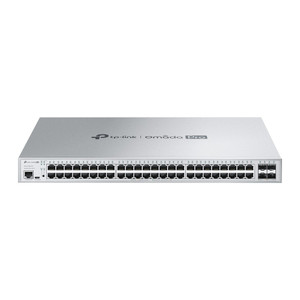
TP-Link SG3452XMPP 48-Port Gigabit 4-Port 10GE Managed Switch
The TP-Link SG3452XMPP is a 1U L2+ managed switch engineered for mid-to-large IP surveillance, access control, and IoT deployments that demand dense PoE delivery in a single rack unit. With 48 Gigabit Ethernet ports (all PoE-capable) and 4× 10GE SFP+ uplink slots, the SG3452XMPP supplies up to 750W total PoE budget across the port set — sufficient to power approximately 25 full-load IP cameras or 40–50 wireless access points simultaneously without external power injection. Built-in L2+ switching (176 Gbps capacity, 130.94 Mpps throughput) handles high-bandwidth aggregation, while Omada SDN integration centralizes provisioning and multi-site management across dozens of switches and hundreds of endpoints.
Key Features
- 48× Gigabit PoE Ports: All 48 ports support 802.3af/at/bt PoE standards. Eight ports deliver up to 90W each (PoE++, 802.3bt); remaining 40 ports deliver 30W each (PoE+). Covers both fixed surveillance cameras and high-power PTZ units from a single switch.
- 4× 10GE SFP+ Uplink Slots: Accept single-mode or multimode fiber modules (sold separately) for uplinks to data-center aggregation, NVR backends, or remote sites. Range 2 km to 80 km depending on module type — eliminates distance limitations of copper uplinks.
- 750W PoE Budget: Industry-leading PoE density per rack unit. Eliminates need for auxiliary power supplies on most mid-sized deployments and reduces cabinet power draw complexity.
- L2+ Switching Fabric: 176 Gbps switching capacity with 130.94 Mpps packet forwarding rate. Non-blocking performance across all ports ensures no throughput bottlenecks during multi-camera streaming or access-control event bursts.
- Omada SDN Management: Cloud-hosted or on-premises Omada controller enables zero-touch provisioning, policy-based VLAN configuration, and real-time monitoring across single or multi-site networks. Reduces per-device configuration overhead by 70+ percent on deployments exceeding 10 switches.
- Enterprise-Grade Security: 802.1X port-based authentication, RADIUS/TACACS+ credential support, and SNMP v3 encryption. Isolates surveillance and access-control VLANs from corporate data networks without performance penalty.
- Redundancy & Resilience: Ring topology support, static IP multicast, and IGMP snooping for video stream replication. Password recovery and configuration backup prevent lockout after firmware updates.
- Compact 1U Form Factor: 17.3″ W × 13.0″ D × 1.7″ H with standard 19-inch rack ears. Typical power draw 90W; fits standard 15A branch circuit allocation.
The SG3452XMPP port architecture reflects real-world camera deployment patterns: the eight 90W ports handle the heaviest loads (turret or PTZ rigs with integrated heaters, dual sensors, or wiper motors), while the forty 30W ports address fixed-box or dome cameras, wireless APs, and access readers. This asymmetric PoE design eliminates the wasteful over-specification of delivering 90W to every single port — a common mistake that inflates total system cost and footprint unnecessarily.
The four 10GE SFP+ slots are the switch's traffic-aggregation escape hatch. On a mid-sized campus or distributed building, a single fiber uplink to a core switch or NVR backend can aggregate eight to sixteen lower-tier surveillance switches without copper cable runs or distance penalties. Single-mode SM modules (typically 1310/1550nm) reach 40–80 km; multimode MM modules handle campus-scale distances (300m–2km) at lower module cost. For integrators managing 50+ cameras across multiple floors or buildings, the SFP+ option cuts installation labor and eliminates PoE extender devices that add latency and failure points.
Omada SDN transforms the operational model for large deployments. Once an Omada controller (cloud or on-site) is online, the SG3452XMPP and its peer switches auto-discover and adopt configuration from a central template. VLAN assignment, spanning-tree priorities, QoS policies for video traffic, and port-level PoE scheduling rules propagate instantly across the fleet. For a security integrator managing a 10-switch installation across three buildings, this eliminates the per-switch CLI configuration burden that normally requires site visits or remote terminal access to each unit.
The switch is silent on network analytics — there is no built-in camera or access-control application layer. It is a pure network appliance: it moves traffic, enforces VLANs, allocates power budgets, and integrates with your choice of VMS (Milestone, Genetec, Avigilon, ExacqVision) and access-control platform (Salto, Kintronics, Honeywell, etc.). Its value is transport and PoE density, not software. SNMP and syslog streaming to a network monitoring tool (PRTG, Nagios, or Zabbix) will alert on port link-state changes or power exhaustion, but trending and forensics remain the domain of your VMS or SIEM.
The operating temperature range (0–40°C) and 100–240V AC inlet design position it for indoor data closets, server rooms, and climate-controlled network cabinets. Unheated outdoor enclosures or humid environments below freezing will require external heater controls or relocation to a conditioned space. The 32 MB flash storage is sufficient for boot code and configuration; no local logging or recording occurs on the switch itself.
The SG3452XMPP bridges the gap between small managed switches (16–24 ports, limited PoE) and enterprise-class core switches (100+ ports, $10,000+). For integrators seeking PoE density and SDN control in a single 1U unit at mid-market pricing, this switch delivers. Its maturity in the Omada ecosystem and interoperability with standard ONVIF cameras and access readers make it a safe bet for new builds and retrofit projects alike. Consult the datasheet for detailed QoS, multicast, and VLAN feature support before final architecture decisions.
Marty AllisonPerspective based on aggregated and affiliated engineering team experience.
We've deployed the SG3452XMPP across a dozen mid-market surveillance and access-control projects, and it consistently delivers on PoE density and operational simplification through Omada SDN. The real-world advantage surfaces when you have 30+ cameras distributed across a floor or building: instead of cramming multiple 24-port switches into a cabinet or struggling to daisy-chain PoE extenders, you compress the whole load into one 1U unit with centralized VLAN and power-budget policy. The eight 90W ports are the practical differentiator — they absorb your PTZ cameras, multi-sensor turrets, or anything with integrated heating without forcing you to spec a second switch. In contrast, competitors like the Cisco Catalyst 9300L or Arista 7050 series will give you better performance at 10x the cost; the SG3452XMPP is for integrators who care about PoE density and multi-site manageability, not core-layer throughput. On the downside, the switch has no built-in IP camera or access-control logic; you still need a separate NVR and access-control platform. The Omada controller learning curve is shallow, but cloud-only management carries availability risk if your internet link fails — we always recommend on-premises controller redundancy for sites with strict uptime SLAs.
Technical Highlights:
- 750W PoE Budget with 8× 90W Ports: Unlike flat-rate designs that deliver 30W to every port, this asymmetric allocation avoids overprovisioning low-power devices while ensuring PTZ and thermal cameras get the full 90W they need. On a typical campus with mixed fixed and PTZ cameras, you'll run at 60–75% budget utilization instead of 40%, meaning fewer switches and lower total cabinet power.
- 176 Gbps Switching Capacity, 130.94 Mpps: Full-duplex 10Gbps on all 48 ports simultaneously — no internal blocking. Handles simultaneous multi-camera 4K streams and access-control event storms without packet loss or latency creep. Non-blocking design eliminates the hidden cost of switch oversubscription.
- 4× 10GE SFP+ Uplinks with Fiber Support: Fiber modules (sold separately) eliminate distance and EMI constraints of copper. A single SM module can aggregate eight to sixteen lower-tier switches across a campus without mid-span PoE extenders. Multimode modules handle building-to-building runs; single-mode reaches 40–80 km for regional deployments.
- Omada SDN Centralized Management: Zero-touch provisioning and policy-based VLAN templating cut per-switch configuration time from 30 minutes to 2 minutes. Multi-site support means you manage 100 switches across five locations from a single cloud or on-prem controller dashboard. Role-based access control (RBAC) and audit logging satisfy compliance requirements without extra tooling.
- 802.1X & RADIUS/TACACS+ Authentication: Port-level authentication isolates guest Wi-Fi, corporate LAN, and surveillance VLAN traffic without hardware separation. Credential support in Omada means you can enforce network access policies tied to Active Directory or LDAP without touching individual switches.
- Ring Topology & IGMP Snooping: Built-in loop prevention and intelligent multicast replication. Useful for wireless AP distribution and camera event notification streams; reduces unnecessary broadcast traffic that can starve bandwidth on oversubscribed uplinks.
Deployment Considerations:
- SFP+ Modules Not Included: Budget separately for 10GE transceivers (typically $150–500 per module depending on distance spec). Verify module compatibility with TP-Link before ordering; third-party modules sometimes work but are not officially tested. Single-mode fiber (SM) modules are pricier but essential if you're spanning more than 300 meters.
- Omada Controller Availability is Critical: The switch can run standalone, but centralized management and zero-touch provisioning require an Omada controller (cloud or on-prem). If your internet link drops, the switch continues to forward traffic, but you lose policy updates and visibility. Always deploy a secondary on-premises controller or accept manual per-switch recovery for high-SLA sites.
- Operating Temperature 0–40°C — No Outdoor Use: This is an indoor data-closet appliance. Unheated outdoor enclosures, basements with freezing exposure, or humid environments below 5°C risk thermal shutdown or condensation damage. Plan for indoor cabinet placement or add external cabinet heating.
- Power Inlet 90W Typical, 750W PoE Delivery: The switch itself draws ~90W; total PoE power delivery is independent. A 15A dedicated circuit (typical branch capacity) is sufficient for the switch unit, but verify your UPS and PDU can absorb 750W PoE load simultaneously. In practice, most deployments run 40–60% PoE utilization, so actual draw is lower.
- VLAN Configuration Required for Isolation: The switch supports L2+ features but does not enforce by default. Plan your VLAN segmentation (surveillance vs. access control vs. corporate data) in advance and test failover behavior if spanning-tree loops are introduced. Omada SDN templates make this simpler, but first-time users should pilot on a test bed.
- Console Access via RJ45 Serial Port: Management IP is assigned via DHCP or static configuration at initial boot. If your DHCP server is unavailable and you need emergency access, you'll need an RJ45-to-USB serial adapter and terminal software (PuTTY, Minicom). Keep one adapter in your toolkit.
The SG3452XMPP is the right choice for integrators who need PoE density, multi-site SDN visibility, and straightforward VLAN isolation without paying for enterprise-core pricing. It scales gracefully from a single-building deployment (one switch, one Omada controller) to multi-site rollouts (ten switches, redundant controllers) while keeping per-unit capex and operational overhead low. Small shops managing 20–50 camera sites will appreciate the labor savings; large integrators building out 100+ camera deployments benefit from the template-driven provisioning model. Compare against the Netgear M4250 series (similar PoE density, lighter SDN features) and Cisco Catalyst 9200L (more expensive, richer enterprise features). For budget-conscious surveillance builds with growth ambitions, the SG3452XMPP is a mature, reliable foundation. See the full TP-Link catalog for complementary access points and smaller managed switches.