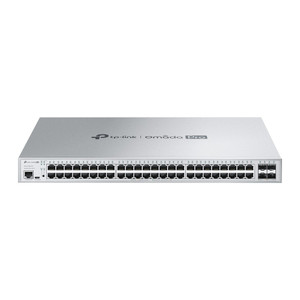
TP-Link SG3452XP 48-Port Gigabit and 4-Port 10GE Managed Switch
The TP-Link SG3452XP is a 1U rackmount L2+ managed access switch designed for enterprise campuses, multi-building IP surveillance, and dense wireless deployments. With 48 Gigabit PoE+ ports, 4× 10 Gbps SFP+ uplinks, and 500W PoE power budget (30W per port), it consolidates power delivery and network switching for dozens of IP cameras, access points, and networked devices without requiring auxiliary injectors or daisy-chained infrastructure. The 176 Gbps switching fabric and 130.94 Mpps forwarding rate sustain simultaneous 4K video streams and high-density VoIP traffic without congestion or frame loss.
Key Features
- 48× Gigabit PoE+ Ports: 802.3af/at dual-standard (up to 30W per port). Perpetual PoE mode maintains power on reboot; fast PoE mode accelerates device discovery—both modes are user-selectable per port.
- 4× 10 Gbps SFP+ Uplinks: Fiber-ready backbone connectivity. Supports single-mode (64m+ backbone distances) and multi-mode modules—swap modules to match your inter-building fiber plant without replacing hardware.
- 500W Total PoE Budget: Simultaneous power delivery across all 48 ports at rated maximums. Real-world budgeting: 16× 30W PoE cameras + 12× 20W APs + 20× 5W phones all powered from a single device.
- 176 Gbps Switching Capacity, 130.94 Mpps: Non-blocking forwarding ensures no bottleneck between PoE endpoints and uplinks. Handles sustained multi-stream video (16+ 4K cameras) plus converged voice/data traffic.
- L2+ Managed with Omada Central: Cloud-based (Omada Central) or on-premises controller deployment. Centralized VLAN, QoS, and PoE scheduling across distributed sites. Standalone mode (web/CLI/SNMP) available for single-site deployments.
- Redundancy & Fault Isolation: ERPS ring topology, static routing, and DDM (Digital Diagnostic Monitoring) on SFP+ ports enable sub-50ms failover and port-level diagnostics without external management platform.
- 1U Rackmount Form Factor: 17.3 × 13.0 × 1.7 inches. Fits standard 19-inch rack with minimal depth footprint; operates −5°C to 45°C (requires climate-controlled IDF placement).
- 802.1X & RADIUS/TACACS+ Authentication: Port-level security for access-control integration; authenticate PoE devices before powering them up to block rogue endpoints.
Deployment Context & ROI
On a typical enterprise campus—three buildings, 60 IP cameras (mix of 3MP and 4K), 24 802.11ax APs, and 40 VoIP phones—consolidating switching and PoE from a single 48-port switch eliminates two or three smaller switches and multiple PoE injectors. Bandwidth aggregation via 10GE SFP+ fiber backbones between IDFs ensures the core sees no congestion during peak recording periods. PoE budget management (port-level power limits, scheduling) prevents brownouts when all endpoints power-cycle simultaneously after an outage. Omada Central visibility across multiple SG3452XP units simplifies troubleshooting: alerting on port overpowering, SFP+ signal degradation, and thermal stress in the IDF.
Single-mode SFP+ fiber modules support 64m+ backbone runs without active repeaters—typical for inter-building campus links. Multi-mode modules serve shorter IDF-to-patch-panel runs. DDM on fiber ports eliminates manual light-meter walks: the switch logs receive-power and temperature directly, allowing predictive maintenance before module failure. VLAN segmentation separates cameras from guest WiFi; static routing or OSPF supports multi-site failover without spanning-tree delays. QoS ensures video streams don't starve voice packets during backhaul saturation.
Power consumption maxes at 500W when all 48 ports deliver 30W simultaneously. Real-world average is 250–350W (most PoE devices draw 5–20W during operation). Deliver 100–240V AC 50/60 Hz from a dedicated UPS-backed circuit; a 15A branch is adequate for normal operation, though surge protection and grounding are mandatory in IDF environments where inductive spikes from power supplies and fiber activations can corrupt management frames.
The SG3452XP integrates natively into any ONVIF-compliant VMS (Milestone, Genetec, Avigilon, ExacqVision) via SNMP traps for port state and PoE alarms. No proprietary drivers required. Integrators using Omada On-Premises Controller can co-locate it on a virtual machine with the NVR, creating a single-pane-of-glass for network and recording health. Standalone deployment (no controller) is also supported for sites running heterogeneous VMS stacks where centralized management is not available.
Network Architecture & Edge Considerations
The SG3452XP operates at Layer 2+ (MAC switching, VLAN, static routing, QoS, ACLs). It does not route between subnets natively—for multi-subnet failover or DHCP relay, layer the switch behind a TP-Link Omada gateway or a campus edge router. The switch's SNMP engine supports read-only community strings (for NMS polling) and SNMPv3 with encryption for sensitive deployments (e.g., financial sector, healthcare). MAC address table capacity is 16K entries—sufficient for campuses up to 1,000 endpoints per switch. Larger deployments should segment VLAN domains to keep MAC learning efficient.
Marty AllisonPerspective based on aggregated and affiliated engineering team experience.
We've deployed the SG3452XP across multi-building campuses, healthcare networks, and large warehouse environments where density of IP cameras, APs, and IoT devices justifies a single converged switch. The 500W PoE budget paired with 30W-per-port headroom is the real differentiator—it eliminates the operational headache of fragmenting PoE loads across two or three smaller switches or running external injectors in parallel. On a 64-camera mixed deployment (sixteen 4K PTZs at 25W, twenty-four 2MP domes at 10W, twenty basic 1MP cubes at 5W), every watt matters. The SG3452XP lets you power everything from the edge switch, consolidating power monitoring into a single SNMP interface. Omada Central management (or on-premises controller) provides per-port PoE trending and alerting—you catch a failing camera power supply or a spike in draw before it cascades into a site outage. The 4× SFP+ uplinks are where the architecture scales: 10 Gbps fiber backbones between IDFs mean zero bottleneck even during simultaneous 4K recording and live backup across three buildings.
Technical Highlights:
- 176 Gbps Switching Capacity, 130.94 Mpps: Non-blocking fabric—every port pair can sustain line-rate traffic simultaneously. In practice, this means 16+ concurrent 4K streams inbound (each 50–100 Mbps) and parallel backbone egress to an NVR uplink without queueing delays or frame loss. Comparison: smaller 24-port switches (88 Gbps) start showing packet loss at 10–12 concurrent HD streams under stress.
- 802.3af/at Dual-Standard, Perpetual & Fast PoE Modes: Perpetual PoE keeps power live across management reboots (critical for cameras that cache footage). Fast PoE accelerates power-up negotiation, useful when provisioning hundreds of devices at once. Per-port mode selection lets you tune endpoints individually—set fast PoE for APs, perpetual for mission-critical cameras.
- 4× 10 Gbps SFP+ Fiber Slots: Single-mode modules (usually $50–150 each) enable 10+ km inter-building runs without active repeaters. Multi-mode ($30–80) handles shorter campus runs. DDM on ports logs real-time receive power and transceiver temperature—you can predict module failure 2–4 weeks in advance rather than troubleshooting in the dark.
- ERPS Ring Topology & Sub-50ms Failover: Loop-free redundancy without spanning-tree delays. Two switches connected in a ring remain active on all ports; a fiber cut triggers automatic reroute in <50ms. Critical for live video—cameras don't drop stream state and NVRs don't lose ingest during failover.
- 802.1X + RADIUS Authentication: Enforce device-level access control before PoE is delivered. Rogue camera on a dark port? RADIUS denial blocks power and logs the attempt. Integrates with most enterprise authentication servers (Windows Active Directory, Okta, Duo)—no additional gear required.
Deployment Considerations:
- Operating temperature range is −5°C to 45°C: this switch is IDF-only, not suitable for outdoor equipment cabinets or unheated server rooms in northern climates. Plan for active cooling (room AC or supplementary fans) in hot datacenters. Power budget (500W) assumes 100–240V AC input on a dedicated circuit; in sites with unstable utility power, add UPS backing or isolation transformer.
- SFP+ modules are user-swappable but not hot-pluggable in all Omada firmwares—power down before swapping fiber modules to avoid controller sync hiccups. Single-mode (9µ core) and multi-mode (50µ or 62.5µ core) modules are electrically compatible with SFP+ slots, but using the wrong type (e.g., short-range multi-mode for a 5km run) will cause intermittent link loss. Keep vendor datasheets for each module type in your spares kit.
- PoE budget is aggregate 500W: if you spec all 48 ports at 30W simultaneous draw (1,440W theoretical), you'll exceed the supply. Real-world power profiles rarely hit that ceiling—typical cameras average 8–15W, APs 15–20W. Use Omada reporting to forecast your site's actual demand before committing to 48 powered endpoints. If you need more PoE capacity, stack a second SG3452XP with fiber interconnect rather than adding smaller switches downstream (better management, fewer spares).
- Rackmount installation: 1U height, 440mm depth (17.3 inches). Ensure your rack has 19-inch EIA compliance and at least 15 inches of front-to-back clearance for cable routing. Cooling: passive ventilation is sufficient for IDF ambient 15–25°C; in crowded racks or datacenters, ensure air gap above/below the switch for convection.
- Omada Central (cloud-based management) requires outbound HTTPS from your site to TP-Link's servers—if your security policy forbids cloud connectivity, use the on-premises Omada Controller (virtual appliance, ~$500–1,000 one-time cost). Standalone mode (web/SNMP only) is also available, but you lose centralized PoE scheduling, multi-site alerting, and firmware updates—manual patching required.
The SG3452XP is the right choice for medium-to-large enterprise campuses, healthcare networks with 50+ IP devices per building, and warehouse environments where dense cabling and PoE consolidation reduce labor and capex. If your deployment is fewer than 20 IP devices total, a 24-port switch is more cost-effective. For integrators standardizing on TP-Link Omada across multiple customer sites, this switch pays for itself through operational simplification and reduced spares inventory. See the TP-Link catalog for related Omada gateways, controllers, and access points that pair with this switch.