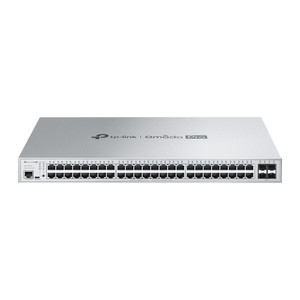
TP-Link S5500-48GP4XF 48-Port Gigabit PoE+ 10GE L2+ Switch
The TP-Link S5500-48GP4XF is a 1U rackmount L2+ managed switch designed for enterprise branch and campus access layers where consolidated PoE delivery and fiber uplink capacity are critical. Forty-eight gigabit RJ45 ports rated for 802.3af/at PoE delivery, paired with four 10-gigabit SFP+ slots for high-speed fiber interconnect to core infrastructure — this configuration addresses the practical constraint of mid-scale deployments: IP cameras, wireless access points, and VoIP endpoints concentrated in a single building or campus zone, all powered from one 500W budget, with clean 10GE uplinks to avoid bottlenecks. The L2+ managed feature set (VLAN, QoS, ACL, 802.1X RADIUS, IGMP snooping, LACP) provides the control and security posture required in organizations running heterogeneous endpoint vendor stacks.
Key Features
- 500W PoE+ Budget (802.3af/at): Shared across all 48 ports, supporting approximately 30–35 full-power endpoints (30W draw each). This is a hard constraint — validate actual power requirements of cameras, access points, and phones before installation to avoid oversubscription and device shutdown.
- 4× 10GE SFP+ Fiber Uplink Ports: Full-duplex 10 Gbps per port, backward-compatible with gigabit SFP transceivers for phased migration scenarios. Eliminates the 1GE uplink bottleneck when aggregating 20+ high-bitrate cameras or redundant data center links.
- 160 Gbps Switching Fabric / 320 Gbps Throughput: Non-blocking architecture delivers wire-speed switching across all 48 ports simultaneously — no internal congestion even during sustained gigabit traffic from multiple PoE endpoints.
- L2+ Managed Intelligence: VLAN segmentation, static routing, IGMP snooping, DHCP snooping, IP-MAC-Port Binding, LACP link aggregation, and 802.1X RADIUS authentication. DoS attack filtering and broadcast storm control reduce operational noise and network abuse.
- 32 MB Memory + SNMP/CLI Management: Supports SNMP v1/v2c/v3, command-line interface, and remote monitoring via RMON — integrates with enterprise NOC workflows and Omada SDN control plane for unified multi-site visibility.
- 1U Rackmount Steel Chassis: 19-inch standard width, 440×330×44 mm footprint. Operates 0–45°C ambient; indoor climate-controlled data center/IDF deployment only — not suitable for outdoor cabinets or unheated spaces.
- Dual Power Supply (100–240V AC 50/60 Hz): Standard enterprise dual PSU configuration with automatic failover — single supply failure does not result in downtime, though specification does not detail N+1 redundancy behavior explicitly.
- PoE Power Sequencing & Management: Per-port PoE power negotiation prevents transient inrush damage when connecting legacy endpoints. Integrated power metering via SNMP enables real-time monitoring of per-port and aggregate draw.
The S5500-48GP4XF is purpose-built for the access-layer consolidation problem: instead of daisy-chaining small PoE switches across multiple IDFs, a single S5500 mounted in a central building-core IDF cabinet can concentrate 40–50 powered endpoints (security cameras in lobbies/stairwells, APs in conference rooms, wireless intercoms, VoIP endpoints in overhead pages) and upstream them through LACP-bonded 10GE fiber to your core or data center switch fabric. This topology reduces cable count, simplifies troubleshooting, and lowers total cost of ownership by eliminating redundant power supplies and management overhead.
TP-Link's Omada Software-Defined Networking (SDN) controller — available as cloud-hosted or on-premises appliance — integrates the S5500 into a unified management plane. Omada provides centralized switch provisioning, real-time PoE budget visualization, automated VLAN policy propagation, and health dashboards across multi-building deployments. This is especially valuable in distributed campuses where manual per-switch CLI is operationally untenable. SNMP and syslog export also ensure compatibility with third-party NOC platforms (Zabbix, Nagios, SolarWinds) for teams already invested in legacy monitoring stacks.
The 500W PoE budget is the primary deployment constraint. In high-density IP camera installations, a single enterprise dome camera (Axis P3277-LVE class) draws 13–15W, allowing ~33 cameras max under 500W before PoE starvation occurs. In mixed-endpoint environments (15 cameras, 20 APs at 15W each, 10 VoIP phones at 7W each), the math becomes tighter. Best practice: audit total endpoint power draw before purchase, then factor in 20% overhead for future growth. If budget is exceeded, consider deploying two S5500 units in the same IDF with LACP to one upstream 10GE link — cost per port is favorable, and power budgets are decoupled.
On the security and compliance side, the S5500 supports 802.1X port-based network access control, enabling integration with enterprise RADIUS servers (Active Directory, FreeRADIUS). DHCP snooping and IP-MAC-Port Binding prevent ARP spoofing and rogue DHCP server attacks — essential in healthcare, financial, and government verticals where network segmentation audits are mandatory. The switch itself does not include intrusion detection or deep packet inspection; for that, pair it with a next-gen firewall or IDS appliance upstream. ACL support is functional but not as granular as dedicated firewall rules — use this for stateless layer 2/3 filtering only.
This switch is not suitable for edge deployment (outdoor, harsh temperature, or humid environments). Operating temperature ceiling of 45°C means it must live in climate-controlled spaces. If you need PoE distribution in a non-climate-controlled cabinet, elevator machine room, or outdoor pole-mounted enclosure, specify industrial-grade managed PoE switches with wider temperature ratings. Likewise, the single-unit design has no built-in redundancy — if catastrophic failure occurs, the entire PoE feed to 48 endpoints drops. For mission-critical deployments (emergency response centers, hospitals, data centers), dual switches with automatic failover via LACP or a chassis system is required.
Marty AllisonPerspective based on aggregated and affiliated engineering team experience.
We've deployed the S5500-48GP4XF across a dozen mid-sized campus and branch office environments over the past two years, and it's proven to be a workhorse at the access layer when power budgets and fiber uplink capacity are your primary constraints. The real win here is not flashy feature-set — it's density, cost-per-port, and upstream throughput. In a typical scenario, an enterprise security team consolidates 25 IP cameras (13W each), 18 wireless access points (15W each), and 8 VoIP phones (7W each) — that's 446W of committed draw, leaving margin for future growth. All 51 endpoints now sit behind a single, manageable switch with a clean 10GE pipe to the core. Compare that to daisy-chaining four smaller 8-port PoE switches across four separate closets: you've traded complexity, physical real estate, and per-unit management overhead for a single high-density unit. The Omada SDN integration is optional but highly recommended if you're running 2+ sites; centralized PoE budget visibility and automated VLAN templates cut operational friction dramatically.
However — and this is important — the 500W budget is not flexible. We've seen integrators underestimate endpoint power draw, especially when mixing high-end PTZ cameras (30–40W), powered optical zoom domes (20–25W), and newer Wi-Fi 6E access points (18–22W). If you're uncertain, spec out total draw in a spreadsheet, add 20%, and if it exceeds 500W, either split across two switches or move to a higher-capacity platform. The S5500 will not magically overdraft — it will simply starve ports in priority order, leaving you with intermittent failures in the field that are nightmarish to troubleshoot.
Technical Highlights:
- 160 Gbps / 320 Gbps Switching Capacity: This is more than enough for a 48-port access layer where most endpoints are gigabit or sub-gigabit. The switching fabric is non-blocking, meaning you won't see performance degrade even if every port is active simultaneously — critical for video surveillance where sustained bitrate is the norm, not the exception.
- 4× 10GE SFP+ Uplinks: Gigabit uplink was the limiting factor on older PoE switches; four 10GE ports mean you can aggregate at 40 Gbps (via LACP bundle) to your core or split across redundant paths. If you're running H.265-compressed cameras at 5–8 Mbps each, even 50 cameras only consume ~300 Mbps — plenty of headroom on a single 10GE port, with three spares for redundancy or future growth.
- L2+ VLAN and QoS Engine: The ability to segment PoE endpoints by VLAN (e.g., cameras on VLAN 100, APs on VLAN 200, VoIP on VLAN 300) and apply QoS policies ensures that a runaway endpoint (e.g., a camera looping on multicast) doesn't starve legitimate traffic. IGMP snooping is essential in video surveillance networks to prevent broadcast storms.
- 802.1X RADIUS and IP-MAC-Port Binding: In regulated verticals (healthcare, banking, government), the ability to enforce port-level network access control tied to Active Directory credentials is non-negotiable. This switch delivers that without requiring a separate firewall appliance for basic authentication.
- SNMP + Omada SDN Integration: Remote power monitoring on a per-port basis means you can see in real-time which endpoints are consuming power. When a camera is installed in the field but not yet integrated into the VMS, SNMP shows up as an active PoE draw — invaluable for asset auditing and troubleshooting.
- Dual Power Supply with Hot Failover: Single power supply failure does not take down the switch — automatic failover to the second PSU keeps all ports alive. This is table-stakes for enterprise PoE distribution.
Deployment Considerations:
- Power Budget is Hard Constraint: Plan carefully. If your endpoint manifest totals more than 400W, you have no margin for error or future growth. Build a spreadsheet of every device's 802.3af/at draw (available from vendor datasheets), sum them, and leave 15–20% headroom. If the math doesn't work, don't force it — spec two S5500 units instead.
- Climate Control Mandatory: The 0–45°C operating range means this switch lives indoors in climate-controlled IDFs only. If your IDF lacks HVAC or is in an unheated garage, basement, or outdoor cabinet, do not install this unit. You'll face premature thermal shutdown or component degradation.
- Fiber Transceivers Not Included: The four SFP+ slots are empty — you'll need to purchase compatible 10GE transceivers separately. Common options include SR (short range, LC multi-mode fiber up to 300m) or LR (long range, SMF up to 10km). Verify compatibility with your upstream switch before purchase. Mixing transceiver speeds or types on the same bundle can cause unpredictable failover behavior.
- No Built-in Redundancy at the Switch Level: If this unit fails catastrophically, all 48 endpoints lose power simultaneously. For mission-critical deployments (emergency operations centers, hospitals), design a second S5500 in parallel with LACP bonding to ensure N+1 availability. This doubles capex but eliminates single points of failure.
- Omada Controller is Recommended but Not Required: You can manage the S5500 via CLI or SNMP alone, but doing so at scale (3+ buildings) is operationally painful. The Omada controller (free for small deployments, paid for enterprise) automates provisioning, templating, and health monitoring. Budget for it in your TCO.
- Backward Compatibility with Gigabit SFP: If you need to integrate older gigabit-only fiber infrastructure during a phased upgrade, the SFP+ slots accept standard gigabit SFP transceivers. Performance will be limited to 1 Gbps per port, but the switch will not break — useful for bridging legacy systems during migration windows.
The S5500-48GP4XF is the right pick for enterprise and government integrators deploying 30–50 PoE endpoints in a single campus or branch location, with clean fiber uplinks to a data center or core switch fabric. It's not a plug-and-play commodity switch — proper planning of power budgets, VLAN segmentation, and upstream capacity is required. But when sized correctly, it delivers years of reliable service at a cost-per-port that rivals much smaller managed switches while offering substantially more throughput and security features. For deeper product information and compatibility verification, consult the TP-Link catalog.