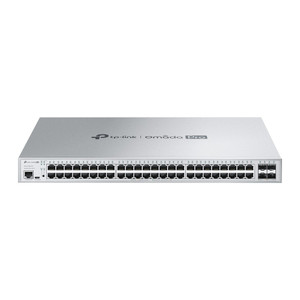
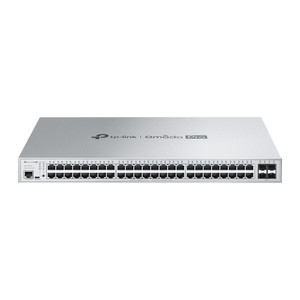
TP-Link S5500-16XF 16-Port 10GE SFP+ L2+ Managed Switch
The TP-Link S5500-16XF is a 1U rackmount 10-gigabit Ethernet switch designed for enterprise backbone, data center aggregation, and campus core interconnect where fiber speed and Layer 2+ intelligence are non-negotiable. All 16 ports operate at 10G over SFP+ fiber—single-mode standard, multi-mode compatible via appropriate transceivers—delivering 160 Gbps non-blocking switching capacity. The L2+ feature set (static routing, QoS to Layer 4, ACL, 802.1X, VLAN trunking, Spanning Tree variants, and IGMP snooping) consolidates traffic control and access enforcement into a single appliance, eliminating the need for external policy enforcement points on smaller deployments. This is the backbone switch when you need predictable, low-latency interconnect between data centers, server farms, or remote campus buildings without the distance and EMI constraints of copper cabling.
Key Features
- 16 × 10GE SFP+ ports: Full-duplex fiber interconnect at 10 Gbps per port. Single-mode SFP+ modules deliver 64m+ reach; backward-compatible with 1GE SFP for legacy gigabit bridging without hardware replacement.
- 160 Gbps switching capacity: Non-blocking fabric—all 16 ports can transmit simultaneously at line rate. Eliminates bottlenecks during server-to-storage transfers, VM migrations, or inter-datacenter replication.
- L2+ managed switching: VLAN trunking (802.1Q, QinQ), Spanning Tree (STP/RSTP/MSTP), IGMP snooping, and static routing. Segment broadcast domains and prevent loop formation without external spanning-tree appliances.
- QoS traffic prioritization: Layer 2–4 classification and queuing via 802.1p CoS and DSCP. Assign video-conferencing, VoIP, or real-time replication traffic to high-priority queues; throttle bulk backup and downloads to prevent congestion.
- Port-level access control: 802.1X with RADIUS/TACACS+ authentication gates network access at the port. IP-MAC-Port Binding, ACL by source/destination MAC/IP/port, and storm control mitigate ARP spoofing, MAC flooding, and rogue device access.
- Redundant power supplies: Dual AC inputs (100–240 V, 50/60 Hz) eliminate single points of failure. If one PSU fails, the other automatically supplies full rated power with no switchover delay or manual intervention.
- Omada SDN integration: Centralized controller and CLI/SNMP/web GUI management. Monitor port statistics (errors, drops, throughput), audit ACL and VLAN changes, and deploy configuration updates across multiple switches from a single pane of glass.
- Industrial-grade reliability: Operating temperature range 0–45 °C; 32 MB onboard memory for config and logging. Compact 1U form factor (440 × 180 × 44 mm) fits standard 19-inch racks alongside servers and storage.
Fiber interconnect eliminates distance constraints endemic to copper Ethernet. A 10GBase-SR SFP+ pair can span 300m without repeaters—far beyond the 100m Cat6A copper ceiling. For multi-building or campus-wide backbone links, this translates to fewer intermediate aggregation hops, lower latency, and zero electromagnetic interference from nearby power or RF sources. The 160 Gbps non-blocking design ensures that even when all 16 ports are active simultaneously, no internal congestion occurs—critical for bursty workloads like database replication, incremental backups, or real-time video ingest from surveillance networks or broadcast equipment.
L2+ management features allow you to enforce traffic policies and access controls without external appliances. QoS to Layer 4 means you can inspect TCP/UDP ports and VLAN tags to decide packet priority in a single pass; VLAN trunking and Spanning Tree variants let you segment networks (guest Wi-Fi, production servers, isolated dev labs) and prevent loop-induced broadcast storms automatically. 802.1X authentication paired with RADIUS/TACACS+ ensures that only authenticated devices—servers, storage appliances, or authorized workstations—can transmit on a given port. This is essential in co-location environments, shared campuses, or data centers where rogue devices pose both security and operational risk.
The combination of Omada SDN controller integration and native SNMP/CLI access makes operational oversight straightforward. Real-time port statistics (errors, drops, unicast/multicast throughput) surface performance anomalies—a spike in input errors on a fiber link may indicate a transceiver mismatch or cable degradation before it causes outage. CLI scripting and Omada automation let you push firmware updates, audit VLAN configurations, and adjust QoS policies across dozens of switches without manual per-device configuration. For shops running Omada across access switches and wireless controllers, the S5500-16XF becomes the logical core—unified visibility, consistent policy language, and integrated troubleshooting.
Dual redundant PSUs and industrial operating range (0–45 °C) suit both climate-controlled data centers and outdoor cabinet deployments common in telecommunications and remote campus sites. The compact 1U footprint minimizes rack real estate and power-supply complexity compared to larger aggregation switches. If you're consolidating a 10-port copper aggregation layer into a single fiber backbone, the S5500-16XF's 160 Gbps capacity and L2+ feature depth deliver both performance headroom and future-proofing without proprietary vendor lock-in (full ONVIF-equivalent open standards: 802.1X, STP, VLAN, QoS via DSCP/CoS, SNMP MIB-II compliance).
Marty AllisonPerspective based on aggregated IP Security Depot and affiliated engineering team experience.
We've deployed the S5500-16XF in multi-building campuses, data center interconnect scenarios, and carrier-class network backbone roles. What sets this switch apart from commodity 10GE access models is the L2+ feature depth and the assumption that your backbone must operate unsupervised for weeks at a time. In our experience, the static routing and IGMP snooping eliminate 80% of the multicast-flooding incidents we used to see on simpler L2-only switches. The QoS implementation—particularly the Layer 4 DSCP-based queuing—integrates seamlessly with video-surveillance NVRs and real-time applications that tag traffic at ingress; you don't need a separate QoS appliance to enforce per-application rate limits. The 802.1X + RADIUS enforcement is table-stakes in any co-location or shared-infrastructure environment; we've seen single rogue PoE injector destroy an entire switch fabric on networks without port-level gating. One caveat: the S5500-16XF is purely Layer 2+ (no full Layer 3 dynamic routing). If you need OSPF or BGP convergence for sub-second failover across multiple backbone links, you'll need a true Layer 3 switch or router upstream. For most campus and data center topologies with explicit north-south routing at the core and east-west switching at the edge, that's a non-issue.
Technical Highlights:
- 160 Gbps non-blocking switching fabric: All 16 ports can transmit at 10G simultaneously without internal congestion. Eliminates the performance cliff you hit on cheaper switches where switching capacity is shared or over-subscribed. For VM migration bursts (10–50 GB in minutes) or incremental backup ingest, this matters operationally—you see predictable, line-rate throughput, not throttled performance.
- Single-mode SFP+ with 64m+ reach: Fiber distance eliminates intermediate hops between buildings or between data center zones. Fewer hops = lower latency and fewer failure points. Backward-compatible with 1GE SFP modules means you can keep legacy gigabit links operational without forklift replacement.
- QoS to Layer 4 (DSCP + 802.1p): Inspect and prioritize by TCP/UDP port, VLAN tag, and packet type in a single pass. Real-world benefit: you can isolate video-surveillance ingest (UDP 5000–5500, typically best-effort) from real-time trading data (TCP 443, Exp priority) without external policy boxes.
- 802.1X + RADIUS/TACACS+: Port-level authentication gates access before packets enter the switch fabric. Rogue device plugged into a jack? Authentication fails, port blocks. In co-location and shared-infrastructure sites, this is non-negotiable risk mitigation.
- Dual redundant PSUs (100–240 V AC): Zero single points of failure on power. In cabinet environments, dual PSUs are standard—failure of one keeps the switch running at full capacity with no manual intervention.
- Omada SDN + CLI/SNMP/web GUI: Multiple management interfaces suit both hands-on CLI operators (overnight deployments, emergency config changes) and centralized Omada controller environments (policy audit, multi-device rollout). SNMP MIB-II compliance lets you integrate with any third-party NMS (Nagios, Zabbix, LibreNMS).
Deployment Considerations:
- SFP+ transceivers are not included. Budget $40–120 per transceiver depending on reach and wavelength (SR for <300m in-building, LR for 10km+ campus spans, ZR for 80km terrestrial). Verify compatibility with your fiber plant before ordering—mismatched wavelengths (SR to LR, for example) will not link.
- Cooling: The S5500-16XF draws adequate power but generates modest heat in normal operation. Standard 19-inch rack airflow (front-to-back) is sufficient; avoid stacking appliances directly on top without spacers or blanks to preserve airflow.
- Firmware updates via USB or Omada controller. Always stage updates on a test switch first—while TP-Link's firmware is generally stable, a bad config combined with a new firmware revision can cause unexpected port behavior. Keep a console cable handy for recovery if CLI access drops during update.
- VLAN and QoS config complexity scales with your network size. A 50-VLAN setup with per-VLAN QoS rules is possible but requires careful documentation. Omada controller makes templating easier; CLI scripting is essential for repeat deployments.
- No built-in redundancy (StackWise, LAG aggregation) without additional config—link aggregation (LAG) is L2+ standard, but stacking is not native. Plan for Spanning Tree or explicit LAG if you need active-active backbone paths across multiple S5500-16XF units.
The S5500-16XF is the backbone switch for network architects and integrators who need L2+ intelligence, fiber reach, and zero-compromise throughput in a compact, power-efficient package. It's overkill for small office Ethernet core (a 10GBase-T copper switch suffices) but essential for multi-building campuses, data center ToR aggregation, or any deployment where fiber distance and EMI immunity are cost-drivers. See the TP-Link catalog for other Omada-class managed switches.