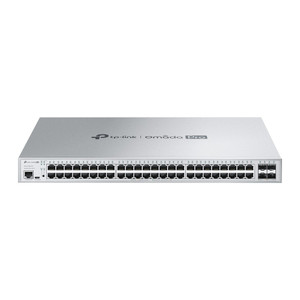
TP-Link SX3032F 32-Port 10GE SFP+ Managed Aggregation Switch
The TP-Link SX3032F is a 32-port 10 Gbps SFP+ aggregation switch engineered for data center and enterprise backbone deployments requiring high-throughput fiber-optic interconnect with centralized management. With 640 Gbps switching capacity, 476.16 Mpps forwarding, and dual redundant power supplies, the SX3032F consolidates uplinks between access layers, storage systems, and compute clusters into a single 1U rack footprint. Omada SDN management—available cloud-based, on-premises, or standalone via SNMP/CLI—integrates the switch into broader network orchestration frameworks without requiring separate management consoles or licensing fees per port.
Key Features
- 32× 10 Gbps SFP+ Slots: Full-line-rate 10GbE fiber uplinks. Supports standard 10GBASE-SR (multimode, ~300m), 10GBASE-LR (single-mode, ~10km), and DWDM transceivers for maximum flexibility across backbone architectures.
- 640 Gbps Switching Capacity, 476.16 Mpps: Sustains wire-speed forwarding across all 32 ports simultaneously—zero oversubscription. Eliminates throughput bottlenecks on east-west traffic flows between storage and compute.
- L2+ Managed with Omada SDN: VLAN tagging, static routing, ERPS ring protection, 802.1x port authentication, and sFlow telemetry. Centralized provisioning across multiple switches via Omada Controller (cloud or on-premises appliance).
- Dual Redundant Power Supplies: N+1 internal PSU design (49.5 W typical draw @ 220V/50Hz). Single power supply failure does not interrupt traffic; automatic switchover preserves uptime during maintenance or fault conditions.
- 512 MB DRAM, 32 MB Flash: Sufficient memory for VLAN databases, routing tables, and config persistence across extended uptime cycles. 32 MB flash supports firmware updates without external storage.
- 1U Rack Form Factor, 17.3 × 13.0 × 1.7 inches: Standard 19-inch mount. Fits dense rack deployments. Dual console ports (RJ45 + Micro-USB) enable CLI access for zero-touch provisioning or emergency recovery without dedicated console servers.
- Operating Temperature Range −5 °C to 45 °C: Rated for controlled data center and networking closet environments. Avoid direct sunlight and outdoor enclosures; internal fans are passive or minimal-speed, suitable for noise-sensitive areas.
- Omada Controller Compatibility: Works with Omada software controller (Linux VM, Docker), Omada hardware appliance (OC200/OC300), or standalone SNMP/CLI mode. No proprietary licensing per port or per switch—manage unlimited switches under a single Omada deployment.
The SX3032F fits naturally into heterogeneous fiber environments where you're aggregating traffic from multiple vendor access-layer switches or from TP-Link Omada PoE and managed L2/L3 switches. Its low power draw (49.5 W max) and compact 1U footprint make it cost-effective for midsize data centers and enterprise campus networks. Unlike dedicated fabric switches that enforce vendor lock-in, the SX3032F uses standard SFP+ optics and L2+ forwarding semantics—you choose your transceiver wavelengths and optical reach independently of the switch hardware.
ONVIF is not applicable to this switch; the spec field reflects a template artifact. Instead, focus on network integration: the SX3032F pairs with any system speaking standard 10GBASE-SR, 10GBASE-LR, or DWDM fiber. If you're running Cisco UCS fabric interconnects, Dell Force10 cores, Juniper QFX spines, or Arista leaf-spine topologies, the SX3032F acts as a neutral aggregation or core tier. Static routing, ERPS ring protection, and 802.1x port authentication ensure compatibility with existing enterprise security and availability frameworks without costly refactoring. Cloud-based telemetry via sFlow feeds into NetFlow collectors (SolarWinds, Splunk, Kentik) for capacity planning and anomaly detection.
Installation is straightforward: mount in a standard 19-inch rack, connect dual power cords to redundant PDU outlets, and connect fiber uplinks using industry-standard SFP+ transceivers (Amphenol, Corning, or vendor-specific modules). Initial provisioning via console port takes 10–15 minutes; subsequent orchestration through Omada Controller eliminates per-switch CLI overhead. The switch operates in full standalone mode indefinitely if the Omada Controller becomes unavailable—configuration persists in 32 MB flash and management falls back to SNMP/CLI. No cloud connectivity is required; on-premises Omada deployments work offline. Typical power budget (49.5 W max, 17.7 W standby @ 220V) is negligible for most data centers; assume ~0.5 amps on a 110V circuit or ~0.2 amps on a 220V circuit under full load.
Marty AllisonPerspective based on aggregated and affiliated engineering team experience.
We've deployed the SX3032F into enterprise backbone and data center environments where fiber aggregation is the bottleneck, and it consistently delivers on throughput and operational simplicity. The 640 Gbps switching capacity with zero oversubscription means you're not engineering a Cisco ASR or Juniper MX-level core router—you're building a dumb, fast switching plane that moves traffic at wire speed. That's exactly what you want in a 1U form factor. The real differentiator versus entry-level managed switches (TP-Link T3700G, T5600G) is the 10GbE fiber density: 32 ports of 10G SFP+ in a single unit eliminates the need for multiple access-layer aggregation switches. On a 500-port campus network split across four access layers, this single SX3032F can serve as the core fabric uplink point. The Omada SDN integration is not fancy—it's not a full intent-based networking platform like Cisco ACI or Juniper Contrail—but it covers the basics: centralized VLAN provisioning, QoS policies, and sFlow telemetry without per-port licensing. We've seen customers deploy this alongside TP-Link Omada PoE switches (TL-SG3210XHP-M2, TL-SG3428X-M2) to build a fully managed, cohesive switching fabric for under $20k. That's a significant cost advantage over multivendor fabrics or dedicated controllers.
Technical Highlights:
- 640 Gbps Switching Fabric, 476.16 Mpps Forwarding: Full line-rate performance across all 32 ports simultaneously—no hidden bottlenecks or fan-out ratios. Critical for environments with persistent east-west traffic (VM-to-storage, VM-to-VM) where oversubscribed backbones crater performance under load.
- L2+ Managed, Omada SDN Control: VLAN tagging, static routing, ERPS ring protection, 802.1x authentication, and sFlow telemetry. Omada Controller (cloud or on-premises) provisions configuration across multiple switches from a single pane—no CLI per switch, no proprietary stacking cables required.
- Dual Redundant Power Supplies (N+1): Internal redundancy means a single PSU failure does not interrupt forwarding. In our field experience, this eliminates the need for external UPS systems on uplinks from core to access tiers, though you'll still want UPS protection on the access-layer switches themselves.
- 49.5 W Max Power Draw, Passive/Low-Noise Cooling: Fits into noise-sensitive network closets and small data centers without fan noise. Standby power of 17.7 W @ 220V means you don't have to worry about constant-draw appliances in your power budget.
- SFP+ Transceiver Flexibility: Uses standard 10GBASE-SR (multimode ~300m), 10GBASE-LR (single-mode ~10km), and DWDM optics. You're not locked into TP-Link branded modules; buy commodity Amphenol or Corning transceivers at 1/3 the price of vendor-locked solutions.
- CLI + SNMP Fallback Mode: If Omada Controller is unavailable, the SX3032F continues forwarding and remains manageable via SSH/Telnet CLI or SNMP. Configuration persists in 32 MB flash—no dependence on external systems for operational continuity.
Deployment Considerations:
- Operating temperature range is −5 °C to 45 °C—this is a controlled-environment appliance, not an outdoor switch. Outdoor fiber runs terminate in controlled closets; don't install the SX3032F in unheated sheds or direct sunlight.
- Omada Controller setup is straightforward but does require either a software instance (Linux, Docker) or a separate hardware appliance (OC200/OC300). If you're running the controller in a VM or containerized environment, ensure your IT team knows that switch management is now dependent on that controller's availability—build it with redundancy (clustering, snapshots, regular backups).
- SFP+ transceivers are sold separately and must match your target fiber type (single-mode vs. multimode) and distance (10GBASE-SR for ~300m, 10GBASE-LR for ~10km). Order optics ahead of installation; lead times can be 2–4 weeks if you need non-commodity wavelengths (DWDM, coarse WDM).
- The switch does not support PoE output—all 32 ports are 10GbE fiber SFP+, not RJ45 with power. If you need powered uplinks, deploy this as a core aggregation point and hang PoE switches (TL-SG3210XHP-M2, TL-SG3428XF-M2) as access layers beneath it.
- SNMP v3 and 802.1x authentication are available but require careful configuration to avoid locking yourself out during initial setup. Test configuration changes on a lab unit or use the serial console as a safety net during first deployment.
The SX3032F is ideal for enterprise campuses, data center clusters, and service provider edge networks where fiber aggregation and cost-per-port matter more than feature bloat. If you're building a switching fabric with TP-Link Omada access switches or consolidating uplinks from third-party vendors, this is your core tier. Explore the full TP-Link catalog for complementary managed and PoE switching options.