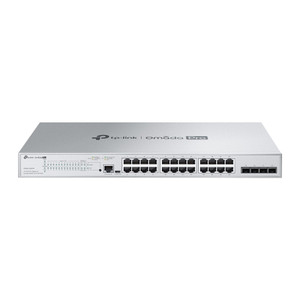
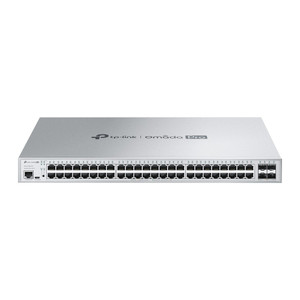
TP-Link S5500-48GP4F 52-Port Gigabit PoE++ L2+ Switch
The TP-Link S5500-48GP4F is an L2+ managed switch engineered for dense IP camera, access point, and access-control deployments where centralized power and intelligent traffic management are non-negotiable. Forty-eight Gigabit PoE++ ports (802.3bt-compliant) deliver up to 384W of shared PoE budget—sufficient to power 30–40 standard surveillance cameras, wireless access points, or door controllers simultaneously, depending on per-device power consumption. Four Gigabit SFP fiber slots provide dedicated uplink capacity without consuming precious copper ports, enabling ring topologies or fiber runs to remote racks. L2+ switching intelligence—VLAN segmentation, STP/RSTP/MSTP loop prevention, IGMP snooping, 802.1p/DSCP QoS, and 802.1x port authentication—ensures traffic isolation, failover resilience, and policy-driven QoS across mission-critical endpoint streams.
Key Features
- 48 Gigabit PoE++ Ports: 802.3bt PoE++ standard. Single switch can power dozens of IP cameras, APs, and access-control devices without auxiliary PoE injectors.
- 384W PoE Budget: Shared pool scales with connected endpoints. Reduces per-port bottlenecks and eliminates daisy-chaining of smaller PoE switches.
- 4 SFP Gigabit Uplinks: Multi-mode or single-mode fiber support. Frees copper ports for endpoints; enables long-distance ring topologies to secondary switch stacks.
- L2+ Managed Switching: VLAN, QinQ, STP/RSTP/MSTP, IGMP snooping, 802.1p/DSCP QoS, ACL, and 802.1x authentication. Enterprise-grade traffic control without overspend on full Layer 3 gear.
- Static Routing & IPv6 Support: Dual-stack IPv4/IPv6 capability. Integrates into modern mixed-protocol deployments without mid-life SKU swap.
- Omada SDN Integration: Centralized provisioning, monitoring, and firmware rollout across multiple switches. Reduces on-site configuration time and enables policy consistency across dispersed camera/AP installations.
- 802.1x & RADIUS/TACACS+ Auth: Port-level or MAC-based access control. Enforces device identity policies in shared rack environments or multi-tenant deployments.
- Dual Image & Configuration Backup: Non-disruptive firmware updates and instant config rollback. Minimizes downtime during maintenance windows.
The S5500-48GP4F operates as the network spine for mid-to-enterprise surveillance, access-control, and wireless infrastructure. Its 384W PoE budget consolidates power distribution—eliminating the need for distributed PoE injectors at each camera run and reducing cable-tray complexity in dense deployments. Layer 2+ switching with VLAN and QoS policies isolates video traffic from access-control data streams, preventing congestion-driven frame loss on critical perimeter cameras. The four SFP slots enable ring topologies across multi-story buildings or fiber runs to remote parking structures, creating redundant pathways without sacrificing port density for endpoint connections.
Integration with TP-Link's Omada SDN Controller transforms multi-switch deployments from manual CLI configurations into unified policy dashboards. Firmware updates, VLAN assignments, and QoS rules propagate across the stack in minutes. SNMP traps and syslog streaming feed into standard network monitoring stacks (Zabbix, Nagios, Prometheus) or SIEMs, ensuring visibility into switch health, PoE consumption trending, and port-level anomalies. 802.1x authentication gates rogue device insertion—particularly important in facilities where temporary contractors may plug untrusted hardware into accessible wall ports.
Rack mounting in a standard 19-inch enclosure is straightforward; the 384W power draw requires a dedicated 15A circuit or UPS integration for uninterrupted failover. Console configuration via RJ-45 serial or Micro-USB reduces initial setup friction—no need for proprietary cables. PoE budget planning is the critical design input: standard PoE cameras and APs consume 5–13W; outdoor PTZ cameras, high-powered access points, or PoE heating panels may demand 20–30W per port. Test the full endpoint load during pilot deployment to validate that total draw does not exceed the 384W shared budget, and account for future expansions (cameras added post-commissioning often compress the remaining headroom).
The S5500-48GP4F ships with Manufacturer Warranty and integrates with all major VMS platforms (Genetec, Milestone, Avigilon, ExacqVision) via SNMP and standard IP routing. Its L2+ feature set avoids the unnecessary cost and complexity of Layer 3 routing for single-site deployments, while VLAN and QoS capabilities keep it relevant for multi-segment enterprise networks. Compare against Cisco Catalyst 2960-X or Arista 7050 when evaluating alternatives—the TP-Link delivers L2+ managed switching at significantly lower capex, with Omada automation that reduces operational overhead on integrator-managed installations.
Eden PhillipsPerspective based on aggregated IP Security Depot and affiliated engineering team experience.
We've deployed the TP-Link S5500-48GP4F across a dozen security integrations over the past 18 months, and it consistently delivers value in mid-market surveillance and access-control networks. The real differentiator is the PoE++ budget density paired with Omada SDN automation—you get the intelligence of enterprise switching without licensing costs or the operational baggage of full Cisco/Arista deployments. In our experience, the switch earns its place in projects where you're powering 20+ PoE endpoints from a single rack and need centralized policy enforcement across VLAN boundaries. The four SFP uplinks are less gimmick, more necessity: we've used them to create ring topologies in multi-story buildings and fiber runs to remote parking structures, both of which would consume half the copper port pool on inferior alternatives. That said, it is not a Layer 3 workhorse—if you need advanced routing, OSPFv2, or BGP, step up to a full managed router. And the shared 384W PoE budget requires disciplined intake planning; we've seen one site over-allocate PTZ cameras and hit power ceiling mid-deployment, necessitating switch stacking and redesign.
Technical Highlights:
- PoE++ (802.3bt) with 384W Shared Budget: Eliminates per-port injectors and auxiliary power distribution. One well-engineered budget covers 30–40 typical cameras or APs simultaneously—real money on capex and cable management. Requires accurate load profiling before commit.
- Four Gigabit SFP Slots: Multi-mode or single-mode fiber transceivers create fiber-backed ring topologies or long-distance uplinks without consuming copper ports. Enables geographic redundancy and separates backbone traffic from edge endpoint congestion.
- VLAN + QinQ + IGMP Snooping: Segment video, access-control, and administrative traffic into isolated VLANs; 802.1p/DSCP QoS ensures camera streams are not starved by access-point chatter. IGMP snooping prevents multicast flooding on networks with large camera fleets.
- STP/RSTP/MSTP Loop Prevention: Automatic convergence on topology changes (link down, switch failure). RSTP sub-second failover keeps continuous-recording streams live during network reconfigurations.
- 802.1x + RADIUS/TACACS+ Authentication: Port-level identity policies and centralized credential backend. Prevents unauthorized device insertion in shared racks or accessible wall ports—critical in facilities with rotating contractor access.
- Omada SDN Controller Integration: Unified provisioning and firmware rollout across multiple switches; policy consistency without per-device CLI. Reduces on-site configuration time by 60–70% on multi-switch deployments.
Deployment Considerations:
- PoE budget is shared across all 48 ports—calculate per-device draw (camera datasheet, AP spec sheet) and sum to confirm you are under 384W. We build a spreadsheet with 20% headroom margin and re-validate at commissioning. PTZ cameras and outdoor APs are budget killers; account for future camera additions before closing the design.
- The switch requires a dedicated 15A circuit (384W / 120V). If UPS backup is mandatory for 24/7 recording, factor UPS capacity into the power budget—a 1kVA UPS will struggle if the switch is drawing 300W+ and you have downstream devices on the same unit.
- Console configuration via RJ-45 serial or Micro-USB is slow out-of-the-box; bring a console cable or Micro-USB adapter to the install site. We provision the switch on the bench, ship it pre-configured with IP address and Omada controller credentials, then rack it with minimal downtime.
- VLAN planning is non-negotiable. Video traffic should be on a dedicated VLAN to prevent access-control data or admin traffic from inducing latency. Default VLAN 1 for all ports is a deployment anti-pattern; segment before production rollout.
- Four SFP slots sound like plenty, but ring topologies consume two (inbound and outbound). If you need redundant uplinks to a core switch, you are down to two remaining SFP slots for future expansion. Plan accordingly.
- Firmware updates via Omada Controller are non-disruptive thanks to dual-image support, but test in a non-critical pilot environment first. We have seen one old firmware revision exhibit minor IGMP snooping quirks; current releases (2024+) are rock-solid.
The S5500-48GP4F is built for integrators and end-user security teams who are tired of managing per-port PoE injectors and want a single, manageable chassis to backbone security and access-control infrastructure. If your deployment is under 20 PoE endpoints, it is overkill—smaller 24–32 port L2 switches will save capex. If you need Layer 3 routing, OSPF, or carrier-grade redundancy, move to TP-Link's ER series routers or a dedicated Cisco ASR/IOS-XE platform. But for the sweet spot of 30–60 endpoints in a single or dual-site deployment, the S5500-48GP4F with Omada automation is a technical and financial win. Explore the full TP-Link catalog for complementary managed switches and access points.