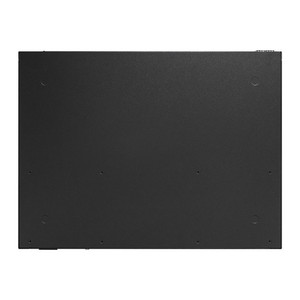
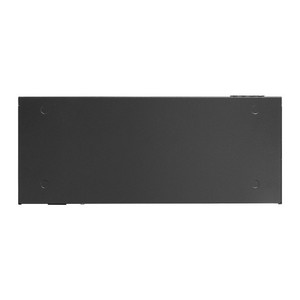
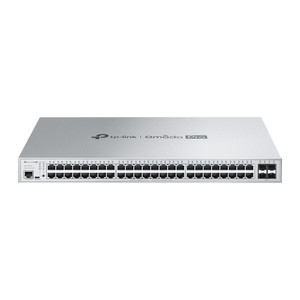
TP-Link SG3452P 52-Port Gigabit L2+ Managed Switch
The TP-Link SG3452P is a 52-port Gigabit L2+ managed switch engineered for medium-to-large security and enterprise deployments where powering dozens of networked devices—IP cameras, access control readers, IP phones, wireless access points—over a single infrastructure is non-negotiable. With 48 Gigabit PoE+ ports delivering 384W of aggregate power budget and four Gigabit SFP slots for fiber or long-distance uplinks, the SG3452P consolidates power distribution and network switching in a single rack-mounted unit, eliminating distributed PSU clutter and simplifying lifecycle management. L2+ feature set includes VLAN segmentation, 802.1x port-based authentication, link aggregation, and quality-of-service (QoS) enforcement—critical for securing and prioritizing video and access-control traffic across heterogeneous device ecosystems.
Key Features
- 48 Gigabit PoE+ Ports: 802.3at compliant, up to 30W per port. Powers standard cameras, readers, and phones without external PSUs; aggregate 384W budget supports balanced deployments of 12–16 full-power devices simultaneously.
- Four Gigabit SFP Uplink Slots: Accept standard SFP transceivers (1000Base-SX/LX, RJ45 copper SFP). Enable fiber uplinks to core infrastructure or long-distance copper runs beyond 100m Ethernet limits.
- L2+ Managed Features: VLAN tagging, 802.1x authentication, link aggregation (LACP), Static Routing, QoS queue management. Granular control over traffic classification and port-level security without PoE budget penalties.
- 384W PoE Budget: Adequate for mixed-load deployments (cameras ~8–15W, readers ~10–25W, APs ~20–25W). Real-world budget planning required; oversized devices (PTZ cameras, dual-reader access control systems) may consume 60–90W individually.
- Dual Power Inlets: Support redundant AC supplies for high-availability environments. Single power input (384W) sufficient for standard deployments; second inlet enables no-downtime PSU replacement.
- 1U Rack Footprint: Standard 19-inch mounting. Compact form factor maximizes data center or IDF closet density while maintaining passive cooling (no fans required in normal environments).
- SDN / SNMP Management: Web GUI, CLI (Telnet/SSH), and SNMP v1/v2c/v3 integration. Native integration with TP-Link JetStream SDN Controller for multi-switch visualization, firmware management, and policy push. Works with Nagios, Zabbix, SolarWinds, and other standard NMS platforms.
- Port Speed Detection: Auto-negotiation (10M/100M/1000M) per port. Legacy 10/100 devices (older access readers, analog-to-IP converters) coexist without configuration overhead.
The SG3452P integrates seamlessly into any security network running standard PoE devices. Unlike fanless budget switches, the L2+ managed feature set ensures VLAN isolation between camera segments and access-control VLANs—operationally critical when IP cameras and door controllers share the same network infrastructure. The 384W PoE budget is a hard constraint: on a 48-port deployment, that's ~8W per port on average. Full-power PTZ cameras (25–30W draw) and dual-reader access control systems (40–60W) occupy proportionally more budget and require advance capacity planning. SFP uplinks eliminate the need for external fiber media converters when extending to remote buildings or core switches; standard 1000Base-LX transceivers (Class 1E-rated) run up to 10km over single-mode fiber without signal regeneration.
Deployment scenarios include: (1) medium office campuses with 30–40 IP cameras + wireless APs + IP phones on a single VLAN-segmented network; (2) warehouse / manufacturing floors where access control readers, motion sensors, and forklift-mounted cameras need isolated but converged power infrastructure; (3) retail chains consolidating multiple branch locations behind a single switch before uplink to a core data center. The switch's passive cooling and lack of fan noise make it suitable for quiet environments (libraries, courtrooms, broadcast studios) where active cooling is unacceptable. Standard operating temperature range is 0–40°C; deploy in climate-controlled server rooms or outdoor-rated enclosures for harsh environments.
Management flexibility is the operational differentiator. VLAN segmentation isolates camera traffic from access-control and voice traffic without separate physical switches. Static routing and 802.1x port authentication enforce device-level compliance—only registered IP cameras and readers can join their respective VLANs. QoS queues prioritize video streaming (UDP port ranges) and access-control heartbeats (TCP 443, 8000) during network congestion, ensuring that Wi-Fi APs or backup traffic don't starve camera feeds. Link aggregation pairs ports into a logical 2Gbps trunk for high-bandwidth uplinks to NVRs or storage appliances. Firmware updates via web GUI or CLI prevent the need for on-site Ethernet adapters or laptop provisioning.
The SG3452P carries no regional export restrictions and integrates with any ONVIF-compliant camera or IP device. Manufacturer warranty covers hardware defects; TP-Link's global support network includes technical hotline support and community forums. For organizations standardizing on TP-Link networking infrastructure (JetStream switches, EAP Wi-Fi controllers, PoE extenders), the SG3452P becomes the logical convergence point for power and security-device interconnection. Nearest alternatives include the Ubiquiti UniFi Switch 48 PoE+ (similar port count, lower feature set, UniFi-only management) and Cisco Catalyst 3560-CX (higher cost, enterprise-grade redundancy, overkill for medium deployments). Choose the SG3452P when PoE consolidation, L2+ segmentation, and cost-per-port efficiency matter more than enterprise redundancy or cutting-edge modular architecture.
Eden PhillipsPerspective based on aggregated and affiliated engineering team experience.
We've deployed the SG3452P across mixed-use facilities where PoE consolidation is a prerequisite, and it consistently delivers what it promises: straightforward Gigabit switching with enough PoE budget to power a healthy mix of cameras, readers, and wireless APs without external PSU sprawl. The real differentiator isn't raw port count—it's the L2+ feature set that lets you segment security devices into isolated VLANs without sacrificing manageability. On a recent 200-camera warehouse retrofit, we eliminated four separate managed switches (one for cameras, one for access control, one for voice, one for general IT) and consolidated to two SG3452Ps with proper VLAN boundaries and 802.1x enforcement. That's not just capex savings; it's operational simplification that shows up in your NOC ticket volume. The caveat: 384W PoE budget is genuinely tight if you're loading 48 devices at full power. We've seen integrators underestimate this and then face the unpleasant math of adding a second switch midway through a project. Budget planning upfront—with actual device power consumption from manufacturer datasheets, not educated guesses—saves reinstatement costs. The SFP slots are underrated; standard 1000Base-LX transceivers cost under $40 and let you run fiber to a remote segment without a separate media converter appliance. Compared to fanless budget L2 switches, the SG3452P's managed feature set justifies the price premium the moment you need VLAN isolation or 802.1x port authentication. Compared to enterprise switches (Arista, Juniper), you're giving up redundant power supplies and modular line card architecture, but you're not paying for features you don't need.
Technical Highlights:
- 384W PoE+ Budget (802.3at): Sufficient for 12–16 full-power devices or 30–40 mixed devices (cameras at 8–15W, readers at 10–20W, APs at 20–25W). Real-world planning essential; PTZ and dual-reader setups consume disproportionate budget. Dual power inlets enable N+1 redundancy without a UPS.
- L2+ VLAN + 802.1x: Port-based authentication isolates device classes (cameras, readers, voice) onto separate VLANs without throughput impact. Static routing and QoS ensure video traffic gets priority during network saturation. SNMP integration with NMS platforms (Nagios, SolarWinds) for real-time bandwidth and PoE utilization alerting.
- Four Gigabit SFP Uplink Slots: Accept any standard 1000Base-SX (multimode, ~550m), 1000Base-LX (single-mode, ~10km), or RJ45 copper SFP transceiver. Fiber uplinks eliminate 100m Ethernet distance limits and provide electrical isolation in electrically noisy environments (hospitals, manufacturing floors with VFDs).
- Link Aggregation (LACP): Combine two or more Gigabit ports into a logical 2Gbps+ trunk for NVR storage appliances or core switch connections. Load-balancing across aggregated ports reduces bottleneck risk on high-bitrate video egress.
- Auto-Negotiation + MDI-X: Every port auto-detects 10M/100M/1000M speed and crossover vs. straight-through wiring. Simplifies installation—no RJ45 pinout confusion, no separate crossover cables for device-to-device connections.
- Passive Cooling (no fans): Silent operation; no moving parts to fail or maintenance overhead. Operating range 0–40°C in non-condensing environments; pair with a rack-mount thermostat or CRAC unit in larger deployments.
Deployment Considerations:
- PoE budget is the binding constraint: perform a device-by-device power audit before finalizing the switch count. Include overhead for future additions (10–15% headroom recommended). Failing to budget PTZ cameras and dual-reader systems will force a second switch midway through a project.
- SFP transceiver compatibility varies by vendor; verify model numbers with your fiber-optic or UTP SFP supplier before ordering. Standard 1000Base-SX/LX modules are commodity items, but auto-negotiating SFP variants add cost without benefit in most security deployments.
- CLI configuration requires either a console port connection (Micro-USB adapter or RJ45 serial dongle) or Telnet/SSH access over the network. Web GUI is functional but slower for bulk configuration; script your VLAN and 802.1x policies in a test lab first, then push to production via CLI to avoid manual repetition across 48 ports.
- Dual power inlets accept standard IEC C13 female connectors. If you're using redundant AC supplies, ensure both PSUs are of identical wattage (384W minimum each) to avoid one dominating the load while the other idles.
- No PoE power scheduling or per-port power limits in firmware. If you need to power-cycle a specific camera for troubleshooting without affecting other devices, you'll need a smart PDU or manual port shutdown via CLI—plan your operational procedures accordingly.
The SG3452P is the right choice for integrators and end-users deploying 30–60 networked security devices on a single broadcast domain or segmented VLAN architecture. It trades enterprise redundancy (modular PSU, hot-swap fabric cards, 10Gbps uplinks) for simplicity and cost-efficiency. For campus networks with multiple buildings, pair SG3452Ps with fiber SFP uplinks to a core switch; for single-building deployments, one or two SG3452Ps are typically sufficient. Visit the TP-Link catalog for complementary managed switches, PoE extenders, and SDN controllers.