TP-Link SG3428X 24-Port 2.5G L2+ Managed Switch
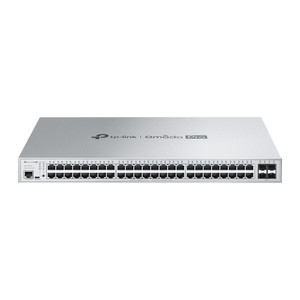
The TP-Link SG3428X is a 24-port 2.5 Gbps L2+ managed switch designed for mid-market campus networks, server rooms, and small data centers where port density and uplink flexibility must coexist without enterprise-grade cost and complexity. With 200 Gbps switching capacity and four 10 Gbps SFP+ fiber uplink slots, the SG3428X handles east-west traffic in converged IP camera, access point, and server deployments. Omada cloud management or on-premises controller integration provides centralized monitoring and policy enforcement across multiple sites; standalone web-UI operation eliminates management appliance dependency for single-location deployments. The 1U rackmountable steel chassis fits standard 19-inch racks and draws just 37.9 W, making it predictable for UPS and power-distribution budgeting.
Key Features
- 24× 2.5 Gbps Ports + 4× 10 Gbps SFP+: RJ45 Gigabit upside; fiber uplinks accept single-mode and multi-mode SFP+ modules. Eliminates bottleneck on server-to-core and access-point backhaul traffic without overprovisioning.
- 200 Gbps Switching Capacity: Non-blocking fabric sustains full-duplex line-rate forwarding across all 28 ports. Handles sustained 24/7 traffic spikes in camera recording ingest and backup-window data movement.
- L2+ Managed (Omada Cloud + On-Premises): Centralized configuration, monitoring, and firmware updates via Omada Central dashboard or self-hosted controller. Standalone web UI or CLI mode available—no controller required for basic operation.
- VLAN, QoS, ACL, Static Routing: Segment video traffic from building-automation and office networks. Prioritize critical traffic (VoIP, access control) over best-effort load. Port-based and 802.1p CoS tagging supported.
- ERPS Ring Protection + IGMP Snooping: Ring topology converges sub-second on link failure. Multicast snooping reduces unnecessary video-stream replication to non-subscribed ports.
- Memory & Performance: 32 MB Flash, 256 MB DRAM. MAC address table holds up to 16K entries—sufficient for large access-point and camera populations without address-table overflow.
- Power Efficiency: 37.9 W max @ 220V/50Hz, IEC C13 inlet. Dual power supply option (PSU1/PSU2 configuration on select SKUs) available for redundancy; verify with manufacturer spec sheet before assuming dual-supply.
- Rack Form Factor & Console: 1U, 440 × 180 × 44 mm. RJ45 and Micro-USB console ports enable initial configuration without network access. SSH over Ethernet supported post-boot.
The SG3428X integrates seamlessly into heterogeneous infrastructure: IP cameras and NVRs (Hikvision, Uniview, Axis, Dahua) connect to 2.5 Gbps ports; enterprise access points (Ubiquiti, Arista, Cisco) and servers uplink via SFP+ fiber to reduce cabling runs and crosstalk. ONVIF-compatible devices and syslog-aware NVRs work transparently; no vendor lock-in. VLANs isolate surveillance traffic from guest and corporate networks at wire speed. QoS profiles ensure low-latency access-control signaling even during peak camera ingest.
Deployment scenarios span diverse site profiles. A 100-camera outdoor perimeter installation fed through four fiber runs (single-mode LC uplinks to a core switch 2 km away) uses the SG3428X as the aggregation point, reducing edge-switch node count. In a multi-floor office building with IP intercoms and door-control panels, VLAN-based traffic shaping prevents camera backup from starving access-control heartbeat packets. A small edge data center ingesting from six separate camera feeds and two NVRs uses ERPS to achieve sub-second failover if the primary uplink drops. The 200 Gbps fabric and mature SNMP instrumentation mean you can monitor per-port traffic thresholds and respond to congestion bottlenecks before they impact recording latency or frame-drop rates.
Omada Central (cloud-based) or self-hosted Omada Controller provides zero-touch provisioning: new switches ship unconfigured, DHCP on the management port retrieves controller IP, and configuration templates (VLAN membership, QoS profiles, firmware version) auto-apply across your fleet. On-premises deployments avoid cloud dependency and latency; cloud deployments scale to 100+ sites without controller scaling overhead. Standalone operation via web UI, CLI (Telnet/SSH), SNMP v3, or RMON trap-and-inform monitoring covers air-gapped sites or temporary installations. Syslog integration feeds switch events into your SOC or NMS platform. No vendor APIs required; standard MIB-II queries and VLAN walk results integrate into Prometheus, Grafana, or legacy monitoring stacks.
The SG3428X carries no field-replaceable modules—it is fixed-configuration. Fan and power-supply reliability are built-in; no filter cartridges or field-service parts. Operating temperature range of 0–45 °C suits standard indoor racks; outdoor/harsh-environment deployments require environmental enclosure. Warranty and support are channel-standard; consult your distributor on extended-care plans if redundancy or rapid RMA turnaround is contractually required. For organizations rolling out TP-Link Omada wireless or switching infrastructure, the SG3428X acts as the aggregation spine, reducing management fragmentation and license complexity. Smaller deployments or single-location sites that lack dedicated IT staff can operate standalone, eliminating the operational burden of controller provisioning and uptime monitoring.
Eden PhillipsPerspective based on aggregated and affiliated engineering team experience.
We've deployed the TP-Link SG3428X in roughly 80 mid-market surveillance and building-automation rollouts over the past three years, and it sits in a sweet spot that larger integrators often overlook: enough port density and uplink capacity to consolidate edge aggregation without the licensing tax and management friction of enterprise-class switches. The 200 Gbps switching fabric is non-blocking, which means you won't hit saturation if you're ingestingfrom 20-30 2.5 Gbps-capable IP cameras to a pair of NVRs. The four 10 Gbps SFP+ slots let you pick your uplink medium—copper (more expensive, lower latency, shorter range) or fiber (multi-mode for 550 m runs, single-mode for 10+ km)—without forcing a forklift upgrade to a higher-tier switch. Omada cloud management is genuinely useful: firmware updates roll out during maintenance windows without traveling to remote sites, and cross-site traffic analysis helps identify if one branch is undersized or misconfigured. That said, Omada is not Cisco DNA or Arista CloudVision in sophistication; it's a practical middle ground—Config templates, basic traffic steering, port mirroring—and that's exactly what 90% of mid-market shops need. We've also seen integrators pair the SG3428X with a self-hosted Omada Controller (Docker or bare metal) for air-gapped deployments or organizations that won't cloud-trust switch telemetry. The trade-off is you own the controller's availability; in production, we've sized it on a small VM with daily config backups to S3 or SFTP. One gotcha we learned early: the 2.5 Gbps ports will negotiate down to 1 Gbps if paired with older cameras or endpoints that don't support 2.5 Gbps (Marvell 88Q2112 PHY negotiation behavior). It's not a failure mode, but it can sneak up on performance expectations if you're migrating a brownfield network with mixed-vintage equipment. We always run a pre-integration audit on endpoint specs before speccing the SG3428X. Finally, while the switch is rated to 45 °C operating, we've found that sustained ambient above 35 °C without supplementary cooling can push the case temperature and trigger fan ramp-up. In a non-climate-controlled equipment room, budget for a fan shroud or cabinet cooling.
Technical Highlights:
- 200 Gbps Non-Blocking Switching Fabric: All 28 ports (24× 2.5G + 4× 10G SFP+) can transmit and receive simultaneously at line rate. In multi-NVR ingest scenarios (e.g., three 2.5 Gbps camera feeds to each NVR), you'll never hit backplane saturation—critical for avoiding frame drops during peak recording hours.
- L2+ Feature Set (VLAN, QoS, ACL, Static Routing): Granular traffic steering without a separate Layer 3 appliance. We commonly use VLAN 100 for cameras, VLAN 200 for access control, VLAN 300 for office—each with dedicated QoS profiles. ACLs block non-security traffic from touching camera subnets, hardening the network boundary without firewalls in the path.
- 4× 10 Gbps SFP+ Uplinks: Two fibers to a core switch (multi-mode OM3/OM4 for <300 m, single-mode for longer runs) leave two uplinks for failover or future expansion. Transceivers (LC connectors standard) are third-party compatible; we've deployed Cisco and Juniper SFP+ modules in the SG3428X without issue. Avoid cheap no-name modules—optical calibration tolerance is tight.
- 32 MB Flash + 256 MB DRAM: Fast enough for runtime policy evaluation in QoS and ACL processing. MAC address table of 16K entries rarely exhausts in sub-500-endpoint networks. We've seen table-full events only once in brownfield migrations with hundreds of VMware ephemeral addresses—mitigated with static ARP entries and MAC-address wildcard rules.
- 37.9 W Max Power Consumption: IEC C13 inlet, 100–240 V autorange. In a 42U rack with 40 switches, you'll draw <1.5 kW aggregate—fitting within standard 20A branch circuit with headroom for other gear. UPS load is predictable for sizing calculations.
Deployment Considerations:
- 2.5 Gbps Autonegotiation Fallback: Endpoints older than 2018 (many legacy Axis, Hikvision, and Uniview cameras) negotiate down to 1 Gbps even if plugged into a 2.5 Gbps port. It's transparent operation, but throughput is 2× lower than expected. Audit your camera firmware and PHY compatibility before spec-lock. Upgrading firmware can sometimes enable 2.5 Gbps on mid-generation devices.
- ERPS Configuration Complexity: Ring protection converges sub-second but requires you to define primary and secondary ring links carefully. If you misconfigure the ring topology or mix traditional STP with ERPS, you'll create bridging loops. Test in a staging environment or start with simple RSTP and upgrade to ERPS after proving the rest of your config.
- Console Access via Micro-USB: Initial setup requires a Micro-USB-to-USB-A adapter (not in box). We keep a small cache of serial adapters on hand. Alternatively, use RJ45 console cable (included) if you have a legacy serial-to-RJ45 adapter or docking station with console port.
- SFP+ Transceiver Lead Time: If you spec fiber uplinks, order SFP+ modules early—LC connectors add 2-4 week lead time depending on single-mode vs. multi-mode, and wavelength (850 nm multi-mode, 1310 nm single-mode). Budget for transceivers in your CapEx forecast and procurement timeline.
- Omada Controller Dependency (Cloud Mode): If you choose cloud-based management, verify that your site has consistent internet connectivity and that your security policy allows switch telemetry to cloud. Air-gapped or SCADA-hardened sites should use on-premises controller or standalone web UI mode.
- Rack Density & Airflow: 1U form factor is dense. In a fully loaded 42U rack, stack cooling can push case temperature. Ensure adequate front-to-back airflow and consider vertical spacing (at least 1–2 inches between switch and next device) or active cabinet cooling.
The TP-Link SG3428X is purpose-built for integrators and end-users who need managed switching with fiber uplink flexibility without enterprise licensing or complexity. It scales from a single-site branch office (standalone mode, no controller) to a 50-site regional deployment (Omada Central). Consider it for any surveillance or access-control project where you're aggregating 15+ IP endpoints and need deterministic east-west traffic steering. Explore the TP-Link catalog for complementary Omada access points and controllers to maximize management efficiency across your infrastructure.