TP-Link SG6654X 48-Port Gigabit L3 Managed Switch with 10GE
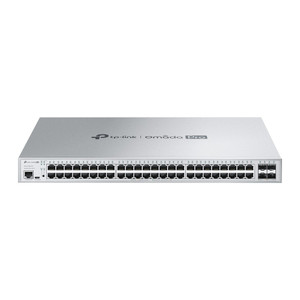
The TP-Link SG6654X is a 48-port Gigabit L3 managed switch with 6× 10GE SFP+ uplink slots, designed for enterprise campus and branch-office networks requiring both access-layer density and core uplink capacity. With 216 Gbps switching capacity and 160.7 Mpps forwarding rate, the SG6654X scales from standalone deployment to multi-unit stacking for larger infrastructure. The switch operates across -5°C to 45°C at up to 2,000 meters elevation, with dual internal power supplies and 39.8 W max power draw—ideal for data closets and network rooms where thermal management and power redundancy matter.
Key Features
- 48 Gigabit Ethernet Ports + 6× 10GE SFP+ Uplinks: 48× RJ45 1GE ports supply branch access; 6 dedicated 10G SFP+ slots accept fiber uplinks to core switches or storage arrays without oversubscription.
- 216 Gbps Switching Capacity, 160.7 Mpps Throughput: Non-blocking fabric handles full-rate forwarding across all 48 ports simultaneously—no packet loss under aggregate load.
- L3 Managed, Omada SDN Ready: Supports standalone CLI/web/SNMP management or centralized control via Omada SDN controller (on-premises or Omada Central cloud). Mix and match SG6428X/SG6428XHP/SG6654XHP in same stack.
- Stackable Architecture (Up to 8 Units): Standalone stacking via 6 dedicated 10G SFP+ stacking ports with 120 Gbps aggregate bandwidth across stack members. Simplifies cabling and reduces management overhead in multi-switch deployments.
- Dual Internal Power Supplies, 100–240 V AC: Redundant power modules accept wide-range AC input; wire separately to UPS for fault tolerance. Standby consumption 16.2 W; max draw 39.8 W @ 220V/50Hz.
- 4GB DDR4 DRAM, 32K MAC Table, 3 MB Packet Buffer: Sufficient capacity for mid-size enterprise deployments; supports 9 KB jumbo frames for high-performance server connectivity.
- 1U 19-inch Rack Mount Footprint: 17.3" W × 15.0" D × 1.7" H; includes rack-mount brackets and fits standard 19-inch network racks without modification.
- Dual Management Interfaces: Dedicated 1× RJ45 management port; console access via RJ45 or USB Type-C for serial/troubleshooting.
The SG6654X fills the middle tier in TP-Link's Omada L3 switch portfolio—more switching capacity and uplink density than smaller 24-port models, but more cost-effective than modular core switches. Each Gigabit port draws minimal power, so branch offices and campus access closets rarely trigger power-budget constraints. The stackable design lets you grow from 1 to 8 units without replacing switching fabric; if you later migrate to a centralized Omada SDN deployment, the same hardware works in controller-managed mode.
ONVIF and VMS integrations are not applicable to this switch—it's network infrastructure, not a camera or recorder. However, integrators who deploy IP surveillance and access-control systems benefit from the SG6654X because it provides dedicated 10G uplinks to NVRs, storage, and controllers without congesting the Gigabit access layer. A typical branch with 48 PoE cameras, door access points, and intercoms consumes 1–2 Gbps aggregate; the 10GE uplinks ensure that backhaul to the data center remains uncongested even during simultaneous recording failover or video export events.
Power redundancy is genuinely useful in camera-heavy installations. If one power supply fails, the switch continues to forward traffic on the remaining supply—your video stream doesn't drop because an AC outlet tripped. Dual supplies also allow staged maintenance: turn off one power module for cleaning or inspection, leave the other live, then swap without a management window. Jumbo frame support (9 KB) is valuable for video NVR traffic where large packet payloads reduce CPU overhead on both switch and recording device.
Compliance: The SG6654X meets FCC, CE, and RoHS standards. It is sourced through legitimate TP-Link channels and contains no grey-market or parallel-import components. Manufacturer warranty applies. For organizations evaluating switching for security operations centers, critical camera backend networks, or multi-branch surveillance rollouts, the SG6654X delivers non-blocking performance at a per-port cost well below modular chassis switches, with the architectural flexibility to stack and grow without rip-and-replace.
Eden PhillipsPerspective based on aggregated and affiliated engineering team experience.
We've deployed the SG6654X across branch offices and campus access closets for integrators building out multi-site surveillance and access-control networks. The appeal is straightforward: 48 Gigabit ports at the edge, 6× 10GE SFP+ fiber uplinks to core or data center, and the ability to stack up to 8 units without a management nightmare. In our experience, the stacking feature is undervalued—many integrators assume they need a modular chassis to grow beyond a single switch, but the SG6654X's dedicated 10G stacking ports and Omada SDN controller integration solve that elegantly. On a site with two closets and 80+ cameras needing PoE, you provision two SG6654Xs in a stack, point them both at Omada Central, and manage the entire branch from a single pane of glass. The non-blocking 216 Gbps fabric means you're not contending for bandwidth between the Gigabit access ports and the 10G uplinks—real money when you're pushing 50+ Mbps streams simultaneously.
The dual power supplies are a credibility signal. We've seen single-supply switches become a liability in critical deployments: a failed PSU means a dead closet and a frantic remediation call. On the SG6654X, redundancy is built in without a premium. Wire both supplies to separate UPS branches, and a single-point power failure doesn't cascade into a network outage.
Technical Highlights:
- Non-Blocking 216 Gbps Switching Fabric: Every port runs at full rated speed simultaneously. In a typical IP surveillance deployment with 40–50 cameras pulling 5–8 Mbps each, you're easily within capacity, leaving headroom for NVR backups and failover traffic without packet drops or QoS contention.
- Stackable via 10G SFP+ (120 Gbps Inter-Stack Bandwidth): Dedicated stacking ports mean you don't sacrifice uplink capacity to bind switches together. Compare this to cheaper stacking designs that force you to use two of your 10G slots for inter-unit links—you're getting more aggregate uplink capacity per dollar.
- 4GB DDR4 + 32K MAC Table: Sufficient for branch and campus deployments up to 200–300 active devices per switch. If you're running VLANs for camera networks separate from access-control networks, the 32K table handles the forwarding load without tuning or memory upgrades.
- Omada SDN Controller Integration (On-Premises or Cloud): Centralized provisioning, monitoring, and firmware updates across 8-unit stacks. No more per-switch CLI management; one controller dashboard tracks health, port utilization, and power consumption across all branches. Real operational savings when you have 5+ sites.
- Jumbo Frame Support (9 KB Payload): Video NVR traffic benefits from larger frames—reduces CPU utilization on the NVR's network interface card. Less relevant for surveillance cameras themselves (which stream variable-sized packets), but meaningful for backend NVR-to-storage or NVR-to-cloud links.
- Low Standby Power (16.2 W): At modern electricity rates, a switch consuming 16.2 W idle is money in the bank across a 24/7 site. Multiplied across 10 branch offices running 365 days, you're avoiding hundreds of dollars in wasted phantom load per year.
Deployment Considerations:
- 10GE SFP+ Uplinks Require Fiber or Twinax: The 6 uplink ports accept SFP+ modules (single-mode fiber, multi-mode fiber, or twinax DAC). Budget for transceiver cost if your core switch or uplink termination point doesn't include matching optics. A pair of 10GBASE-LR modules (single-mode, 10 km) runs ~$200–300 per pair; twinax is cheaper ($50–100) if distances are <3 m in the same room.
- Stacking Topology Requires Careful Planning: While up to 8 units stack, backplane bandwidth is shared across all stack members. A realistic limit is 4–6 units before inter-unit traffic becomes a bottleneck if all members are pushing 10G uplinks. Know your traffic pattern before assuming an 8-unit stack is viable for your topology.
- Omada SDN Controller Licensing: Standalone management (CLI, web UI, SNMP) is free. Omada SDN controller mode requires licensing (per-device or site-wide). Factor the controller cost into your total-of-ownership if you're standardizing on Omada across multiple branches.
- Operating Temperature -5°C to 45°C: Typical for commercial switches, but verify your closet isn't an attic or outdoor cabinet exposed to freeze-thaw cycles. In harsh environments, auxiliary cooling or a heated/cooled enclosure is necessary.
- Console Access via RJ45 or USB Type-C: Older data-center staff may expect serial (DB9) console. The RJ45 console cable is not a standard Ethernet cable—don't mix them up in a dark closet. Label it clearly, and keep a spare console cable with the switch documentation.
The SG6654X is the right choice if you're building a branch or campus network that needs non-blocking Gigabit access, redundant power, and future scalability without rip-and-replace. It's especially compelling for integrators deploying 50+ PoE cameras across multiple closets, where a single-switch design would force oversubscribed uplinks and Omada SDN gives you centralized visibility. For organizations running on-premises or hybrid surveillance with dedicated backend networks, this switch earns its cost through operational simplicity and reliable failover. Explore the full TP-Link catalog for additional managed switches, wireless controllers, and network infrastructure.