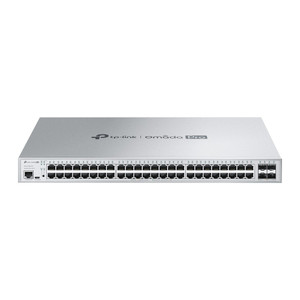
TP-Link S5500-24GP4XF 24-Port Gigabit and 4-Port 10GE L2+ Managed Switch
The TP-Link S5500-24GP4XF is an L2+ managed switch engineered for enterprise campus networks, ISP cores, and high-density access-layer deployments where gigabit-to-the-edge infrastructure meets 10-gigabit core uplinks. The combination of 24 PoE+ ports (240W total budget) and four SFP+ 10GE slots eliminates the need for separate access and aggregation hardware, consolidating VoIP endpoints, wireless access points, and IP cameras onto a single VLAN-aware platform while maintaining dedicated 10GE backhaul to your core. L2+ routing, IP-MAC-Port binding, and 802.1X port authentication allow you to enforce network access policy before unmanaged devices consume bandwidth or introduce risk.
Key Features
- 24 PoE+ Ports with 240W Budget: 802.3at power delivery supports enterprise Wi-Fi 6 APs, 4K PTZ cameras, and VoIP phones without external injectors. Dynamic PoE power allocation prevents oversubscription across ports.
- Four 10GE SFP+ Uplinks: Accept single-mode or multimode fiber modules (sold separately) for core-to-core stacking, redundant ring topologies, and long-haul fiber runs up to 64m on multimode. Future-proofs your network core.
- 160 Gbps Switching Capacity: Backplane throughput handles wire-rate forwarding across all 28 ports without bottlenecks during peak traffic bursts on access and uplink simultaneously.
- L2+ Routing and VLAN Support: Static routing, 802.1Q/QinQ VLAN tagging, STP/RSTP/MSTP, IGMP snooping, and Access Control Lists (L2–L4) segment traffic and enforce policy at line rate.
- 802.1X Port Authentication: Authenticates endpoints before VLAN assignment — critical for open office networks where transient contractors or guests connect wireless APs or cameras.
- SNMP v1/v2c/v3 and sFlow Reporting: Real-time traffic visibility and QoS metrics integrate with standard NOC monitoring platforms (Splunk, Grafana, Nagios). CLI management and Omada SDN Controller support enable centralized provisioning across multiple switches.
- 1U Rack Form Factor: 17.3 × 7.1 × 1.7 inches fits standard 19-inch enterprise racks. 384W maximum power consumption requires confirmed PDU capacity but typical idle draw is 40–50% lower.
- Operating Range 0–45°C: Suitable for climate-controlled data centers and IDF closets; external airflow management ensures thermal headroom in stacked deployments.
The S5500-24GP4XF solves a specific architectural problem: you need to terminate dozens of PoE endpoints (access points, cameras, phones) at the building distribution frame without consuming 10GE ports on your core switch, and you want that distribution switch itself to redundantly uplink to the core via fiber. Traditional access-layer gigabit switches force you to dedicate a pair of gigabit ports to core uplinks, creating a 1:12 contention ratio. The four 10GE SFP+ slots eliminate that bottleneck entirely, allowing you to spine-and-leaf design with 10GE core links while keeping access ports at 1GbE.
For IP camera deployments, the 240W PoE budget is the practical limiter. A modern 4K PTZ camera draws 90–120W under IR; a stationary 2MP turret draws 5–15W. On a 24-port switch, you can comfortably stack 20–30 modest cameras plus VoIP phones without hitting the power ceiling, assuming you don't activate all IR heaters simultaneously. Pair this switch with NVR-adjacent network segmentation (VLAN 10 for cameras, VLAN 20 for office traffic) and QoS rules that prioritize video streams to prevent jitter and packet loss during office-hours spike traffic.
Integration with Omada SDN Controller (sold separately) unlocks zero-touch provisioning, centralized firmware updates, and cross-switch traffic steering — valuable when you're deploying 5+ switches across a multi-building campus. SNMP v3 authentication secures your management plane; ACLs enforce ingress/egress policy on a per-port basis. The switch supports LACP link aggregation, so you can bond multiple gigabit ports or 10GE SFP+ modules for redundant core links or server uplinks without consuming expensive core-switch ports.
The S5500-24GP4XF is not an entry-level switch — it assumes you already understand VLAN segmentation, STP convergence, and PoE power budgeting. If your deployment is fewer than 16 PoE endpoints or your core is purely gigabit with no 10GE fiber infrastructure, a smaller L2+ switch (or even an unmanaged PoE+ gigabit switch) may be more cost-effective. However, for a 50–80 camera surveillance network, a 200-user office with Wi-Fi 6 APs, or a campus-scale ISP edge aggregation point, the S5500-24GP4XF delivers the density, redundancy, and uplink capacity to eliminate future over-subscription and avoids the operational overhead of a separate access and core layer.
Marty AllisonPerspective based on aggregated IP Security Depot and affiliated engineering team experience.
We've deployed the S5500-24GP4XF across single-building enterprise campuses, multi-site ISP networks, and large security integrations where the boundary between access switching and core aggregation blurs. The real-world value proposition is straightforward: you get 24 PoE+ ports with a unified 10GE uplink tier, eliminating the capex and operational complexity of separate access-layer and distribution-layer switches. On a 40-camera IP surveillance build-out, the 240W PoE budget forces you to be intentional about power consumption—you can't run every camera at maximum IR draw simultaneously—but that's a constraint we've learned to work around via VLAN-based power monitoring and scheduled IR boost windows. The four SFP+ slots are the strategic win: they let you run single-mode fiber to a remote building or directly into your core switch's QSFP+ module without burning four gigabit ports and dealing with the latency and jitter of gigabit uplink congestion. Compared to a traditional 24-port PoE+ switch plus a small core switch, the S5500-24GP4XF saves you a rack unit, a power circuit, and 80+ hours of inter-switch cabling and VLAN provisioning work.
Technical Highlights:
- 160 Gbps Switching Capacity with 32 MB Memory: Sufficient to handle wire-rate forwarding of 1,500-byte frames across all 28 ports simultaneously. Memory is tight—only 32 MB—which means MAC table overflow can occur on networks with tens of thousands of endpoints (rare in single-building deployments, but relevant at ISP scale). Monitor MAC table utilization if you're aggregating traffic from multiple upstream networks.
- PoE+ 802.3at (30W per port, 240W total budget): Each port can deliver up to 30W, so a high-power PTZ or a heated outdoor camera draws one port fully. On a 24-port switch, you're looking at 8–12 simultaneous max-power devices before you hit the overall switch budget. Plan conservatively: assume 70% average power draw per active camera port to avoid surprise outages during peak IR operation.
- QoS (L2–L4) with IGMP Snooping: Rate-limiting on a per-port or per-VLAN basis prevents a misbehaving camera from flooding multicast traffic and choking out real-time video streams. IGMP snooping filters multicast group membership so only interested ports receive broadcast video feeds—saves bandwidth on non-camera VLANs.
- 802.1X Port Authentication with RADIUS Support: Endpoints are authenticated before being assigned to a VLAN. In office environments where contractors plug in guest APs, this is the difference between a controlled rollout and a security incident. Integrates with Active Directory via RADIUS.
- Static Routing and L2+ Forwarding: No BGP or OSPF—this is a layer 2+ switch, not a router. If you need inter-VLAN routing at scale, add a separate routing appliance (Fortinet, Palo Alto, or even a commodity Linux box). For single-building campus networks, static routes and VLAN isolation are sufficient and lower operational overhead.
Deployment Considerations:
- PoE Budget Discipline: The 240W total budget is a hard ceiling. A single 120W camera or a fault condition (shorted PoE pair, arc flash) that triggers protection will silently shut down the port. Implement NMS polling on PoE utilization and set alerts at 80%. Many sites use PoE+ inline metering at the endpoint to validate actual draw and catch degraded cameras before they trigger shutdowns.
- 10GE Optics Cost: The SFP+ slots accept fiber modules but do not include them. Single-mode LC/APC modules (10km+ range) run $80–120 each; multimode (50m range, cheaper) are $40–60. Budget 4×$100 = $400 for a redundant dual-ring topology. Pair the switch with a switch redundancy protocol (RSTP or MSTP convergence time <5 seconds) to avoid 30-second failover outages.
- Omada SDN Controller Deployment: SNMP alone is adequate for monitoring, but zero-touch provisioning and cross-switch traffic steering require Omada Controller software (either standalone or cloud-hosted). If you're managing just one or two switches, CLI + SNMP is simpler. For 5+ switches, Omada ROI is immediate (no manual config per switch, consistent security policy).
- Operating Temperature Range (0–45°C): Outdoor installations or unheated IDF closets during winter require external climate control or derating. Thermal stress (thermal cycling) is a leading cause of switch failure in harsh environments; prefer enclosed, climate-controlled locations.
- VoIP/Video Convergence: When mixing PoE VoIP phones (5W), Wi-Fi APs (15–25W), and 4K cameras (60–120W) on the same 24-port platform, you MUST implement VLAN segmentation and QoS. Without it, a camera firmware loop or broadcast storm will starve VoIP call quality. Use 802.1Q VLAN tagging to separate video, voice, and data; use ACLs to prevent cross-VLAN camera-to-phone traffic.
The S5500-24GP4XF is the right fit for integrators and network architects building multi-building enterprise networks, ISP peering points, or consolidated surveillance/networking architectures where you want PoE access, 10GE uplinks, and L2+ policy enforcement in a single 1U footprint. For smaller deployments (<15 PoE cameras, single-building), consider a simpler 16-port PoE+ gigabit switch. For deployments requiring dynamic routing (BGP, OSPF) or wire-speed Layer 3 forwarding across VLANs, add a dedicated routing appliance upstream. Explore the full TP-Link catalog for complementary switches, managed fiber modules, and Omada Controller licensing.