
TP-Link SG6654XHP vs Ubiquiti USW-PRO-48: Specification Comparison
Both the TP-Link SG6654XHP and the Ubiquiti USW-PRO-48 are rack-mounted, 1U, 48-port gigabit managed switches aimed at enterprise and prosumer LAN deployments. The comparison is meaningful but asymmetric: the SG6654XHP is a PoE+ switch with a substantial power budget, while the USW-PRO-48 is a non-PoE switch. Buyers cross-shopping these are typically choosing between a PoE-capable L3 platform and a non-PoE L2/L3 fabric switch, trading powered-device support, uplink density, and controller ecosystem against switching efficiency, NDAA compliance, and power simplicity.

In This Guide
- Which switch delivers more uplink bandwidth and switching capacity for high-density deployments?
- Does the switch power the connected devices, and what are the power and environmental constraints?
- How does each switch integrate into a managed network and what ecosystem or compliance requirements apply?
- Which should you choose: the SG6654XHP or the USW-PRO-48?
- Side-by-Side Specs
- FAQ
Which switch delivers more uplink bandwidth and switching capacity for high-density deployments?
The SG6654XHP provides 48× 10/100/1000 Mbps PoE+ RJ45 ports plus 6× 10G SFP+ uplink slots, yielding a switching capacity of 216 Gbps under the Omada L3 managed platform. The dual 10G SFP+ uplink density is a meaningful advantage for aggregation or spine roles where inter-switch bandwidth is a bottleneck.
The USW-PRO-48 also offers 48× 10/100/1000 Mbps ports with a switching capacity of 176 Gbps and a forwarding rate of 131 Mpps. No uplink SFP+ slot count is specified in the provided specs. The 40 Gbps gap in switching fabric favors the SG6654XHP for high-concurrency traffic, though 176 Gbps still exceeds full-duplex wire speed across all 48 gigabit ports.
Buyers stacking switches or feeding a 10G core will find the SG6654XHP's six 10G SFP+ slots directly spec'd; the USW-PRO-48's uplink configuration is not itemized in the provided specification data.
Does the switch power the connected devices, and what are the power and environmental constraints?
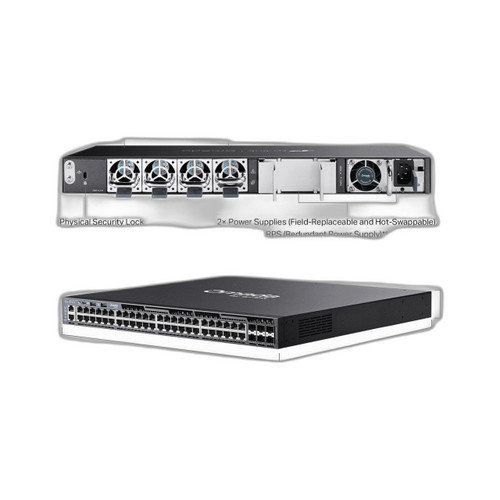
The SG6654XHP supports PoE+ (802.3af/at) on all 48 RJ45 ports, with a maximum PoE budget of 1,440W when fitted with two PSM900-AC modules, or 812W with two PSM500-AC modules. Per-port delivery is up to 30W (802.3at). This makes it directly suitable for powering IP cameras, access points, VoIP phones, and access controllers without external injectors.
The USW-PRO-48 is a non-PoE switch. Its total power consumption is 60W from an internal AC/DC supply. No powered-device support is specified. Buyers needing to power edge devices must budget for separate PoE injectors or additional switches.
On operating environment, the SG6654XHP is rated -5°C to 45°C; the USW-PRO-48 is rated -5°C to 40°C. The SG6654XHP's 5°C wider upper thermal tolerance can matter in poorly cooled IDF closets or outdoor enclosures. Power input for both is 100–240V AC.
How does each switch integrate into a managed network and what ecosystem or compliance requirements apply?
The SG6654XHP operates under TP-Link's Omada SDN ecosystem, supporting both standalone mode and Omada controller-managed mode. It is an L3 managed switch with a dedicated RJ45 management port. Security features specified include 802.1X port authentication, ACL, and DoS defense. Storage includes 4 GB DDR4, 2×4 MB NOR flash, and 8 GB eMMC. The processor is a dual-core ARM at 1.5 GHz.
The USW-PRO-48 is positioned as a UniFi platform device, managed via the UniFi Network application. It carries NDAA compliance certification alongside CE, FCC, IC, and Anatel. NDAA compliance is a hard procurement requirement for U.S. federal, state, and many municipal projects. No processor or memory specification is provided in the available data.
Buyers already invested in Omada infrastructure gain native controller integration with the SG6654XHP. Buyers on the UniFi platform, or those subject to NDAA procurement rules, will find the USW-PRO-48 the conforming choice. The two ecosystems are not interoperable at the controller level.
Which should you choose: the SG6654XHP or the USW-PRO-48?
Our take: The SG6654XHP is the stronger choice when powered edge devices—cameras, access points, VoIP endpoints—must be fed from the switch and when 10G uplink density or L3 routing at the distribution layer is required. It delivers a 1,440W PoE+ budget versus zero PoE on the USW-PRO-48, a 216 Gbps switching fabric versus 176 Gbps, and six specified 10G SFP+ uplink slots versus an unspecified uplink count on the USW-PRO-48. Conversely, the USW-PRO-48 is the correct choice for UniFi-controlled environments, for projects with NDAA compliance mandates (the SG6654XHP carries no NDAA designation in its provided specs), and for non-PoE access-layer roles where its 60W total draw simplifies power budgeting. Neither switch is a drop-in replacement for the other across ecosystems.
Side-by-Side Comparison
Spec-for-spec, from manufacturer data.
| Specification | TP-Link SG6654XHP | Ubiquiti USW-PRO-48 |
|---|---|---|
| RJ45 Access Ports | 48× 10/100/1000 Mbps PoE+ | 48× 10/100/1000 Mbps |
| PoE Standard | 802.3af/at (PoE+, up to 30W/port) | None |
| PoE Budget | 1,440W (2× PSM900-AC) / 812W (2× PSM500-AC) | — |
| Uplink Slots | 6× 10G SFP+ | — |
| Switching Capacity | 216 Gbps | 176 Gbps |
| Forwarding Rate | — | 131 Mpps |
| Layer | L3 Managed | — |
| Management | Omada controller or standalone; 1× RJ45 mgmt port | UniFi Network application; Ethernet |
| Processor | Dual-core ARM @ 1.5 GHz | — |
| Memory | 4 GB DDR4 + 2×4 MB NOR + 8 GB eMMC | — |
| Power Consumption (unit) | — | 60W |
| Power Input | 100–240V AC, 50/60 Hz | 100–240V AC |
| Operating Temperature | -5°C to 45°C (23°F to 113°F) | -5°C to 40°C (23°F to 104°F) |
| Dimensions (W×D×H) | 440 × 420 × 44 mm | 442 × 285 × 44 mm |
| NDAA Compliant | — | Yes |
| Certifications | — | CE, FCC, IC, Anatel |
Frequently Asked Questions
Which should you choose: the SG6654XHP or the USW-PRO-48?
The SG6654XHP is the stronger choice when powered edge devices—cameras, access points, VoIP endpoints—must be fed from the switch and when 10G uplink density or L3 routing at the distribution layer is required. It delivers a 1,440W PoE+ budget versus zero PoE on the USW-PRO-48, a 216 Gbps switching fabric versus 176 Gbps, and six specified 10G SFP+ uplink slots versus an unspecified uplink count on the USW-PRO-48. Conversely, the USW-PRO-48 is the correct choice for UniFi-controlled environments, for projects with NDAA compliance mandates (the SG6654XHP carries no NDAA designation in its provided specs), and for non-PoE access-layer roles where its 60W total draw simplifies power budgeting. Neither switch is a drop-in replacement for the other across ecosystems.
Can the USW-PRO-48 power IP cameras or access points directly?
No. The USW-PRO-48 is a non-PoE switch with a 60W total power draw for the unit itself. Powering PoE devices requires separate injectors or a different switch. The SG6654XHP supports PoE+ (802.3at) on all 48 ports with up to 1,440W of PoE budget using dual PSM900-AC modules.
Is either switch compliant with NDAA Section 889 requirements for government or federal projects?
The USW-PRO-48 is listed as NDAA compliant in its provided specifications. The SG6654XHP's provided specifications do not include an NDAA compliance designation. Buyers with federal, state, or municipal procurement rules requiring NDAA compliance should verify the SG6654XHP's status directly with TP-Link before specifying it.
Which switch is better suited for an existing UniFi or Omada deployment?
Each switch is native to its own SDN ecosystem and the two are not interoperable at the controller level. The USW-PRO-48 is managed through the UniFi Network application. The SG6654XHP integrates with the TP-Link Omada controller in either standalone or controller-managed mode. Mixing ecosystems requires managing two separate platforms and is not recommended for unified visibility.
More Network Switch Comparisons
- TP-Link SG6654XHP vs Ubiquiti USW-PRO-MAX-48
- TP-Link SG6654XHP vs TP-Link SG3452XMPP
- TP-Link SG6654XHP vs TP-Link SG3452XP
- TP-Link SG3452XMPP vs Ubiquiti USW-48
- TP-Link SG3452XMPP vs Ubiquiti USW-PRO-MAX-48
- TP-Link SG3452XMPP vs Ubiquiti USW-PRO-48
Network Switch Buying Guides
Get a Second Opinion on Your Camera Choice
Share your site layout, coverage goals, and budget. Our team will validate the camera selection, flag anything we would change, and recommend products that match the use case.