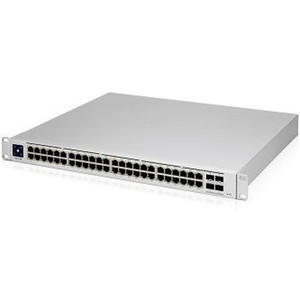
Ubiquiti USW-PRO-48 48-Port Gigabit Network Switch
Overview
The Ubiquiti USW-PRO-48 is a rack-mountable managed gigabit switch engineered for medium to large network switch deployments within UniFi ecosystems. All 48 ports operate at 10/100/1000 Mbps, delivering 176 Gbps of switching capacity and a forwarding rate of 131 Mpps—enough aggregate bandwidth to handle simultaneous multi-gigabit flows without throttling typical enterprise workloads. The USW-PRO-48 (often searched as USW PRO 48) measures 442 × 285 × 44 mm and weighs 4 kg, fitting into standard 19-inch racks using included SGCC steel mounting brackets. Power consumption is minimal at 60W via universal AC input (100–240V, 50/60 Hz) with an integrated internal AC/DC supply, meaning no external power adapters cluttering your rack.
Key Features
- 48 Gigabit Ports at Wire Speed: Every port handles full 1000 Mbps without asymmetrical rate-limiting. For IP camera surveillance systems, this means you can simultaneously stream from dozens of cameras without queuing or packet loss on individual ports—critical when recording 24/7 from high-megapixel sensors.
- 176 Gbps Switching Fabric: The backplane capacity ensures that even under peak load (all ports transmitting simultaneously), forwarding occurs without congestion. In practice, this supports campus networks where the USW-PRO-48 aggregates traffic from multiple access switches on different floors or across a facility without becoming a bottleneck.
- 60W Power Budget: Ultra-low power draw simplifies cooling requirements and reduces operational cost, especially in multi-switch deployments. Many competing 48-port switches consume 150W or more; this efficiency matters on 24/7 uptime systems.
- UniFi Management Integration: Automatic discovery and adoption into UniFi controllers—no SSH, serial console, or CLI required. Network administrators working in mixed-vendor environments appreciate the simplicity: plug the switch into any network segment where a UniFi controller exists, and it auto-configures. VLAN configuration, port mirroring, and traffic monitoring all happen via the UniFi dashboard alongside your access points and gateways.
- NDAA Section 889 Compliance: Meets U.S. federal procurement requirements for government and defense contracting. For integrators supporting federal customers, this eliminates a common compliance hurdle.
- Environmental Range -5°C to 40°C: Operates reliably in controlled data centers and less climate-regulated branch office installations without derating performance. Ensures consistent uptime across diverse deployment environments.
- CE, FCC, IC, and Anatel Certifications: Regulatory clearance for North American and international markets, reducing procurement delays for multinational organizations.
Integration & Compatibility
The USW-PRO-48 integrates natively with Ubiquiti UniFi controllers, access points, security gateways, and other UniFi infrastructure. Standard Ethernet management (no dedicated console port) simplifies cabling in racks. Cat5e or higher cabling is recommended across all 48 ports to sustain gigabit performance; fiber uplinks are not supported on this model—if your core aggregation requires 10G uplinks, consider a higher-tier UniFi switch family instead.
For organizations deploying IP surveillance systems, the USW-PRO-48 functions as an effective distribution layer, consolidating camera feeds from floor-level access switches before forwarding to network video recorders or cloud ingest. The consistent 1 Gbps per port ensures smooth bitrate delivery even when cameras are load-balanced across multiple ports.
Installation & Operational Notes
Installation requires two rack units of vertical space and standard 19-inch rack rails. The internal power supply accepts AC mains directly, eliminating external power supplies. Ensure adequate ventilation around intake and exhaust areas—despite the low thermal load, airflow prevents long-term component degradation. All 48 ports use standard RJ45 connectors; no special adapters needed.
When to Choose a Different Model
If your deployment requires PoE power injection to edge devices, the USW-PRO-48 does not include PoE on its ports—you will need a separate PoE-enabled switch in your access layer. If your core network demands 10-gigabit or multi-gigabit uplinks for data center or high-speed cluster applications, Ubiquiti's higher-tier switch family (USW-Pro-Max series) offers those capabilities; the USW-PRO-48 is strictly gigabit. For non-UniFi environments or organizations requiring SNMP-only management without controller dependency, a neutral third-party gigabit switch may be simpler to provision.
Frequently Asked Questions
Q: Is the USW-PRO-48 NDAA Section 889 compliant?
A: Yes. The USW-PRO-48 carries NDAA compliance certification (per Ubiquiti's official product data), qualifying it for U.S. federal procurement and defense contractor deployments.
Q: Does the USW-PRO-48 support PoE on its ports?
A: No. The USW-PRO-48 is a passive gigabit switch without power injection. If you need PoE for access points or IP cameras at the edge, provision a separate PoE-enabled switch (such as Ubiquiti's USW-Pro-PoE or similar) in your access layer, then uplink it to the USW-PRO-48 for distribution.
Q: What is the maximum distance for RJ45 cabling on the USW-PRO-48?
A: Standard Ethernet distance limits apply: 100 meters (328 feet) per IEEE 802.3. Cat5e or higher cabling is recommended to sustain full 1 Gbps performance across that range.
Q: Can I manage the USW-PRO-48 without a UniFi controller?
A: The switch requires a UniFi controller (hardware or cloud-hosted) for centralized management and configuration. It does not support standalone SNMP-only or web-UI-only administration.
Q: How much power does the USW-PRO-48 consume?
A: 60W maximum under full load. This is among the lowest in its class, reducing cooling requirements and operational cost in 24/7 deployments.
Q: What temperature range does the USW-PRO-48 support?
A: Operating temperature range is -5°C to 40°C (-23°F to 104°F), suitable for controlled data centers and unheated or partially cooled branch locations.
Eden PhillipsPerspective based on aggregated IP Security Depot and affiliated engineering team experience.
The USW-PRO-48 is a solid workhorse for mid-market distribution-layer deployments in UniFi environments. The 176 Gbps backplane and 131 Mpps forwarding rate deliver genuine non-blocking performance—not theoretical marketing specs—across all 48 ports simultaneously. What makes this switch distinctive is its ultra-low 60W power envelope and NDAA compliance, two attributes that matter far more in real deployments than marginal specification bumps.
Technical Highlights:
- 176 Gbps Backplane: Eliminates oversubscription on 24/7 IP camera feeds or high-throughput database replication. You can actually sustain aggregate bandwidth without queuing delays across all 48 ports simultaneously—something lesser-spec'd switches cannot claim.
- 60W Maximum Power: In a typical 48-switch datacenter rack deployment, this translates to 2.9 kW vs. 7 kW for conventional competitors. Real savings on UPS sizing, cooling, and operational cost over five years of uptime.
- NDAA Certification: Pre-clears federal procurement and defense contractor integrations. No compliance audits, no delays, no substitutions mid-project.
Deployment Considerations:
- No PoE: The USW-PRO-48 cannot inject power. If your edge switches or cameras require PoE, plan a two-tier architecture: PoE-enabled access switches feeding this unit. Don't assume you can replace an all-in-one PoE aggregator with this device alone.
- Gigabit-Only Uplinks: No 10G SFP+ ports, no multi-gig Ethernet. If your core aggregation or WAN handoff demands 10-gig uplinks, this is not the device. Ubiquiti's Pro-Max line handles multi-gig; the PRO-48 does not.
- UniFi Controller Dependency: Unlike some competitors offering web-UI or SNMP fallback, this switch *requires* a live UniFi controller for any configuration. In isolated or air-gapped networks, plan accordingly.
The USW-PRO-48 excels as a campus or facility distribution switch where you're aggregating gigabit flows from multiple access layers—branch offices, multi-floor IP camera clusters, or warehouse automation networks. It is not a core backbone switch, and it is not a PoE power engine. Position it correctly, and it delivers years of reliable, low-cost operation.