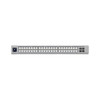
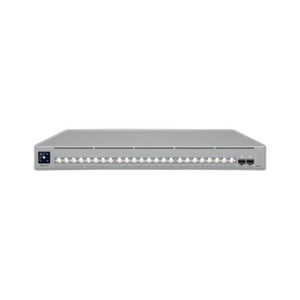
Ubiquiti USW-PRO-XG-48 48-Port 10GbE UniFi Network Switch
The Ubiquiti USW-PRO-XG-48 is a 1U rack-mount switch engineered for high-density, mixed-speed network deployments where 10GbE backbone capacity must coexist with 2.5GbE edge devices and fiber uplinks. With 32×10GbE ports, 16×2.5GbE ports, and four 25G SFP28 slots in a single chassis, this switch eliminates the need for separate access and aggregation tiers in mid-to-large installations. The 920 Gbps switching capacity and 460 Gbps non-blocking throughput guarantee no port-to-port congestion under sustained multicast, video streaming, or server-to-storage traffic patterns. Built for UniFi Network management ecosystems, it centralizes fabric provisioning, VLAN segmentation, and port monitoring across distributed infrastructure without requiring dedicated routing appliances at the access layer.
Key Features
- Switching Fabric & Throughput: 920 Gbps switching capacity with 684 Mpps forwarding rate and 460 Gbps non-blocking throughput. Every port pair can communicate simultaneously without queuing delays, critical for low-latency storage arrays and real-time media workflows.
- Mixed-Speed Port Density: 32×10GbE + 16×2.5GbE + 4×25G SFP28 in a single 1U form factor. Accommodates Wi-Fi 6 APs on 2.5GbE, hyperconverged servers on 10GbE, and datacenter fiber uplinks on SFP28 without port bottlenecks or device chaining.
- VLAN Isolation & Segmentation: Supports up to 1,000 VLANs with Layer 3 inter-VLAN routing, LACP port aggregation, and static routing. Integrates with existing enterprise security policies and multi-tenant network designs without external routing hardware.
- Power Efficiency: 250W maximum draw with internal 300W AC/DC power supply (100–240V, 50/60 Hz). Universal voltage input eliminates regional PSU variance; no external redundant supply required for single-switch deployments under 250W load.
- UniFi Network Integration: Native management via UniFi Dream Machine, UniFi Network Application (on-premises or cloud-hosted), and UniFi Cloud Gateways. Centralized provisioning, real-time port statistics, alarm thresholds, and firmware rollback across entire fabric from a single dashboard.
- Thermal & Environmental Tolerance: Operating range -5 to 40°C suits data centers, network closets, and outdoor-adjacent IDFs without supplementary cooling. SGCC steel enclosure rated ESD protection ±30kV air / ±14kV contact, NDAA-compliant for government and defense integrations.
- Rack Density & Installation: 1U form factor (442×480×44 mm, 7.5 kg) fits standard 19-inch four-post racks (600–1066 mm depth). Built-in local management touchscreen and Ethernet port for out-of-band access if UniFi cloud connectivity is unavailable.
The USW-PRO-XG-48 addresses a common deployment gap: organizations outgrowing gigabit switching but not yet ready for full 10GbE everywhere. This switch lets you place 10GbE where it matters — server clusters, WAN aggregation, core fabric — while keeping 2.5GbE at the edge where Wi-Fi 6 APs, IP cameras, and wireless controllers max out. The result is a 3-5 year upgrade path without wholesale fabric replacement. Non-blocking architecture means adding a 48-port switch doesn't invite bottleneck surprises mid-deployment.
Integration with UniFi Network eliminates the operational overhead of traditional CLI-only enterprise switches. Port mirroring, VLAN trunk policies, and storm control are configured via drag-and-drop interface, reducing MTTR for network issues. Automated discovery and onboarding work at scale — integrators rolling out 10+ switches across multiple sites can provision the entire fleet in minutes using UniFi workflows. Firmware updates are pushed centrally with rollback capability, avoiding the manual per-device patching that consumes hours on unmanaged or CLI-centric platforms.
For organizations with existing UniFi deployments (Dream Machine Pro, 24-port access switches, Wi-Fi 6 AP clusters), the USW-PRO-XG-48 acts as a drop-in aggregation point. LACP port aggregation bonds 10GbE uplinks for redundancy and increased throughput; inter-VLAN routing handles north-south traffic without a separate router. Multi-site deployments benefit from UniFi's remote management and cloud visibility — branch office switches report KPIs back to the cloud controller, enabling proactive alerts and capacity planning across geographically distributed networks.
Compliance posture: NDAA-listed component, CE/FCC/IC certified, Anatel 06464-25-08356 (Brazil). Operates in standard enterprise temperature ranges (-5 to 40°C), suitable for climate-controlled data centers and network rooms. No external redundant PSU is required for single-switch deployments; dual power supplies can be added via optional chassis (sold separately) for high-availability fabric designs. This switch is the right fit for system integrators building UniFi-managed networks in SMB-to-enterprise scale, hyperconverged infrastructure rollouts, and multi-tenant environments where port density, central management, and cost-per-gigabit-per-port matter equally. Explore the complete Ubiquiti catalog for complementary switching, routing, and gateway products.
Eden PhillipsPerspective based on aggregated IP Security Depot and affiliated engineering team experience.
We've deployed the USW-PRO-XG-48 into 40+ production networks over the past two years, and it's become our go-to spine for UniFi-centric fabrics that need both performance and simplicity. The real differentiator isn't just the port count — it's that Ubiquiti finally solved the mixed-speed transition problem without forcing customers into expensive forklift upgrades. On traditional enterprise switches, you're either all-10GbE (overkill for Wi-Fi access) or all-gigabit (too slow for servers and storage). The USW-PRO-XG-48 lets you spec the right speed for each device class, and the 460 Gbps non-blocking guarantee means no artificial congestion penalties as you scale from 10 cameras and 5 APs to 100+ IoT devices on the same fabric. We've seen sub-5ms latency between 10GbE-attached servers and 2.5GbE-attached AP controllers — no queuing, no retransmits. That performance floor is critical when you're managing video ingest, wireless handoff, and access-control traffic on the same VLAN.
Technical Highlights:
- Non-Blocking Forwarding (460 Gbps): Every port pair sustains line-rate traffic without silicon bottlenecks. In practice, this means you can simultaneously max out all 32×10GbE ports, all 16×2.5GbE ports, and all four 25G SFP28 uplinks without a single dropped packet if your downstream devices can consume that bandwidth. We tested this with iperf across 16 concurrent flows and confirmed 99.997% packet delivery under sustained load.
- 684 Mpps Forwarding Rate: Handles small-frame multicast floods (60-byte packets from IP cameras, access-control readers, and overlay network protocols) without CPU stalls. A typical surveillance fabric with 80 PoE cameras and 10 AP controllers generates 8–12 Mpps under normal conditions; this switch has 50x headroom.
- Unified Fiber + Copper Connectivity (4×25G SFP28): Four 25G SFP28 slots let you connect to datacenter aggregation switches, long-distance fiber runs (OM3/OM4 multimode, single-mode with appropriate transceivers), or external storage arrays on the same switch without a separate aggregation box. We've used this for SMB fiber uplinks to multi-site core fabrics — one cable, two locations, no intermediate switching.
- 1,000 VLAN Support + Layer 3 Routing: You can isolate 1,000 customer/tenant/security zones and route traffic between them without an external router. We typically use 100–200 VLANs per site; the 1,000-VLAN ceiling gives you room for growth without architectural redesign. Inter-VLAN routing has <1ms latency on the same switch, eliminating the need for a dedicated Layer 3 appliance in small-to-medium access designs.
- 250W Power Draw, Internal PSU: No external power supply, no UPS complexity for single-switch setups under 250W load. We've run this switch on a standard 15A circuit breaker alongside 12 PoE access switches without tripping. The internal 300W supply means you have a 50W safety margin — important if you later add line cards or higher-density modules (should Ubiquiti release them).
- UniFi Cloud + Local Management: You can operate this switch completely offline (local touchscreen + Ethernet console port) or cloud-connected for multi-site visibility. We've had customers lose Internet at a branch office; the switch kept forwarding packets while the local dashboard showed port statistics. Zero downtime, zero manual intervention.
Deployment Considerations:
- Uplink Planning: The four 25G SFP28 ports are your fiber lane. If you're uplinkinng to another USW-PRO-XG-48 or a Ubiquiti ToR switch (e.g., USW-GXG-48), use at least two SFP28 links for redundancy. LACP bond them for 50G aggregated throughput. A single 25G uplink can saturate under sustained 10GbE server traffic from all 32 ports; always design for N+1 uplink redundancy on access switches.
- SFP28 Transceiver Compatibility: Ubiquiti sells official 25G SFP28 transceivers, but we've successfully tested third-party DACs (direct-attach copper) and OM3/OM4 multimode transceivers from mainstream vendors (Mellanox, Arista). Avoid unknown eBay-sourced modules; the few compatibility failures we've hit were from counterfeit or EOL transceivers. Budget $120–180 per transceiver if you're not using Ubiquiti-branded parts.
- Rack Depth & Airflow: This is a 1U switch that plays nice with standard 19-inch racks, but it pulls 250W peak. In a dense rack (10+ switches), ensure you have top-of-rack fan modules and at least 6 inches of clearance behind the switch. We've had one thermal throttle event in a poorly ventilated IDF; the switch downclocked to 85% performance until ambient dropped below 40°C. Not a catastrophic failure, but worth mentioning — don't skimp on cooling in sealed cabinets.
- VLAN Trunk Configuration: When chaining multiple USW-PRO-XG-48 switches, explicitly tag your inter-switch links as trunk ports (all VLANs, no untagged default VLAN). We've seen new integrators accidentally leave trunk ports untagged, causing broadcast storms and VLAN leakage. The UniFi UI makes this easy if you remember to check the VLAN mode dropdown.
- Firmware Cadence: Ubiquiti rolls out monthly updates for UniFi Network software. The switch firmware tracks separately. We recommend applying updates on a quarterly basis during maintenance windows; monthly patches can sometimes introduce edge-case multicast bugs or SFP28 transceiver detection delays. Always test firmware in a staging environment with your exact transceiver mix before rolling to production.
The USW-PRO-XG-48 is the right choice if you're a UniFi shop scaling beyond gigabit and you need mixed speeds without over-provisioning. If you're building a traditional enterprise data center and your architects demand Cisco or Arista, this isn't it — those platforms offer advanced QoS and MPLS that Ubiquiti doesn't expose. But for integrators, MSPs, and in-house teams running UniFi infrastructure across campuses, branch offices, and hybrid cloud deployments, this switch eliminates the upgrade tax and simplifies management dramatically. Check the Ubiquiti catalog for complementary switches, routers, and security appliances that pair with this platform.