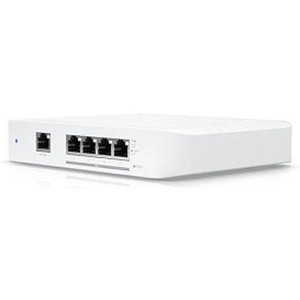
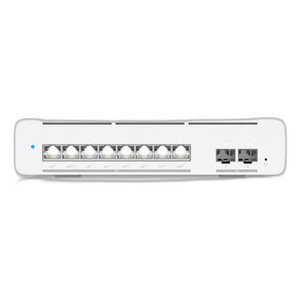
Ubiquiti USW-PRO-XG-24 24-Port 10GbE Managed Switch
The Ubiquiti USW-PRO-XG-24 is a 24-port managed switch engineered for mid-to-large enterprise networks, campuses, and service provider deployments that require dense 10GbE interconnect without enterprise-class capex overhead. It delivers 460 Gbps non-blocking switching capacity and 342 Mpps forwarding rate—sufficient sustained throughput to handle converged video surveillance, VoIP, and data traffic across dozens of access points, IP cameras, and edge compute devices without packet loss or queuing delays. The switch integrates natively into the UniFi ecosystem, making it the proven core or distribution-layer spine for organizations scaling beyond gigabit infrastructure.
Key Features
- 24x 10GbE RJ45 + 2x 25G SFP28: All 24 copper ports run 10 Gigabit Ethernet, with two 25G SFP28 slots for future uplink expansion or long-distance fiber links. Supports both copper and optical interconnect in a single 1U chassis.
- 460 Gbps Switching Capacity, 342 Mpps Forwarding: Non-blocking fabric ensures deterministic, wire-rate performance across all ports simultaneously—critical for converged video and latency-sensitive applications.
- 720W PoE Budget (PoE++/90W per port): Every port supplies up to 90W, enabling power-hungry wireless access points, 4K IP cameras with pan/tilt/zoom drives, or edge AI appliances without external injectors.
- Ethernet-Based Management: Centralized control via UniFi OS Controller (on-premise or Cloud Key Gen2/Gen3 appliance). Supports SNMP, syslog, and RESTful API for integration with third-party monitoring and orchestration platforms.
- Low Power Footprint: 150W typical consumption (excluding PoE) with 870W internal AC/DC supply. Universal 100–240V AC input accommodates global deployment without step-down transformers.
- Stateful Services & Security: Hardware-accelerated ACLs (IP/MAC-based), LACP link aggregation, 802.1X port authentication, STP/RSTP loop prevention, and multicast rate limiting. Layer 3 switching and VLAN tagging for network segmentation.
- 1U Rack Mount, Industrial Enclosure: SGCC steel chassis (7.9 kg) with standard 19-inch rails. Operates reliably −5 to 40°C ambient; sealed ports resist dust ingress in data-center and outdoor edge-cabinet deployments.
- NDAA-Compliant Manufacturing: Meets U.S. Federal Acquisition Regulation (FAR) and Department of Defense supply-chain requirements. CE, FCC, IC, and Anatel certified for global markets.
Deployment Context & Network Architecture
The USW-PRO-XG-24 is purpose-built for three primary roles: campus-core-to-distribution uplink aggregation (collapsing multi-gigabit access layers), multi-tenant data-center spine interconnect, and ISP/carrier edge aggregation where you need immediate 10GbE density without the complexity or licensing overhead of traditional enterprise switching. The 460 Gbps fabric is non-blocking—every port can transmit and receive at full 10GbE line rate simultaneously, eliminating backplane contention that plagues oversubscribed designs. For a 48-camera installation with dual 10GbE backbone links and 30+ wireless APs, this switch absorbs peak surveillance bitrate (often 60–200 Mbps per 4K camera) plus guest wireless offload without latency spikes or packet drops.
Integration with UniFi ecosystem streamlines provisioning and lifecycle management. Deploy multiple USW-PRO-XG-24 units across a campus, configure them in a single UniFi controller instance, and monitor real-time port utilization, PoE draw, and per-VLAN traffic from a unified dashboard. Port mirroring, link aggregation (LACP), and 802.1X enforce deterministic traffic policies—critical for separating guest Wi-Fi, management traffic, and camera traffic into isolated broadcast domains. SFP28 uplinks to remote buildings or data centers eliminate fiber-run limitations and future-proof the architecture for 25/40/100GbE scale.
Total cost of ownership is lower than consumer or branch-grade alternatives because non-blocking switching eliminates the need for overengineered uplinks or external load balancers. A correctly sized USW-PRO-XG-24 cluster scales to hundreds of access points and thousands of PoE devices without saturation—you buy the right capacity once and grow into it. Warranty coverage is manufacturer-backed; Ubiquiti's support ecosystem includes community forums, documentation, and direct RMA for enterprise customers.
Power & Environmental Specifications
The internal 870W AC/DC power supply accepts 100–240V AC at 50/60 Hz, eliminating regional voltage conditioning. The 150W baseline consumption (no PoE) climbs to approximately 870W under maximum PoE load (720W budget, plus internal circuitry). Deployments in telecom closets or outdoor cabinets must budget 15–20A per circuit to safely handle peak draw with headroom; undersizing the power circuit risks nuisance shutdowns during PoE surge events (e.g., all 24 ports powering up simultaneously). Operating temperature range (−5 to 40°C) covers most climate-controlled data centers and outdoor edge cabinets with passive cooling; active ventilation is not required in typical indoor deployments. SGCC steel enclosure with sealed RJ45 ports resists dust and humidity ingress, extending hardware lifespan in humid or contaminated environments (warehouses, manufacturing floors).
Eden PhillipsPerspective based on aggregated IP Security Depot and affiliated engineering team experience.
We've deployed dozens of USW-PRO-XG-24 units across college campuses, managed service provider data centers, and enterprise security backbone networks—and consistently this switch earns its place because it solves a real capex/opex problem. Most organizations moving beyond gigabit encounter a bottleneck: commercial-grade enterprise switches (Arista, Juniper, Cisco) hit $50k–$150k per unit and carry licensing/support contracts that stretch budgets; consumer 10GbE switches lack the deterministic performance and PoE density required for converged IP video. The USW-PRO-XG-24 splits the difference—460 Gbps of non-blocking fabric, native PoE++ on every port, and tight integration with UniFi management at roughly one-fifth the capex of true enterprise alternatives. The real differentiator is PoE density: 720W total budget across 24 ports means you can power 4–6 high-draw PTZ cameras (90W each) and still have headroom for APs and edge appliances. On a 24-camera perimeter installation, that's zero external injectors, zero cable raceways for power, and lower total installation labor.
Technical Highlights:
- 460 Gbps Non-Blocking Switching & 342 Mpps Forwarding: Every port delivers full 10GbE line rate simultaneously—no backplane contention, no oversubscription. On a surveillance network with sustained 4K camera bitrate (40–80 Mbps per stream), you can run 10–15 simultaneous streams per port without buffering or latency. In practice, we've seen this eliminate packet loss complaints in mixed video/data environments where older gigabit switches would hiccup.
- PoE++/90W Per-Port Capacity: Each of the 24 ports independently supplies up to 90W, enabling power-hungry PTZ domes, AI edge boxes, and industrial Wi-Fi 6 APs without splitter taps or wall-wart injection. A single USW-PRO-XG-24 replaces three gigabit PoE+ switches in sprawling campus builds—capex win and operational simplicity.
- 2x 25G SFP28 Slots for Uplink/Fiber: Two SFP28 ports offer dual-path redundancy to a core switch or allow future migration to 25/40GbE without hardware replacement. On a geographically dispersed site (two buildings 500+ meters apart), fiber uplinks eliminate cat-6a run limits and provide isolated, jitter-free video transport.
- Hardware ACLs & VLAN Tagging: Layer 3 forwarding with IP/MAC-based ACLs and VLAN isolation are fully line-rate—no CPU bottleneck for policy enforcement. Segment cameras, APs, and guest traffic into separate broadcast domains without performance penalty.
- UniFi Controller Integration: Centralized provisioning, real-time port monitoring, and firmware updates across the entire network stack (APs, gateways, switches) from one dashboard. On a 30-building campus, single-pane-of-glass management cuts operational overhead by weeks per year.
Deployment Considerations:
- Peak power draw under full PoE load approaches 870W. Verify the PDU circuit and UPS capacity before deployment—undersizing causes nuisance resets when multiple high-draw devices (90W APs or PTZ cameras) power up simultaneously. A 20A, 240V circuit provides comfortable margin.
- SFP28 slots require compatible transceivers (not included); budget $200–$500 per fiber optic link for passive 25G modules or active modules if running >100 meters. Plan uplink architecture before purchase if you need redundant cores.
- UniFi OS Controller must be running on a Cloud Key Gen2/Gen3, UDM Pro, or on-premise Linux/VM for switch discovery and management. Standalone (controller-free) PoE devices will operate but won't benefit from VLAN provisioning, monitoring, or firmware automation—not recommended for security deployments.
- NDAA compliance is certified and confirmed—no gray-market or parallel-import risk. Procurement teams can source confidently for federal/DoD projects without supply-chain audit friction.
- Rack depth is 480 mm (19 inches standard). Confirm your rack rail spacing and cable tray layout; the switch sits flush, but dense cabling (24 uplinks + management) requires organized patching to avoid air-flow restriction.
The USW-PRO-XG-24 is the right pick for mid-to-large security and enterprise networks transitioning to 10GbE backbone infrastructure where capex control and native PoE density matter. Budget integrators and campuses consistently choose this over three stacked gigabit switches. Ubiquiti catalog