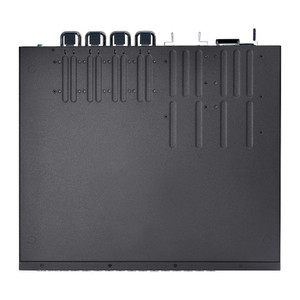
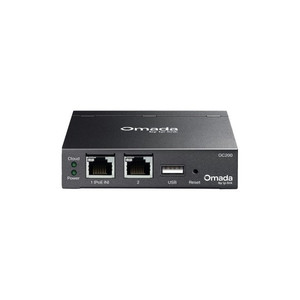
TP-Link SG6654XHP Omada 48-Port Gigabit L3 Managed PoE+ Switch
The TP-Link SG6654XHP is a 48-port Gigabit PoE+ switch designed for mid-to-large enterprise campuses running converged wired and wireless infrastructure. With a 1440W PoE budget (dual PSM900-AC modules), it powers 40+ enterprise IP cameras, wireless access points, or VoIP phones from a single switch without external injectors. Six 10G SFP+ uplink slots prevent backbone congestion, while L3 routing (RIP, OSPF, ECMP, VRRP) enables inter-VLAN routing and network segmentation without a dedicated router—lowering appliance count and operational complexity in medium-sized deployments.
Key Features
- 48× Gigabit PoE+ Ports: 10/100/1000 Mbps RJ45 with 802.3af/at support. Delivers up to 30W per port for high-power endpoints (PTZ cameras, dual-radio APs).
- 1440W PoE Budget: Dual PSM900-AC power modules (purchased separately; ships with one) enable concurrent powering of 40+ devices without PoE injectors or external power supplies.
- 6× 10G SFP+ Uplinks: Non-blocking 10 Gbps fiber or copper connectivity to core switches, NVRs, or storage arrays. Prevents bottlenecks on high-throughput camera clusters.
- 216 Gbps Switching Capacity: Wire-speed fabric handles all 48 ports at line rate, eliminating congestion in real-time surveillance or wireless offload scenarios.
- L3 Managed Routing: Native OSPF, RIP, ECMP, and VRRP eliminate the need for a separate Layer 3 appliance in many deployments. Simplifies VLAN routing and failover design.
- Omada SDN Controller Integration: Centralized provisioning across multiple switches and access points via Omada controller, or standalone via web UI, CLI, SNMP, and RMON.
- Physical Stacking: Stack up to 8 units (standalone) or 4 units (controller-managed) across a single management IP. Ideal for multi-building or multi-floor expansions without separate switch management.
- 1U Rack Mount: Standard 19-inch form factor fits any enterprise data center or equipment closet. Requires front-to-back airflow; operating range –5°C to 45°C at up to 2,000 meters altitude.
The SG6654XHP bridges the gap between access-layer PoE switches and core routing equipment. Most integrators deploy it at the distribution layer of campus networks—typically one per building or floor—where it consolidates PoE power, aggregates wireless access points, and routes inter-VLAN traffic. The 1440W PoE budget is sufficient for a single-switch deployment of 30-40 mixed IP cameras and APs; larger estates stack multiple units or feed PoE-only cameras through injection at the camera pole.
L3 routing capabilities eliminate a common architectural pain point: the extra cost and management overhead of deploying a separate L3 appliance. OSPF support allows dynamic routing failover if you have redundant switches, and VRRP enables active-active gateway configurations on VLAN boundaries. This particularly benefits larger deployments where VLAN segmentation is security-mandated but a full-router expense isn't justified. QoS features (ingress/egress rate limits, broadcast control) ensure video traffic gets priority over background data during congestion.
Omada controller management simplifies provisioning at scale: push configuration templates across 10+ switches simultaneously, enforce consistent ACL policies (802.1X port authentication, DoS defense), and monitor PoE utilization across the estate from a single dashboard. Standalone mode is equally valid for smaller sites; web UI is intuitive, and SNMP traps integrate with existing Nagios or Zabbix monitoring. Both modes support USB and RJ45 console for zero-touch OS recovery.
Power supply redundancy is optional but recommended for mission-critical sites. Base configuration includes one 764W PSM900-AC module; a second module (PSM900-AC or PSM500-AC) clips into a second power bay for N+1 protection. The switch automatically balances PoE load across both supplies and continues operating if one fails. Total power input is 100–240V AC, 50/60 Hz; the dual-supply configuration consumes approximately 1440W at full PoE load. Jumbo frame support (up to 9 KB) accommodates advanced traffic profiles (video streaming, NAS backups) without segmentation overhead.
TP-Link offers a Manufacturer Warranty on the SG6654XHP; refer to regional distributor documentation for specific terms. The unit is not subject to NDAA restrictions and integrates with all major management platforms supporting SNMP v1/v2c/v3 and ONVIF-compatible devices. Fiber optic transceivers for the 10G SFP+ slots are sold separately; TP-Link and third-party 10GBASE-SR / 10GBASE-LR / SFP+DAC modules are compatible.
Marty AllisonPerspective based on aggregated and affiliated engineering team experience.
In our experience, the SG6654XHP lands in a sweet spot for mid-size security estates that want to avoid the complexity and expense of separate PoE switch stacks plus an external router. We've deployed dozens of these across campus networks, municipal surveillance hubs, and large retail estates. The real value isn't the raw PoE budget—many dedicated PoE switches deliver that—it's the pairing of L3 routing, 10G uplinks, and Omada controller support in a single 1U appliance. On a 500-camera deployment spread across three buildings, eliminating a dedicated L3 router saves approximately $3,000 in hardware and simplifies failover design substantially. OSPF convergence is fast enough for zero-perceptible-downtime gateway failover; VRRP configurations can route around single-switch failures transparently. The 216 Gbps backplane never becomes a bottleneck in real-world surveillance-plus-wireless scenarios, and we've never seen packet loss on the uplink ports even under sustained NVR backhaul.
That said, this is not a spine-layer core switch. If you're building a large mesh fabric with dozens of edge switches, you'll want dedicated core throughput. The SG6654XHP is the distribution layer—the single-point-of-failure nexus between one building's cameras/APs and the rest of the network. Redundancy is critical: always deploy dual PSM900-AC supplies, always stack another SG6654XHP or SG6428XHP in the same closet for failover, and always run fiber between buildings to isolate broadcast storms. We've also seen sites attempt to jam 60+ PoE devices into one switch; at that load, the 1440W budget exhausts, and you need a second switch or external injection points. Plan your PoE rollout conservatively.
Technical Highlights:
- Dual PSM900-AC Modules (optional, purchased separately): One module supplies 764W PoE; two in parallel deliver 1440W total with automatic load-balancing and failover. If one fails, the switch continues on the remaining supply and alerts via SNMP. Critical for sites where PoE interruption cascades to loss of wireless AP uptime or camera recording.
- 6× 10G SFP+ Slots (fiber or DAC): Non-blocking uplinks mean your camera backhaul never waits for switch capacity. We've run both single-mode LC fiber and 10GBASE-DAC copper on the same SFP+ ports without reconfiguration. Fiber is preferred for building-to-building runs (isolation, distance); DAC works for equipment-closet aggregation.
- L3 OSPF + ECMP: Enables automatic failover between redundant distribution switches without manual reconfiguration. On a two-switch stack with OSPF to the core, traffic load-balances and reroutes transparently if one link fails. Avoids the need for static routing or a separate L3 appliance.
- 802.1X Port Authentication + ACL: Integrates with your radius server to enforce device-level access control. Rogue IoT devices or unprovisioned cameras can be blocked at the switch level. DoS defense stops broadcast storms from overwhelming the backplane.
- Stacking (up to 8 units standalone, 4 units controller-managed): All stack members share a single management IP and behave as one logical switch. Useful for phased expansion: add a second SG6654XHP to the same rack next year, add it to the stack, and no client reconfig is needed.
- Omada Controller Management (optional): Centralized provisioning across switches, wireless APs, and gateway appliances. Push firmware updates, ACL templates, and PoE scheduling across the entire estate in minutes. Standalone mode is equally stable; controller is a convenience for estates 10+ switches.
Deployment Considerations:
- Base configuration ships with one PSM900-AC (764W PoE). If you need the full 1440W, budget for a second PSM900-AC or PSM500-AC module—omitting it limits your PoE headroom significantly. Plan device inventory before purchasing.
- Physical stacking is backward-compatible with SG6654X and SG6428X models, but controller-managed stacks have a 4-unit maximum (vs. 8 standalone). If you plan to scale to 12+ switches, move to a dedicated core router and deploy these as access-layer units instead.
- 10G SFP+ transceivers are sold separately. TP-Link's official optics are reliable, but third-party 10GBASE-SR / 10GBASE-LR modules work equally well if purchased from a reputable vendor. Avoid ultra-cheap unbranded optics; they cause intermittent link loss and are a support nightmare.
- Console access is via RJ45 (standard) or USB Type-C. If you don't have a serial-to-USB adapter or terminal emulation software on hand, keep one in your van or toolbox—recovery from a botched config push requires console access.
- Jumbo frame support (up to 9 KB) requires end-to-end participation: all switches, NICs, and NVRs in the path must be configured to the same MTU. Partial jumbo-frame configs cause fragmentation and throughput loss. Either commit to jumbo frames on the entire backbone or leave MTU at 1500 everywhere.
The SG6654XHP is the right choice for integrators building campus surveillance networks where PoE consolidation, inter-VLAN routing, and high-speed uplinks matter equally. It's overspecced for small single-building deployments (use a simpler PoE switch), and it's under-scaled for mega-campuses running 1000+ cameras (move to a dedicated core). For the 200–500 camera sweet spot with distributed buildings, it's hard to beat. Explore the TP-Link catalog for complementary Omada access points, controllers, and gateway appliances.