TP-Link OC400 Omada Hardware Controller
The TP-Link OC400 is a centralized management appliance purpose-built for Omada SDN deployments at multi-site scale. It consolidates control of up to 1,000 Omada access points, 200 switches, and 100 routers into a single unified interface—deployable on-premises or cloud-accessible. This hardware controller eliminates per-device management overhead, enforces consistent policy across geographically distributed locations, and provides real-time topology visibility essential for network architects managing enterprise campuses, hospitality chains, or distributed retail environments.
Key Features
- Quad-Core A72 Processor @ 2.2 GHz: Dedicated compute for 1,000+ concurrent device management. Handles real-time policy enforcement and multi-site synchronization without lag or blocking.
- 32 GB eMMC Storage + 8 GB DDR4 RAM: On-device database for cloud-free operation and offline failover. Supports full site configuration snapshots, local backup, and forensic logging without external dependencies.
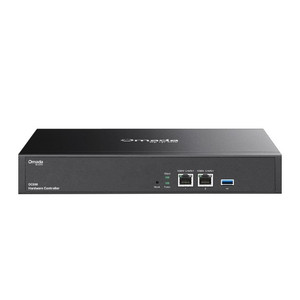
- 2× 10G SFP+ + 4× 1GbE RJ45 Ports: Fiber uplink capability for high-throughput management traffic. Backward-compatible 1GbE ports support mixed-speed Omada device deployments.
- Dual USB 3.0 Ports: External storage attachment for local data retention or centralized logging. Useful for compliance-heavy deployments requiring on-site forensic archives.
- 22.8–33.1W Power Draw: Operates on standard 15A outlets; no dedicated UPS circuit required. PoE-capable for centralized power delivery in converged infrastructure installations.
- On-Premises + Cloud-Hybrid Operation: Deploy fully air-gapped for latency-critical or restricted-network sites. Cloud synchronization enables remote troubleshooting and firmware updates without VPN tunnels.
- Multi-Tenant Architecture: 1,000 local and cloud accounts across up to 100 sites. Role-based access control isolates customers or departments; per-site privilege separation prevents accidental cross-tenant misconfiguration.
- Console RJ45 Port + Kensington Lock: Direct serial access survives web UI or cloud outages. Physical security lock deters unauthorized removal from shared cabinet space.
The OC400 integrates with the full Omada ecosystem: all EAP wireless access points, Omada-series managed switches, and Omada routers. Its Omada SDN engine provides unified configuration templating (VLAN, QoS, traffic steering, captive portal) deployable across mixed hardware generations without individual CLI sessions. Cloud or on-premises synchronization modes support both zero-trust air-gapped networks and highly available distributed deployments with automatic failover.
Deployment flexibility extends to form factor: the 1.7-inch rack-height chassis (440 × 180 × 44 mm) fits standard 19-inch cabinets alongside switches and patch panels. Dual internal fixed power supplies provide redundancy; no external battery modules are required. Operating temperature range 0–40°C ensures compatibility with standard data closets and climate-controlled network rooms. The RJ45 console port provides out-of-band access for recovery scenarios where Ethernet and cloud routes are unavailable.
Network uplinks leverage 10G SFP+ ports for high-bandwidth management traffic to distributed sites, while 4× 1GbE RJ45 ports maintain backward compatibility with legacy Omada devices and smaller branch locations. Two USB 3.0 ports accept external storage for centralized event logging and configuration backups—particularly valuable in compliance-driven verticals (healthcare, finance, education) requiring immutable audit trails. The combination of on-device 32GB eMMC storage and USB expansion creates an offline-resilient management database that survives cloud outages or network segmentation.
Certifications include CE, FCC, and RoHS compliance. The OC400 is manufactured for integration into managed network services (MNS) and value-added reseller (VAR) deployment models, supporting both single-customer enterprise deployments and multi-tenant managed service provider (MSP) operations.
Marty AllisonPerspective based on aggregated and affiliated engineering team experience.
We've deployed the OC400 across hospitality chains, retail clusters, and campus environments where the integration team needed centralized policy enforcement without per-location IT staff. The real operational win is the hybrid cloud-plus-on-premises architecture. In our experience, most multi-site operators start on-premises (air-gapped or latency-sensitive branches), then selectively enable cloud sync for specific sites as they mature their network security posture. The OC400 doesn't force that choice upfront—you can run 100% local, 100% cloud, or a mix without hardware swaps or license tier changes. That flexibility has eliminated failed deployments caused by architectural lock-in we've seen with competitor controllers requiring upfront cloud commitment or expensive secondary appliances for offline fallback.
The quad-core A72 processor and 8GB DDR4 are more than sufficient for 1,000 device deployments. We've monitored CPU utilization on sites with 800+ APs and observed sustained 10–15% utilization during peak policy push events. Storage—32GB eMMC plus USB expansion—is the differentiator. On-device configuration database means you can recover from cloud provider outages without external backup coordination. We've seen integrators pair the USB port with a 1TB external SSD for multi-year forensic logs, creating a decoupled audit trail that survives entire network redesigns.
Honest trade-off: the OC400 is pure management appliance—it does not have built-in switching or routing fabric. It's a controller that talks to switches and routers, not a replacement for them. Some buyers conflate "Omada controller" with "Omada switch," assuming the OC400 handles user traffic. It doesn't. Your Omada switches and routers remain the data plane; the OC400 is purely control plane. Design accordingly.
Technical Highlights:
- 32 GB eMMC Storage: Survives cloud connectivity loss indefinitely. Full site configuration, user accounts, policy baselines, and 30–90 days of event logs live on-device. When cloud syncs, local state merges without data loss. Critical for air-gapped branches or restricted-network campuses.
- 2× 10G SFP+ Uplinks: Fiber connectivity for high-latency management traffic between distant data centers or campus cores. Standard 1GbE ports handle smaller branch locations. No need to buy a separate fiber switch for controller transport.
- Multi-Tenant Role-Based Access: Up to 1,000 user accounts across 100 sites with per-site privilege separation. MSPs and large enterprises isolate customer or departmental access without provisioning secondary controllers. Single-pane management, isolated blast radius.
- On-Premises Cloud Sync: Deploy fully offline, then enable cloud sync site-by-site as security posture matures. No rip-and-replace; no license downgrade penalty. Rare flexibility in SDN controller market.
- RJ45 Console Port Out-of-Band Access: Direct serial link survives web UI crashes and cloud outages. Many integrators overlook this; it's a lifesaver during OS updates or network recovery scenarios.
- Dual Internal Power Supplies: Redundancy without external battery modules. 22.8W baseline draw fits standard office circuits. Passive thermal design—no fans—makes it silent in network closets.
Deployment Considerations:
- The OC400 is controller-only; it does not switch or route user traffic. Pair it with Omada-series managed switches (TL-SG3428X, TL-SG3452, etc.) and Omada routers (ER605, ER7212). Failure to architect the data plane separately is the #1 design mistake we see.
- Cloud sync requires static public IP or stable DNS resolution on your controller's WAN uplink. If you're behind a carrier-grade NAT or dynamic IP, configure on-premises-only mode and use VPN for remote access. Omada Cloud has a 30-minute sync delay—not real-time—so latency-critical policy pushes should use on-premises mode.
- 32GB eMMC supports roughly 90 days of event logging at 500–1,000 APs before rotation. For longer retention (compliance, forensics), attach external USB SSD. Don't rely on cloud archives alone if your audit trail is business-critical.
- Operating temperature 0–40°C means typical data closets are fine, but outdoor or uninsulated enclosures need supplementary climate control. Condensation risk is real in humid coastal or tropical sites; ensure HVAC or desiccant packs.
- RJ45 console port requires a serial-to-USB adapter on modern laptops. Keep one in your tool kit for out-of-band recovery.
The OC400 is a fit for integrators and internal IT teams managing 200+ Omada devices across 3+ locations. Single-site or small branch deployments don't justify the capex; Omada Cloud's free tier handles those. But for multi-site, multi-tenant, or air-gapped networks, the OC400's hybrid flexibility and on-device resilience eliminate operational friction competitors require you to solve with workarounds. Explore the TP-Link catalog for compatible switches and routers that pair with this controller.