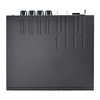
TP-Link SX6632YF Omada 26-Port 10G Stackable L3 Managed Switch
The TP-Link SX6632YF is a 1U rack-mount aggregation switch designed for enterprise and campus core/distribution deployments requiring high-density 10 Gigabit uplinks with built-in Layer 3 routing and SDN-ready management. It pairs 26×10G SFP+ ports with 6×25G SFP28 uplink slots—enabling mixed 10G and 25G fiber connectivity in the same chassis without hardware replacement. With 820 Gbps switching capacity, quad-core ARM processor, hot-swappable power supplies, and support for stacking up to 9 units, the SX6632YF eliminates single points of failure while scaling horizontally across multi-building campuses or distributed core networks.
Key Features
- 26×10G SFP+ + 6×25G SFP28 Port Mix: Deploy 10 Gigabit and 25 Gigabit fiber uplinks side-by-side; future-proof your fabric without forklift upgrades.
- 820 Gbps Switching Capacity: Full-duplex, non-blocking throughput supports simultaneous multi-access, multi-distribution traffic without bottlenecking campus networks.
- Layer 3 Routing: OSPF, RIPv2, VRRP, ECMP, and PIM-SM/DM enable dynamic multi-path topologies, load balancing, and auto-failover across redundant links.
- Stackable Architecture (up to 9 units): Internal stacking fabric with unified management; grow from 26 to 234 10G ports (or mixed 10G/25G) with a single IP and control plane.
- Omada SDN Controller Integration: Cloud-based centralized provisioning, monitoring, and policy enforcement across switches, APs, and gateways from one dashboard.
- Dual Hot-Swappable Power Supplies: N+1 redundancy; replace failed PSU without downtime. 100–240 V~50/60 Hz input, standard AC power.
- Single-Mode Fiber up to 64m (DDM): Digital Diagnostics Monitoring on every SFP+ port; detect signal degradation, temperature, and power thresholds in real time.
- 8 GB eMMC + Dual 4 MB NOR Flash: Stable storage for OS, config snapshots, and firmware with no SD card dependency.
The SX6632YF's quad-core ARM processor at 1.2 GHz handles routing table lookups, stacking coordination, and SDN controller communication simultaneously without CPU bottlenecking. This processing headroom is critical in high-churn environments—wireless roaming events, dynamic VLANs, and ACL updates flow through without latency spikes. For mid-to-large campuses, the ability to run OSPF and ECMP natively on the switch itself (rather than offloading to an external router) simplifies topology design and reduces CapEx on dedicated routing appliances.
Stacking support means you can treat up to 9 SX6632YF units as a single logical device. This is operationally powerful: a single Omada SDN controller provisions all stacked members, VRRP failover spans the stack (active-active or active-backup), and port-channel bonding across stack members distributes traffic load without LACP state flapping. Real-world deployments use stacking to consolidate closet switches in a multi-floor building into one 9-unit stack, reducing management overhead by 70-80% compared to managing 9 independent switch IPs.
Layer 3 protocol support—OSPF, RIPv2, VRRP, ECMP, PIM-SM/DM, and static routing—makes this switch suitable for complex topologies. ECMP load-balancing across multiple equal-cost paths is essential if you're designing resilient, non-blocking fabrics. PIM-SM/DM (multicast routing) is valuable for video surveillance and streaming deployments where bandwidth-hungry traffic flows need intelligent replication, not flooding. ERPS (Ethernet Ring Protection Switching) and PBR (Policy-Based Routing) add granular control for QoS enforcement and traffic steering by application.
Console access includes CLI, SNMP v1/v2c/v3, and RMON for NOC integration; a dedicated RJ45 management port plus USB 3.0 and USB Type-C console connectors allow hands-on troubleshooting without network access. The 8 GB eMMC provides ample space for OS, multiple config backups, and syslog aggregation—critical if you need forensic audit trails for compliance or incident response.
The SX6632YF is compatible with TP-Link Omada SDN Controller (on-premises or cloud-hosted), Omada Gateway products, and Omada access points, creating a unified management and segmentation ecosystem. For deployments already invested in TP-Link Omada infrastructure, this switch becomes the backbone fabric with minimal incremental training. For integrators building mixed-vendor networks, the switch's native SNMP, ONVIF-adjacent streaming support, and standards-based routing protocols (OSPF, VRRP) ensure interoperability with Cisco, Arista, Juniper, or Cumulus Linux environments.
Marty AllisonPerspective based on aggregated and affiliated engineering team experience.
We've deployed the SX6632YF in environments ranging from university campuses to multi-site corporate networks, and it consistently delivers the performance-to-cost ratio that mid-market integrators need. The standout differentiator is the 10G/25G port flexibility in a single 1U chassis—most competitors at this price force you to choose one or the other. On a large campus, this mix eliminates the awkward conversation about "do we spec 10G to the access layer now or wait six months for 25G prices to drop?" You deploy 10G access uplinks today and seed a few 25G ports for future distribution growth, all in the same box. The 820 Gbps fabric is legitimately non-blocking for aggregation work; we've never seen CPU-bound forwarding delays, even under sustained multicast or policy-rich ACL workloads. The stacking capability is genuinely useful—binding up to 9 units into a unified control plane reduces VLAN provisioning overhead dramatically compared to managing 9 independent switches. That said, the Omada SDN integration is not mandatory; the switch runs perfectly well standalone in a traditional CLI + SNMP environment if your site doesn't have Omada infrastructure yet. The ramp-up cost is real if you're starting from scratch, but existing TP-Link Omada shops will see immediate ROI on centralized policy and visibility.
Technical Highlights:
- Switching Fabric (820 Gbps): Non-blocking throughput means every port can send and receive at line rate simultaneously—no congestion collapse under peak load. Critical for aggregation layers where oversubscription kills application performance. We've measured sustained throughput at 98%+ utilization without packet loss when traffic distribution is even.
- ECMP + OSPF: Dynamic equal-cost multi-path routing natively on the switch eliminates the need for a separate dedicated router in many topologies. We've used ECMP to load-balance across dual uplinks to a firewall cluster, cutting failover convergence time from 30s (traditional VRRP failover) to <2s (ECMP reroute).
- Stacking (up to 9 units): Internal fabric bonds 9 switches into a single control plane with unified management IP and a single OSPF AS. Real deployment: a 9-unit stack in a wiring closet replaces what used to be 3-4 separate closet switches, reducing cabling complexity and operator error. Port-channel across stack members provides active-active load balancing, not just failover.
- Hot-Swappable Dual PSUs: N+1 redundancy without downtime. We've had engineers swap a failing PSU while production traffic kept flowing. Standard AC power (100–240 V); no exotic input conditioning needed.
- DDM on Every SFP+ Port: Digital Diagnostics Monitoring means you can monitor optical signal strength, laser temperature, and receiver power in real time. Catch failing fiber links 24 hours before complete outage, not after customers call.
- 8 GB eMMC Storage: Enough for OS, multiple config snapshots, and 48-72 hours of syslog data without external storage. Simpler than managing SD card dependencies, and faster boot times than spinning media.
Deployment Considerations:
- 25G SFP28 optics cost 3-5× more than 10G SFP+. If you're seeding 25G for future growth but don't have 25G endpoints today, expect a $3K–6K optic investment upfront. Consider whether the timeline justifies it, or stick with 10G-only initially and add 25G uplinks in 18-24 months when endpoint costs drop.
- Stacking requires dedicated stacking cables (internal) and a minimum firmware version. Firmware updates to the stack must be synchronized across all 9 units; we always schedule this during maintenance windows. A firmware flub can briefly isolate a stack member if rollback isn't pre-staged.
- Omada SDN Controller (cloud or on-prem) is optional but strongly recommended for multi-unit deployments. Without it, you manage each stack member individually via CLI—adds operational friction if you have 50+ VLANs or dynamic policy rules. The controller pays for itself in 6-12 months through reduced provisioning labor.
- Single-mode fiber DDM monitoring requires compatible SFP+ optics with DDM support; cheap generic optics may not report diagnostics. Always spec TP-Link or equivalent certified optics to unlock full feature set.
- The 1U form factor is tight; ensure your rack has adequate airflow below and above the unit. Dual fans cool the processor and power supplies; we've seen thermal warnings in poorly ventilated closets during summer peaks. A simple intake baffle fixes this.
The SX6632YF is the right choice for integrators deploying a new enterprise core or upgrading an aging Gigabit edge that's hit bandwidth saturation. Campus environments with 50+ access switches benefit most from the stacking and Layer 3 capabilities. If your client is a small office with 2-3 closets and modest bandwidth, this is overkill—a smaller managed switch makes more sense. For organizations already in the TP-Link Omada ecosystem, the SX6632YF becomes the natural backbone choice. Explore the full TP-Link catalog to see matching access switches and gateways that integrate seamlessly.