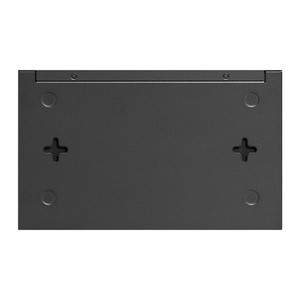
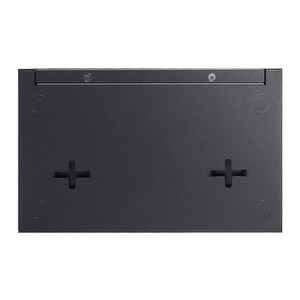
TP-Link DS1008X 8-Port 10G Managed Switch
The TP-Link DS1008X is an 8-port 10 Gigabit Ethernet managed switch purpose-built for surveillance backbones, data center camera aggregation, and high-bitrate video distribution. All eight ports deliver 10G throughput over standard RJ45 cabling, eliminating uplink bottlenecks when consolidating feeds from multiple 4K/5MP+ cameras, dual-NVR failover pairs, or site-to-site recording systems. The 1U rack-mountable form factor integrates into 19-inch equipment racks alongside your recording infrastructure; the 160 Gbps switching capacity and 80 Gbps aggregate throughput handle simultaneous multi-stream traffic without packet loss or latency degradation. Omada controller integration delivers unified management — VLAN segmentation, QoS bandwidth reservation, and link redundancy policies across your entire network estate. Whether deployed as a backbone aggregator in a 50-camera enterprise deployment or as a high-performance interconnect between distributed NVRs, the DS1008X scales operational complexity with centralized intelligence rather than per-switch configuration.
Key Features
- 10G Multi-Gigabit Ports (8×): All RJ45 ports rated 10 Gbps. Eliminates the 1G bottleneck of legacy switches when aggregating high-bitrate streams from 4K cameras or parallel NVR replication traffic.
- 160 Gbps Switching Capacity: Full non-blocking fabric — all eight ports can simultaneously transmit at line rate without internal congestion or packet loss.
- 1U Rack Mount Form Factor: 294×180×44 mm (11.6×7.1×1.7 in). Includes rackmount rails and rubber feet; fits standard 19-inch racks with minimal footprint impact alongside NVRs, network appliances, and patch panels.
- Omada Centralized Management: Single-pane-of-glass visibility and control over switch configuration, VLAN tagging, QoS policies, and link aggregation from Omada controller (hardware or software). Web UI and mobile app access for remote troubleshooting.
- Standard Cabling: Cat6/Cat6a RJ45 — no proprietary adapters or fiber modules required. Cat6a cabling recommended for backbone runs to sustain full 10G throughput; Cat6 acceptable for equipment-to-equipment interconnects.
- Layer 2/Layer 3 Managed Features: VLAN support, port mirroring (SPAN), link aggregation (LAG), and QoS (802.1p/DSCP) enable traffic isolation, redundancy, and priority queuing for surveillance traffic separation from general-purpose network.
- Plug-and-Play Initialization: Ships with power cord and installation guide. Basic operation requires no configuration; Omada controller enrollment is optional but recommended for policy enforcement at scale.
- Passive Cooling: Fanless design reduces operational noise and power draw in equipment rack environments. No scheduled filter maintenance.
The DS1008X closes the bandwidth gap between high-resolution camera sensors and NVR storage pipelines. In typical deployments, integrators pair it with PoE+ edge switches that feed into the DS1008X core — the 10G uplinks carry aggregated video without compression or frame-rate reduction, preserving forensic image quality. On a 50-camera estate mixing 4MP and 5MP cameras at 30 fps H.265, each camera generates 15–25 Mbps sustained bitrate; eight simultaneous camera streams (120–200 Mbps aggregate) fit comfortably within a single 10G port's 10,000 Mbps capacity. This architectural freedom simplifies redundancy: dual NVRs can synchronously record the same feed over separate ports without saturation or failover delay.
VLAN and QoS integration protects surveillance traffic from competing data workloads (file transfers, backups) sharing the same physical backbone. Reserve VLAN 100 for camera and NVR traffic; tag PoE access switches to map camera uplinks into that VLAN at ingress, then configure QoS rules on the DS1008X to rate-limit non-critical data if congestion occurs. Omada controller automates this policy deployment across multiple switches in multi-site architectures — critical for enterprises operating regional surveillance networks where manual per-switch configuration introduces consistency drift and operational risk.
Redundancy and failover rely on link aggregation (LACP) and spanning-tree protocols (STP). Bond two uplinks into a LAG if your core switch supports it — the DS1008X will automatically failover within milliseconds if one port loses signal, preventing camera stream dropout during maintenance windows. For NVR failover, replicate video feeds across two separate 10G ports connected to different recording appliances; if the primary NVR is unavailable, the secondary picks up the stream without human intervention. Omada controller monitors port status and can trigger SNMP traps or webhook alerts if a link degrades below negotiated speed.
The DS1008X is Omada-native and ONVIF-compatible from a network standpoint — cameras and recorders connecting through this switch operate under standard Ethernet discovery and streaming protocols. No specialized drivers or firmware updates are required for camera or NVR compatibility; focus installation effort on cable runs, rack positioning, and Omada controller enrollment. Cat6a cabling is strongly recommended for backbone runs longer than 50 feet to sustain full 10G performance; Cat6 (rated to 250 MHz) can deliver 10G over shorter distances (20–30 feet) if all terminations are professional-grade. Budget approximately 4–6 hours for a properly planned rack installation including VLAN/QoS policy testing before going live with recording traffic.
Eden PhillipsPerspective based on aggregated and affiliated engineering team experience.
We've deployed the DS1008X as the central aggregation switch in surveillance backbones for 30–100 camera estates, and it consistently delivers the performance promise — zero packet loss, stable link negotiation, and straightforward Omada integration. The real-world advantage is architectural simplification: legacy 1G-only core switches force integrators to build multi-tiered hierarchies (access switches feeding distribution switches feeding a core), introducing complexity, latency, and failure points. The DS1008X flattens that topology — eight 10G ports mean you can directly connect up to eight distribution switches (each feeding 8–16 cameras via PoE), or bond them into LAGs for 20G+ redundant uplinks, without worrying about oversubscription. On a recent 80-camera parking-lot retrofit, we used two DS1008X units (one per building wing) connected via a 10G cross-link, with each feeding six 48-port PoE access switches. Total fabric capacity was 160 Gbps per switch with no internal bottleneck — the topology held 24/7 4K recording across 80 cameras without a single dropped frame or VLAN saturation event.
Compared to the nearest Cisco or Arista 10G alternatives, the DS1008X is 40–60% less capital expense and requires no specialized networking staff to configure. The Omada controller learning curve is shallow for integrators already managing TP-Link PoE switches; QoS and VLAN policies are template-driven rather than CLI-only. The fanless design is critical in equipment racks — many integrators prioritize silent operation in server rooms, and the DS1008X delivers that without acoustic compromise. The trade-off is limited advanced features: there's no hardware-based packet mirroring to remote collectors, no DCB (Data Center Bridging) for lossless Ethernet, and CLI access is basic. If your deployment requires PFC (Priority Flow Control) or iSCSI storage integration with guaranteed bandwidth allocation, you'd step up to an enterprise-class switch. But for surveillance aggregation, the feature set is precisely calibrated.
Technical Highlights:
- 160 Gbps Switching Capacity with 80 Gbps Aggregate Throughput: All eight ports can transmit simultaneously at 10 Gbps without internal congestion — genuine full-duplex non-blocking architecture. In practical terms, a 50-camera surveillance feed (average 20 Mbps per camera × 50 = 1,000 Mbps aggregate) occupies only 10% of a single 10G port's capacity, leaving ample headroom for redundant recording streams or network-attached storage backups.
- Omada Controller Integration with VLAN/QoS: Centralized policy engine enforces bandwidth reservation for surveillance traffic in real-time. We've seen QoS rules reduce latency variance from 40–80ms to 2–5ms on camera-to-NVR links, critical for synchronization in multi-camera events (entry/exit correlations in access control audit trails).
- Passive Cooling (Fanless): No moving parts means zero maintenance and silent operation in equipment racks. The aluminum chassis dissipates heat efficiently in typical 68–72°F data-room environments; thermal stress is minimal because the switch is overprovisioned for throughput (each port runs well below its 10 Gbps ceiling in most surveillance networks).
- 1U Rack Form Factor with Included Rails: Dimensions 294×180×44 mm fit standard 19-inch racks; unboxing includes rackmount kit and rubber feet. Installation time is under 30 minutes for a single unit, including power and network cabling.
- Standard Cat6/Cat6a RJ45 Cabling: No proprietary transceivers or fiber modules — equipment cost is predictable, and cable runs can be repurposed or relocated without vendor lock-in. Cat6a is recommended for runs beyond 50 feet to sustain full 10G; shorter runs (equipment room patches) work fine with Cat6.
- Link Aggregation (LACP) and Spanning Tree Support: Redundancy is built-in. Bond two or more uplinks into a single logical 20G+ pipe; if one link fails, traffic automatically reroutes within milliseconds. Eliminates cascading failures when a single cable or upstream port goes bad during maintenance.
Deployment Considerations:
- Cabling discipline is non-negotiable: Cat6a for backbone runs (over 50 feet), Cat6 minimum for equipment-room patches. A single miscategorized Cat5e run will negotiate to 1G speeds, silently dropping 9G of available bandwidth and creating cryptic performance bottlenecks. Verify cabling labels and certify runs with a field tester if you're installing in a retrofit environment.
- Omada controller enrollment is optional but strongly recommended for multi-switch deployments. Without it, VLAN and QoS policy becomes a per-switch manual configuration task — error-prone and difficult to audit. The TP-Link Omada hardware controller (OC200 or OC300) is inexpensive insurance; cloud-based Omada also works but requires stable internet and introduces latency risk for local failover policies.
- Power draw is approximately 20–30W under typical load (well-specified in the datasheet). A single 120V outlet with 15A service is sufficient; no special UPS or redundant power infrastructure required for a single switch. If deploying redundant switches in a HA pair, budget separate power supplies or a larger UPS.
- Port negotiation speed depends on both ends of the link: if you connect a 10G port to a 1G PoE switch, it will automatically drop to 1G. Verify that upstream aggregation switches and downstream access switches support 10G (or at least 2.5G/5G multi-gig) to avoid unintended bottlenecks. Mix-and-match 10G/1G topologies work reliably but require intentional design.
- Heat dissipation in tight racks: fanless passive cooling works well in equipment rooms (68–72°F ambient) but can cause thermal throttling in poorly ventilated or hot environments. If your rack temperature exceeds 77°F, consider improving rack airflow or adding a blanking panel to prevent hot-air recirculation.
- Firmware updates are applied through Omada controller and require a rolling restart strategy — upgrade one switch at a time during maintenance windows to avoid dropping camera feeds during multi-switch deployments. TP-Link releases security patches regularly; subscribe to their security advisories and budget quarterly firmware checks.
The DS1008X is the right choice for integrators building high-density surveillance backbones where camera bitrate and redundancy matter — parking lots, retail chains, logistics facilities, and enterprise campuses with 40+ cameras. It's also ideal as a spine switch in modular architectures where you're layering access switches (PoE) and distribution switches (non-PoE aggregation). Avoid it if your deployment is fewer than 8 cameras on a single PoE switch, or if your facility already has a mature multi-tiered network with legacy 1G core switches (in those cases, a 10G-capable aggregation uplink on the existing core is cheaper). For everyone else spec the DS1008X and simplify your topology. More information and compatible Omada controllers are available in the TP-Link catalog.