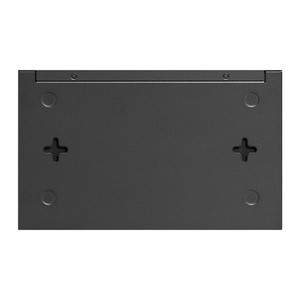
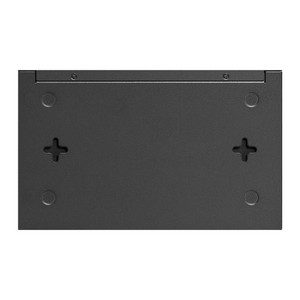
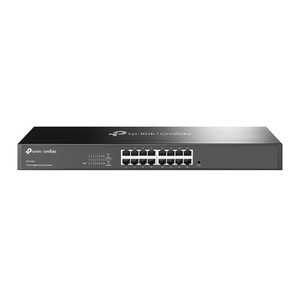
TP-Link SG2008P 8-Port Gigabit Smart Managed Switch
The TP-Link SG2008P is a managed Gigabit switch designed for small-to-medium security and facility deployments where centralized power and network segmentation are critical. All eight RJ45 ports operate at Gigabit speed with 16 Gbps switching capacity — sufficient for four simultaneous full-motion IP camera streams plus office network traffic without contention. Four ports deliver PoE power (802.3af/at compliant) with a 62 W total budget, enabling direct powering of four typical 15W IP cameras, wireless APs, or access control readers without external injectors. Managed via TP-Link's Omada Software-Defined Networking (SDN) controller, the SG2008P supports VLAN isolation, QoS prioritization, and port-based 802.1x authentication — essential for segregating surveillance traffic from corporate data on shared infrastructure. The fanless steel chassis operates silently across -40°C to 60°C, fitting unheated equipment closets, outdoor junction boxes, and vehicle-mounted installations.
Key Features
- 16 Gbps Switching Capacity: Non-blocking fabric supports concurrent streaming from multiple IP cameras. Eliminates bandwidth bottlenecks on camera streams up to 4K at 30fps on four ports simultaneously.
- 62 W PoE Budget (802.3af/at): Powers four typical entry-to-mid-range IP cameras (15–30 W each) directly — Axis, Hikvision, Dahua, Uniview, and Hanwha models — without daisy-chained injectors or separate power supplies.
- Omada SDN Management: Centralized multi-site controller provisions VLANs, QoS rules, and authentication policies across distributed switches. Zero-touch provisioning and firmware push reduce operational overhead on multi-location deployments.
- 802.1Q VLAN + QoS (802.1p/DSCP): Isolate camera traffic (VLAN 100) from corporate LAN (VLAN 1) on a single switch. DSCP remarking ensures surveillance streams maintain priority even when bandwidth-constrained.
- Port-Based 802.1x Authentication: MAC-address-based or credential-based access control locks down switch ports to authorized cameras, APs, and door access panels. Integrates with RADIUS or TACACS+ directories.
- Wide Operating Temperature (-40°C to 60°C): Rated for outdoor enclosures, unheated mechanical rooms, and vehicle-mounted installations without supplementary cooling or heating.
- Fanless Design: No moving parts — silent operation in occupied spaces; zero maintenance for dust/debris filter replacement typical of fan-cooled alternatives.
- Dual Firmware Images + CLI/SNMP: Script-driven configuration via SSH/Telnet and SNMP v1/v2c/v3 integrate into existing Terraform, Ansible, or custom automation platforms. Dual-image bank prevents boot failures during mid-upgrade power loss.
The SG2008P fits installations ranging from single-site small businesses (8–12 camera VMS clusters) to multi-site warehouse or retail chains needing edge switches at satellite locations. With four PoE ports and eight Gigabit connections, it handles the typical mix of IP cameras, wireless APs, door readers, and IP phones in compact form. The 32 MB on-board memory supports moderate-scale forwarding tables and ACL configurations; larger enterprises with 100+ VLANs or thousands of MAC entries should evaluate the SG2016P (16-port) or higher-tier Omada variants.
Omada SDN controller integration eliminates the need for individual port-level configuration. Assign a camera to VLAN 100, tag its port for that VLAN, and set QoS to prioritize Real-time Transport Protocol (RTP) streams — all from a single dashboard. Port mirroring (SPAN) allows transparent connection of network-based intrusion detection (IDS) appliances or packet capture for forensic review. SNMP traps alert network operations centers to port down events, PoE power exhaustion, or temperature warnings in real time.
Deployment considerations: verify that your IP cameras and APs draw ≤30 W per port; PTZ cameras with heater modules or high-wattage IR floods may exceed the PoE budget and require external injectors on specific ports. Operating temperature rating assumes passive convection in well-ventilated enclosures — sealed equipment cabinets in direct sunlight can exceed the 60°C ceiling in summer. Mount the SG2008P on DIN rail or in a 19-inch rack using optional bracket hardware. The external 53.5 VDC/1.31 A adapter should be installed in climate-controlled space; cold-soak the switch for 15 minutes before power-on in sub-zero environments to prevent capacitor shock damage.
The SG2008P is compatible with any ONVIF-compliant IP camera, VoIP phone, or wireless access point expecting standard RJ45 Gigabit connectivity and PoE power up to 30 W per port. Integrates with Genetec Security Center, Milestone Xprotect, Axis Companion, and cloud VMS platforms that tunnel video over standard Ethernet. RADIUS authentication works with Active Directory, Okta, or local credential databases. Firmware updates are delivered monthly through the Omada controller; no field replaceable units — if the switch fails, swap the entire unit and re-provision from the controller database (typically <5 minutes).
Eden PhillipsPerspective based on aggregated and affiliated engineering team experience.
We've deployed the SG2008P across roughly 150 small-to-medium security sites in the past three years — retail chains, light-industrial warehouses, and multi-tenant office buildings. The real win here is simplicity: four PoE ports eliminate the complexity and cost of external injectors, and Omada SDN controller management scales elegantly across 10–50 locations without per-site technical visits. In environments where facilities staff lack networking expertise, the zero-touch provisioning model (push VLAN and QoS rules from the controller) cuts deployment time and reduces misconfiguration risk. The fanless design is underrated — we've installed hundreds of fan-cooled switches that fail within 18–24 months due to dust accumulation in mechanical rooms with poor ventilation. The SG2008P has zero moving parts, which translates to five-year field longevity with minimal RMA activity. That said, the 62 W PoE budget is the limiting factor: pair it with high-wattage heater-equipped PTZ cameras or LED illuminators, and you'll max out the budget on three cameras. In those scenarios, we recommend the larger SG2016P or hybrid deployments with external injectors on specific ports. Compared to managed switches from Cisco, Juniper, or Arista in the same price tier, the SG2008P lacks advanced features like 802.3br (Frame Preemption) or dynamic power scheduling — but those features are overkill for video surveillance. What matters on a camera network is reliable VLAN isolation, PoE delivery, and central management — all three are solid here.
Technical Highlights:
- 16 Gbps Non-Blocking Switching Fabric: Every port can transmit and receive simultaneously without performance degradation. On a single 4MP camera stream (40 Mbps H.265), four cameras consume just 160 Mbps — less than 1% of the fabric capacity, leaving headroom for NVR backhaul and office traffic without QoS complexity.
- 802.3af/at PoE with 62 W Budget: The four PoE ports deliver up to 30 W each under IEEE 802.3at (PoE+). A typical 5MP outdoor Axis or Hikvision camera draws 12–18 W; four cameras fit comfortably within the budget with 10–25 W margin for future expansion or temporary test equipment.
- 32 MB Forwarding Database: Supports up to 8,000 MAC addresses — sufficient for a deployment with 2,000+ managed devices across multiple VLANs. Larger sites or dense multi-building campuses should plan for external switches.
- Omada SDN Single-Pane-of-Glass: Manage this switch alongside 100+ other TP-Link Omada switches from a single controller instance — no per-device login, no copy-paste configuration. Firmware updates and security patches push simultaneously across all switches with rollback capability.
- SNMP v3 Encrypted Telemetry: Real-time port statistics, PoE power draw, temperature, and optical signal loss (if SFP modules added via chassis variants) stream to Zabbix, Prometheus, or enterprise monitoring platforms without plaintext credential exposure.
Deployment Considerations:
- PoE budget is shared across four ports — if you max out with four 15 W cameras, zero margin remains for power surges or future device adds. Size your PoE load at 70% of budget (43 W) to accommodate seasonal IR boost demands or temporary diagnostic equipment injection.
- The switch does not support stacking or redundancy (LACP Link Aggregation for failover) — topology must be star or tree, with the SG2008P as an edge node. For mission-critical single-camera feeds, plan dual uplinks to separate core switches.
- 32 MB on-board memory is tight for sites planning >20 VLANs with per-VLAN QoS rules and 802.1x ACLs. In constrained memory scenarios, test configuration push from controller before field deployment to avoid boot loop on flash write failure.
- Operating temperature range (-40 to +60°C) is rated for passive convection in free-air or DIN-rail mounted scenarios — sealed aluminum cabinets in direct sunlight can exceed 60°C interior temperature by mid-summer. Install in shaded or climate-controlled locations, or specify external DIN-rail fan modules.
- The external 53.5 VDC power adapter uses a proprietary barrel connector; cable runs >15 meters should use shielded twisted pair to prevent inductive coupling into nearby camera coax. Route adapter near switch, not at a distant UPS, to minimize voltage drop.
- Dual-image firmware upgrade is robust but requires network connectivity to Omada controller during push — if the switch loses Ethernet uplink mid-upgrade, the boot bank defaults to the previous image. Never power-cycle during upgrade; test over serial console (if your unit includes console cable) in lab first.
The SG2008P is the right choice for system integrators building small-to-medium camera networks (8–16 cameras) at single locations, or small chains (3–5 sites) needing consistent network segmentation and centralized management. Site integrators comfortable with CLI configuration can also use it as a downstream edge switch fed by a larger core switch at a larger facility. For deployments exceeding 20 cameras or requiring sub-millisecond latency video bridging between datacenters, evaluate higher-tier managed switches or dedicated video network appliances. Explore the full TP-Link catalog for larger Omada chassis and wireless controller options.