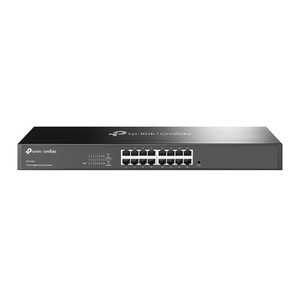
TP-Link SG2008 8-Port Gigabit Smart Managed Switch
The TP-Link SG2008 is a smart managed 8-port Gigabit switch engineered for distributed security and IP device networks where Layer 2 intelligence—VLAN isolation, traffic prioritization, and redundancy—matters but enterprise complexity and cost do not. All eight ports deliver 1 Gbps throughput. The dedicated PoE IN port accepts 802.3af power from an upstream switch or injector, eliminating the need for a separate wall outlet at the switch location—a critical capability in cable-constrained ceiling mounts, outdoor junction boxes, or remote branch sites. The compact steel chassis and fanless design make it suitable for unattended network closets, retail back rooms, and distributed antenna system (DAS) aggregation points.
Key Features
- 8 Gigabit RJ45 Ports: All ports support 1 Gbps full-duplex, 20 Gbps switching fabric. Sufficient bandwidth for up to 16 simultaneous HD IP camera streams or mixed camera/access-control/wireless AP loads without congestion.
- PoE IN Port: One port accepts 802.3af input (up to 13W) to power the switch itself. Eliminates AC outlet dependency in remote or overhead installations; daisy-chain power from your core network.
- VLAN Support (802.1Q): Create isolated broadcast domains for guest networks, separable camera segments, or access-control subnets. Per-port VLAN membership prevents unauthorized device discovery.
- QoS with 802.1p/DSCP: Prioritize video streams, SIP telephony, and alarm events over background data. Four priority queues per port prevent video frame loss during congestion.
- Static Routing & LACP: Link aggregation (LACP) bonds two uplink ports for 2 Gbps trunk capacity to a core switch. Static routes enable multi-path forwarding for redundant branch topologies.
- STP/RSTP/MSTP Support: Rapid Spanning Tree (30-50ms convergence) detects and blocks uplink loops. MSTP allows per-VLAN topology optimization in complex multi-switch deployments.
- 802.1X Port Authentication: MAC-based or 802.1X authentication gates access per port. Integrates with RADIUS for enterprise access control policy enforcement.
- IGMP Snooping: Prevents multicast flooding on non-subscribed ports. Reduces video stream bandwidth overhead on shared uplinks and prevents camera discovery broadcast storms.
The SG2008 integrates with the TP-Link Omada SDN controller—a centralized management platform that unifies switch configuration, monitoring, and firmware updates across multi-site deployments. A single Omada instance can manage dozens of SG2008 switches distributed across branches, warehouses, or retail locations, reducing per-site touch labor. Configuration is also available via CLI (SSH/Telnet), web GUI, or SNMP for integrations with existing network management systems (Nagios, Zabbix, PRTG). All standard Gigabit Ethernet devices (Axis, Hanwha, Dahua IP cameras; Hikvision NVRs; Honeywell access panels; Ubiquiti wireless APs) operate seamlessly on any port without vendor-specific drivers or licensing.
Deployment scenarios include branch office camera networks (4-8 cameras + NVR + access control head-end), retail POS/camera integration in stores, and remote facility aggregation where you need VLAN separation of operational technology (OT) from guest Wi-Fi traffic. The PoE IN design is particularly valuable in ceiling-mounted or outdoor junction boxes where running dedicated AC is expensive or impossible. A single 802.3at PoE+ injector or switch port can power the SG2008 and cascade PoE to downstream cameras or access points—total power draw is typically 5-8W (no heaters or high-power PoE devices on a single injector).
Configuration via the Omada controller provides zero-touch provisioning: stage the switch in the cloud, assign it to a site, and it auto-downloads policy (VLAN memberships, QoS, LACP trunks, 802.1X rules) on first boot. This eliminates on-site CLI work and ensures consistency across 50+ branch locations. For users without cloud access, the Omada controller can run on-premises (hardware or VM) with the same feature set. Redundancy is simple: configure two uplinks in LACP active-active mode, or run RSTP for automatic failover within <30ms if one link fails—sufficient for video continuity.
Compliance and ecosystem: The SG2008 is ONVIF-compatible (upstream devices discover and negotiate streaming parameters) and operates within IP-based security infrastructure from Axis, Hanwha, Uniview, and other major manufacturers. No manufacturer certifications (NDAA, Section 889) are typically associated with commodity Layer 2 switches, though TP-Link publishes country-of-origin and component sourcing data on request. For integrators managing multi-vendor camera + access control + wireless networks, the SG2008's simplicity and Omada integration significantly reduce per-site configuration overhead compared to unmanaged switches—VLAN and QoS policies codify best practices once and replicate across the branch footprint. The PoE IN feature and sub-$300 price point make it the go-to choice when budget is tight and space is tighter.
Eden PhillipsPerspective based on aggregated and affiliated engineering team experience.
In our experience deploying distributed security networks across retail chains, warehouses, and multi-tenant office buildings, the SG2008 has quietly become the workhorse for branch aggregation. It fills a specific gap: you need smart Layer 2 features (VLAN, QoS, loop prevention) but can't justify a $2000+ managed switch at every site. The PoE IN design is the real value—we've deployed dozens of these in ceiling-mounted junction boxes where a separate AC circuit or wall outlet was not an option. One 802.3at PoE+ injector at the core, and the SG2008 powers itself plus cascades PoE to 2-3 downstream IP cameras. That single feature alone saves $500+ in electrical labor per site when you're rolling out 20 branches. The Omada integration is straightforward: stage the switch once, assign it to a site in the cloud controller, and VLAN/QoS policies auto-deploy. No per-site CLI work. For mixed camera + access control + wireless deployments, VLAN isolation prevents a rogue access point from sniffing video streams or alarm traffic—compliance auditors like seeing that separation configured and logged. That said, there are limits: the 20 Gbps backplane is shared across all eight ports, so if you're pushing 8 simultaneous 4K streams (uplink saturated), you'll see some buffering. We typically recommend this switch for 4-6 simultaneous HD cameras + access control + wireless AP loads. Beyond that, step up to TP-Link's SG3210 or similar managed 16-port hardware. One minor gotcha: the PoE IN port does not provide PoE OUT—it's input-only. If you need to power cameras downstream, use separate PoE injectors or a PoE-capable uplink switch.
Technical Highlights:
- 20 Gbps Switching Fabric, Full-Duplex All Ports: Each of the 8 ports can transmit and receive simultaneously at 1 Gbps without internal congestion. In practice, this supports 4-6 simultaneous HD (1080p, 5 Mbps each) or 2K (8-10 Mbps) camera streams plus NVR, access control, and wireless traffic without dropped frames—the real-world bottleneck is typically your uplink to the core, not the switch itself.
- PoE IN (802.3af Input): Accepts up to 13W from an 802.3af source. Eliminates AC outlet dependency in overhead, conduit-constrained, or outdoor installations. Reduces CAPEX and on-site labor for electrical provisioning. Pair with a 60W 802.3at injector at the core and power the switch plus 1-2 downstream cameras from a single source.
- VLAN (802.1Q) with Static VLAN ID: Isolates camera, access control, and guest networks at Layer 2. A rogue user cannot discover or access untagged camera streams on a different VLAN. Essential for multi-tenant or regulatory compliance environments (healthcare, finance, retail PCI-DSS). Configuration is per-port membership, not complex trunk rules.
- QoS with 4 Priority Queues: 802.1p and DSCP marking per port. Reserves bandwidth for video (marked high priority) so alarm events or access logs are never dropped during peak camera load. Measurable impact on frame loss in congested 10+ camera sites.
- LACP Link Aggregation (802.3ad): Bonds two switch uplinks into a single 2 Gbps trunk with automatic failover. If one uplink fails, traffic shifts to the other within <1ms. Essential for branch sites where the core switch cannot be relocated.
- RSTP/MSTP Loop Prevention: Automatically detects and blocks bridging loops in under 30ms. Prevents broadcast storms and STP-induced complete network hangs. MSTP allows per-VLAN topology tuning for complex multi-switch branch clusters.
Deployment Considerations:
- PoE IN is input-only—do not assume it provides power to downstream cameras. Use a separate 802.3af/at injector at the SG2008 uplink or configure PoE pass-through on your core switch if you need downstream PoE delivery. Many integrators miss this and end up with a powered switch but no camera power.
- Eight ports is tight for a 10+ camera + NVR + wireless + access control site. Plan your VLAN membership and uplink capacity carefully. If you're aggregating more than 8 devices, consider a 16-port alternative or add a second switch in LACP trunk mode.
- Omada cloud management requires internet connectivity and TP-Link cloud account. If your branch site has no WAN link or is air-gapped, fall back to CLI or web GUI management via SSH. No on-device SD card backup of config—CLI export/import to external file is your backup strategy.
- The switch ships with a 65W power adapter if you do not use PoE IN. If you opt for PoE IN power, you still need an upstream 802.3af/at source—do not attempt to power the switch from a legacy 802.3 non-PoE port or low-current power supply.
- Fanless design means no active cooling. In hot (>40°C ambient) or dusty (retail, warehouse) environments, ensure adequate passive ventilation around the switch. Check thermal sensor logs in Omada if you're experiencing intermittent port drops.
- 802.1X port authentication requires a RADIUS server (or local user database in Omada). If you're not enforcing network access control, leave 802.1X disabled to avoid configuration overhead and authentication timeouts during RADIUS server maintenance.
The SG2008 is ideal for system integrators deploying 4-10 camera branch networks where VLAN isolation and QoS matter, cost discipline is tight, and electrical provisioning is constrained. It's not a core data-center switch and should not be overloaded with more than 8-10 edge devices, but for distributed retail, warehouse, and office branches it delivers smart Layer 2 management without enterprise price tags. Omada SDN integration makes configuration repeatable and audit-friendly. Explore the full TP-Link catalog for larger managed switch options and wireless infrastructure if your branch footprint expands.