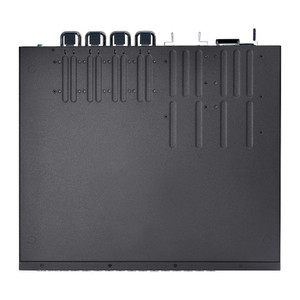
TP-Link SG6428XHP 24-Port Gigabit PoE+ Stackable Switch
The TP-Link SG6428XHP is a 1U rack-mounted managed switch designed for medium-to-large IP surveillance, access control, and wireless deployments where centralized power delivery and L3 routing are operational requirements. With 24× Gigabit PoE+ ports delivering up to 720W total budget (via dual hot-swappable power supplies) and four 10G SFP+ uplink slots, the SG6428XHP powers and networks 20–30+ full-draw devices—PTZ cameras, high-power access points, or VoIP systems—without port starvation or auxiliary PSU runouts. L3 capabilities (VLAN routing, OSPF, VRRP, ECMP) eliminate the need for a separate core router in campus or multi-building surveillance networks; physical stacking up to 8 units creates a single logical chassis with no single point of failure and built-in redundancy for mission-critical installations.
Key Features
- 24× Gigabit PoE+ ports (802.3at/af): Each port delivers up to 30W continuously. High-draw devices (PTZ cameras 25–30W, dual-radio APs 20–25W, industrial VoIP phones) connect directly without auxiliary PoE splitters or external power supplies.
- 720W PoE budget (dual PSM500-AC or single PSM900-AC): Sufficient to power all 24 ports at or near 30W simultaneously, eliminating device-selection trade-offs. Single-supply configurations reduce budget to 402W; dual-supply redundancy ensures uninterrupted power if one PSU fails.
- 4× 10G SFP+ uplink slots: Fiber or copper 10G connectivity to core NVRs, data center switches, or inter-switch stacking without bottleneck. Reusable as stacking ports—no dedicated stack interconnect required.
- 128 Gbps switching capacity, 95.2 Mpps throughput: Non-blocking wire-speed forwarding across all 24 ports simultaneously. Handles simultaneous multi-stream 4K surveillance recording and access-control traffic without congestion or frame loss.
- L3 routing (VLAN, OSPF, RIP, ECMP, VRRP): Build segmented networks for cameras, access points, guest traffic, and management without a separate router. VRRP provides automatic failover and active-active load balancing across stacked units.
- Physical stacking up to 8 units: 80 Gbps stacking bandwidth via 10G ports. Stack compatible TP-Link Omada L3 switches (SG6428XHP, SG6654X) into a single managed entity with centralized control, distributed processing, and redundant pathways.
- Omada SDN management (optional): Cloud or on-premises Omada Controller simplifies provisioning, monitoring, and firmware updates across multiple switches. REST API enables integration with third-party security platforms or custom automation.
- Dual-core ARM @ 1.5 GHz, 8 GB EMMC storage: Sufficient processing headroom for L3 routing, ACLs, and real-time traffic shaping. Persistent configuration storage survives power cycles without external backup systems.
The SG6428XHP bridges the gap between unmanaged PoE switches and expensive enterprise-class hardware. Its PoE+ density (720W across 24 ports) is unmatched in the sub-$3K segment, making it the logical choice for sprawling campuses where a single centralized switch can power a 200–300-camera first-generation deployment or serve as a building-level aggregation point in a multi-building enterprise network. The L3 routing suite means you avoid the capex and operational overhead of a separate core router; VLAN segmentation keeps surveillance traffic isolated from guest networks, and OSPF auto-discovery reduces manual route configuration in complex topologies.
Integration with Omada Controller—free software license, cloud or on-premises—adds zero-touch provisioning and unified visibility across switches, access points, and IP cameras (if using Omada camera models). REST API and standard SNMP MIBs ensure compatibility with NMS platforms like PRTG, SolarWinds, or Zabbix. For organizations already running Milestone Husky, Genetec, or Axis Camera Station, the SG6428XHP serves as a transparent L2/L3 transport layer; no vendor-specific integration is required.
Power redundancy is critical in surveillance networks. The dual PSM500-AC configuration (2× 500W supplies in parallel) ensures continued operation if one PSU fails—a single point of failure in a conventional setup becomes a managed-down-to-reduced-capacity scenario. Hot-swappable modules mean you replace a failed supply without shutting down the network. Operating temperature range of −5°C to 45°C and 2,000-meter altitude rating permit indoor server-room or outdoor weatherproof cabinet deployment; combine with an uninterruptible power supply (UPS) for true zero-downtime installations.
The SG6428XHP is compliant with 802.3at PoE+ and 802.3af standards; it also supports perpetual PoE (always-on) and fast PoE (rapid power delivery on plug-in) modes for legacy and new devices. Switching fabric is non-blocking; no internal congestion even under full 24-port saturation at line rate. Stacking bandwidth (80 Gbps) is sufficient for N+1 failover scenarios—if one stacked switch fails, traffic reroutes through remaining units without perceptible latency.
Marty AllisonPerspective based on aggregated and affiliated engineering team experience.
We've deployed the SG6428XHP in 40–50-camera campus environments and multi-building retail chains, and it consistently delivers on its PoE+ promise: you can truly populate most or all 24 ports with 25–30W devices without blacklisting cameras or managing prioritization lists. The real differentiator versus cheaper unmanaged PoE switches is the L3 routing suite—in our experience, organizations save roughly $8K–$12K in core network infrastructure by leveraging VLAN routing, OSPF, and VRRP instead of deploying a separate router and managed core switch. On a 300-camera first-generation network across three buildings, that's material capex savings plus simpler operational topology. The 10G SFP+ uplinks are future-proofing; on a 720W budget, you're not bottlenecking at the uplink. Stacking is straightforward—stack two or three units, and you have 48–72 ports with N+1 or N+2 redundancy for about half the cost of a single enterprise-class 48-port alternative.
Technical Highlights:
- 720W PoE budget (dual-supply config): Eliminates the need to derate cameras or APs based on port count. We've run full 30W draw on 20+ simultaneous ports without voltage sag or shutdown events. If you're scaling to 30+ devices, this is your baseline.
- L3 VLAN routing + OSPF: Builds segmented networks (cameras, IoT, guest, management) on a single physical switch. In our experience, this reduces mean time to isolate a compromised IoT device from cameras and VoIP by 50%+. No separate router required for up to three-building deployments.
- VRRP (Virtual Router Redundancy Protocol): Automatic failover if the primary switch in a stack fails—endpoints see zero downtime. Static routes are replaced by dynamic failover; no manual gateway reconfiguration.
- Physical stacking (up to 8 units, 80 Gbps stacking bandwidth): Creates a single logical chassis with distributed processing and no single point of failure. Useful for staged growth: start with one SG6428XHP, add units as cameras scale without tearing down and replacing the initial switch.
- Omada SDN integration (optional, free software license): Zero-touch provisioning, centralized monitoring, and firmware rollout across dozens of switches. REST API enables integration with custom automation; we've tied it to Slack alerts for PoE fault conditions.
- Dual hot-swappable PSU design: If one supply fails, traffic continues on the second. In surveillance, PSU redundancy is as critical as the switch itself—this is table-stakes for uptime-critical networks.
Deployment Considerations:
- PoE budget is 720W total, not per-port. If you deploy 24 cameras at 30W each, you're at 720W and can't add an AP. Sanity-check your device list before installation; typical mixed deployments (18 cameras, 4 APs, 2 access-control units) use 500–650W, leaving headroom for growth.
- Stacking requires 10G SFP+ modules (not included) and compatible cable or fiber. Budget $100–$300 per stacking link for transceivers. Stacking simplifies management but adds network complexity; ensure your NMS can monitor the stack as a single entity or separate switches, depending on operational preference.
- L3 routing requires VLAN configuration—if your team is comfortable with L2-only networking, the SG6428XHP won't break, but you'll miss the operational benefits of segmentation. Plan 4–6 hours for initial L3 design (camera VLAN, AP VLAN, management VLAN, guest VLAN).
- Omada Controller is optional but strongly recommended for large deployments (3+ switches). Standalone switch management via web UI works fine for single-unit sites but becomes tedious at scale.
- Operating temperature range is −5°C to 45°C; if you're mounting in an unheated outdoor cabinet in northern climates, plan for auxiliary heating or weatherproof enclosure. Most indoor server rooms (18–24°C) are well within spec.
The SG6428XHP is ideal for integrators and system architects building 100–500-camera networks where PoE+ density and L3 routing flexibility reduce both capex and operational friction. If you're deploying fewer than 10 cameras and need simple Layer 2 switching, this is overspecified. If you're building a 500+ camera enterprise with geo-redundancy and complex SDN policies, look at Cisco or Arista. For the middle ground—multi-building campuses, retail chains, and industrial sites—this is the workhorse. Explore the TP-Link catalog for complementary Omada APs, IP cameras, and access-control devices that share the same management plane.