
TP-Link SG6654XHP vs TP-Link SG3452XP: Specification Comparison
Both the TP-Link SG6654XHP and SG3452XP are Omada-managed, 1U rackmount switches with 48 gigabit PoE+ RJ45 ports and 10G SFP+ uplinks, making them direct cross-shop candidates for IP security camera deployments and enterprise access-layer builds. The comparison centers on switching tier (L3 stackable vs. L2+ standalone), PoE budget (1,440W vs. 500W), uplink density (6× 10G vs. 4× 10G SFP+), and processor/memory resources — dimensions that determine which unit fits a high-density camera floor versus a mid-size wiring closet.
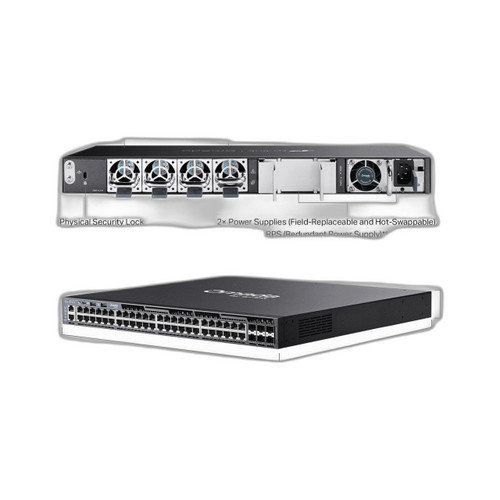
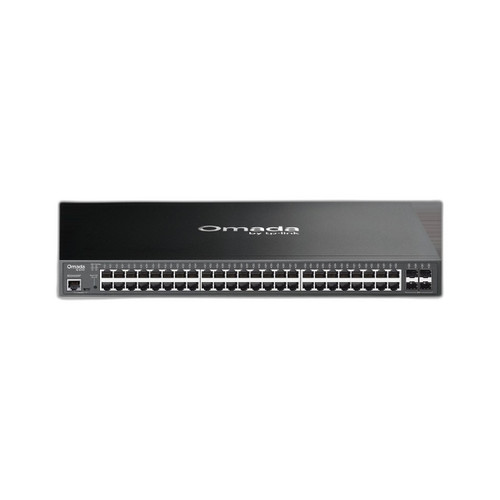
In This Guide
- Which switch delivers more PoE headroom and uplink throughput for dense camera deployments?
- Does the L3 capability and stacking architecture of the SG6654XHP justify the step up from the L2+ SG3452XP?
- How do the two switches compare on physical footprint, power supply, and operating environment?
- Which should you choose: the SG6654XHP or the SG3452XP?
- Side-by-Side Specs
- FAQ
Which switch delivers more PoE headroom and uplink throughput for dense camera deployments?
The SG6654XHP provides a 1,440W PoE+ budget (with dual PSM900-AC modules) across 48 ports rated at 802.3af/at, supporting up to 30W per port via 802.3at. Six 10G SFP+ slots yield a switching capacity of 216 Gbps. The SG3452XP's PoE budget is 500W total, also 802.3af/at at up to 30W per port, with four 10G SFP+ uplinks and a 176 Gbps switching capacity. For reference, 500W across 48 active cameras averages approximately 10.4W per port — enough for most fixed cameras but tight if PTZ or multi-sensor units drawing 25–30W are present. The SG6654XHP's 1,440W headroom allows full 30W allocation on all 48 ports simultaneously. The SG3452XP also specifies a forwarding rate of 130.94 Mpps; an equivalent figure is not provided in the SG6654XHP spec set.
Does the L3 capability and stacking architecture of the SG6654XHP justify the step up from the L2+ SG3452XP?
The SG6654XHP is classified as an L3 managed switch with a dual-core ARM processor at 1.5 GHz, 4 GB DDR4 RAM, 2×4 MB NOR flash, and 8 GB eMMC storage. The specs note stackable architecture and list the operating system as 'PF,' though no explicit stack member count or stacking bandwidth figure is provided in the supplied data. L3 capability means inter-VLAN routing, static routing, and typically dynamic routing protocols (OSPF, RIP) can be handled on-device without a separate router — relevant when camera VLANs must communicate with NVR management VLANs at wire speed. The SG3452XP is L2+ managed with 512 MB DRAM and 32 MB flash; it supports inter-VLAN routing at the L2+ tier but lacks full L3 routing protocol support per its classification. Both units integrate with the Omada SDN controller (cloud or on-premises) and support standalone web/CLI/SNMP management. The SG3452XP spec explicitly lists RADIUS/TACACS+ authentication; the SG6654XHP spec notes 802.1X and ACL but does not separately list TACACS+ in the supplied data.
How do the two switches compare on physical footprint, power supply, and operating environment?
Both switches are 1U rackmount units sharing an identical height of 1.7 in (44 mm) and the same 17.3 in (440 mm) width. The SG6654XHP is deeper at 16.5 in (420 mm) versus the SG3452XP at 13.0 in (330 mm) — a 90 mm difference that may matter in shallow-depth racks or wall-mount enclosures. Both accept 100–240 V ~50/60 Hz AC input. The SG6654XHP's 1,440W maximum draw (dual PSM900-AC) demands careful circuit planning; the SG3452XP's 500W maximum is more conventional for a single 20 A branch circuit. Both are rated for -5°C to 45°C operation. The SG6654XHP spec adds an altitude qualifier of 2,000 meters at that temperature range; the SG3452XP spec does not include an altitude rating in the supplied data. The SG3452XP lists wall and ceiling mount in addition to rack as supported mount types; the SG6654XHP spec lists rack only. The SG3452XP specifies a max copper range of 64 m; the SG6654XHP spec lists 8 m — likely a management port or specific test condition rather than a standard PoE port range, as no clarifying note is provided in the supplied data.
Which should you choose: the SG6654XHP or the SG3452XP?
Our take: The SG6654XHP is the stronger choice when PoE budget, L3 routing, and uplink density are the primary constraints. Its 1,440W PoE budget is 2.88× the SG3452XP's 500W, enabling full 30W 802.3at allocation across all 48 ports simultaneously versus the SG3452XP's ~10.4W average ceiling at full port population. Its six 10G SFP+ uplinks versus four on the SG3452XP provide more backbone or inter-switch redundancy paths. The dual-core 1.5 GHz ARM processor with 4 GB DDR4 supports L3 inter-VLAN routing on-device, eliminating a separate distribution-layer router in VLAN-segmented camera networks. Conversely, the SG3452XP is better suited to mid-size access-layer deployments where 500W PoE suffices, a shallower chassis (330 mm vs. 420 mm) aids cabinet fit, and L2+ management meets the routing requirement. Both platforms run Omada SDN, so either integrates cleanly into an existing Omada controller environment.
Side-by-Side Comparison
Spec-for-spec, from manufacturer data.
| Specification | TP-Link SG6654XHP | TP-Link SG3452XP |
|---|---|---|
| Product Class | L3 Stackable PoE+ Switch | L2+ Managed PoE+ Switch |
| PoE Budget | 1,440W (dual PSM900-AC) | 500W total |
| PoE Standard | 802.3af/at (up to 30W/port) | 802.3af/at (up to 30W/port) |
| RJ45 Ports | 48× 10/100/1000 Mbps | 48× Gigabit |
| SFP+ Uplinks | 6× 10G SFP+ | 4× 10G SFP+ |
| Switching Capacity | 216 Gbps | 176 Gbps |
| Forwarding Rate | — | 130.94 Mpps |
| Processor | Dual-core ARM @ 1.5 GHz | — |
| RAM | 4 GB DDR4 | 512 MB DRAM |
| Flash / Storage | 2×4 MB NOR + 8 GB eMMC | 32 MB Flash |
| Chassis Depth | 16.5 in (420 mm) | 13.0 in (330 mm) |
| Mount Types | Rack | Rack, Wall, Ceiling |
| Operating Temp | -5°C to 45°C (@ ≤2,000 m) | -5°C to 45°C |
| Management | Omada SDN / Standalone / CLI / SNMP | Omada Cloud & On-Prem / Standalone Web / CLI / SNMP |
| Authentication | 802.1X, ACL, DoS Defense | 802.1X, RADIUS/TACACS+ |
| Power Input | 100–240 V ~50/60 Hz | 100–240 V~ 50/60 Hz |
Frequently Asked Questions
Which should you choose: the SG6654XHP or the SG3452XP?
The SG6654XHP is the stronger choice when PoE budget, L3 routing, and uplink density are the primary constraints. Its 1,440W PoE budget is 2.88× the SG3452XP's 500W, enabling full 30W 802.3at allocation across all 48 ports simultaneously versus the SG3452XP's ~10.4W average ceiling at full port population. Its six 10G SFP+ uplinks versus four on the SG3452XP provide more backbone or inter-switch redundancy paths. The dual-core 1.5 GHz ARM processor with 4 GB DDR4 supports L3 inter-VLAN routing on-device, eliminating a separate distribution-layer router in VLAN-segmented camera networks. Conversely, the SG3452XP is better suited to mid-size access-layer deployments where 500W PoE suffices, a shallower chassis (330 mm vs. 420 mm) aids cabinet fit, and L2+ management meets the routing requirement. Both platforms run Omada SDN, so either integrates cleanly into an existing Omada controller environment.
Is the SG6654XHP or SG3452XP better for a 48-camera deployment where most cameras draw 20–25W?
The SG6654XHP is the safer choice. At 24W average across 48 cameras, total draw reaches approximately 1,152W — within its 1,440W budget but already 130% over the SG3452XP's 500W ceiling. The SG3452XP can support 48 cameras only if average draw stays below roughly 10.4W per port, which limits camera selection to lower-power fixed units.
Can either switch handle inter-VLAN routing without an external router for separating camera and management traffic?
The SG6654XHP is rated L3 managed, which per its specification includes on-device routing capability suitable for inter-VLAN routing between camera and management VLANs. The SG3452XP is rated L2+ managed; L2+ switches typically support basic static inter-VLAN routing but do not run full dynamic routing protocols. If dynamic routing (OSPF, RIP) is required, the SG6654XHP is the appropriate tier. For simple VLAN separation with static routes, either may suffice — verify with TP-Link documentation for protocol-level confirmation beyond what the supplied specs state.
Does the SG3452XP's smaller depth make it a better fit for shallow-rack or wall-mount installations?
Yes. The SG3452XP measures 13.0 in (330 mm) deep versus the SG6654XHP's 16.5 in (420 mm), a 90 mm difference. The SG3452XP spec also lists wall and ceiling mount as supported mount types in addition to rack; the SG6654XHP spec lists rack mount only. For shallow-depth enclosures or non-rack installations, the SG3452XP is the specified option.
More Network Switch Comparisons
- TP-Link SG6654XHP vs Ubiquiti USW-PRO-MAX-48
- TP-Link SG6654XHP vs Ubiquiti USW-PRO-48
- TP-Link SG6654XHP vs TP-Link SG3452XMPP
- TP-Link SG3452XMPP vs Ubiquiti USW-48
- TP-Link SG3452XMPP vs Ubiquiti USW-PRO-MAX-48
- TP-Link SG3452XMPP vs Ubiquiti USW-PRO-48
Network Switch Buying Guides
Get a Second Opinion on Your Camera Choice
Share your site layout, coverage goals, and budget. Our team will validate the camera selection, flag anything we would change, and recommend products that match the use case.