
TP-Link SG3452XMPP vs Ubiquiti USW-PRO-48: Specification Comparison
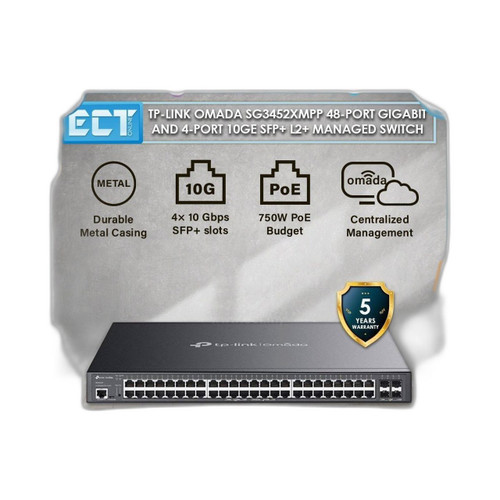
The TP-Link SG3452XMPP and Ubiquiti USW-PRO-48 are both 1U rack-mount, 48-port managed gigabit switches sharing an identical 176 Gbps switching fabric and 131 Mpps forwarding rate. The critical fork: the SG3452XMPP is a PoE++ switch delivering up to 750 W of budgeted power across all 48 ports, while the USW-PRO-48 carries no PoE capability at all. This comparison covers PoE capacity and port power, throughput and uplink architecture, and management platform fit for installers choosing between these two switches.

In This Guide
- Which switch delivers the PoE budget and port-power headroom your deployment requires?
- How do the switching fabric, forwarding rate, and uplink ports compare for high-density traffic?
- Which management model and software ecosystem fits your deployment and monitoring workflow?
- Which should you choose: the SG3452XMPP or the USW-PRO-48?
- Side-by-Side Specs
- FAQ
Which switch delivers the PoE budget and port-power headroom your deployment requires?
The SG3452XMPP is a full PoE++ (802.3bt) switch with a declared 750 W PoE budget across 48 ports. Eight ports are rated at 90 W each under 802.3bt, and the remaining 40 ports support 802.3af/at (up to 30 W each). This allows simultaneous powering of high-draw PTZ cameras, multi-radio APs, and 60 W-class devices without an external injector or midspan. Typical system power consumption is listed at 90 W.
The USW-PRO-48 provides zero PoE output. Its 60 W internal AC/DC supply powers only the switch itself; every connected device requiring PoE must be powered by an external injector, midspan, or a separate PoE switch. For any camera, AP, or IP intercom deployment, the USW-PRO-48 mandates additional infrastructure cost and rack space that the SG3452XMPP eliminates.
How do the switching fabric, forwarding rate, and uplink ports compare for high-density traffic?
Both switches share an identical Layer-2/2+ switching fabric of 176 Gbps and a forwarding rate of 130.94–131 Mpps, so raw throughput capacity is equivalent at wire speed across all 48 downlink ports. Neither is a bottleneck for standard gigabit edge traffic.
The uplink tier diverges significantly. The SG3452XMPP adds four 1/10GE SFP+ ports (dual-rate, accepting single-mode or multimode modules with reach from 2 km to 80 km depending on module), enabling 10 Gbps uplinks to aggregation or core switches. The USW-PRO-48 spec as provided lists 48 × 10/100/1000 Mbps ports with no SFP or SFP+ uplink slots specified. If uplink bandwidth beyond 1 Gbps or fiber connectivity to the distribution layer is required, the SG3452XMPP's 4× 10GE SFP+ ports represent a material architectural advantage.
Which management model and software ecosystem fits your deployment and monitoring workflow?
The SG3452XMPP is an L2+ managed switch operating under TP-Link's Omada SDN platform. It runs standalone or under centralized Omada Controller management, with 802.1X port authentication, RADIUS/TACACS+ support, SNMP Trap/Inform, and password recovery. Flash memory is 32 MB with 512 MB DRAM. Management connectivity includes USB in addition to Ethernet.
The USW-PRO-48 is managed exclusively within the Ubiquiti UniFi ecosystem via UniFi Network Controller. The provided specs list Ethernet as the management interface. No RADIUS, TACACS+, or SNMP specifics are stated in the supplied data. NDAA compliance is explicitly confirmed for the USW-PRO-48; the SG3452XMPP spec set provided does not include an NDAA compliance declaration. Buyers in federal, NDAA-restricted, or government-adjacent projects must note this distinction.
Which should you choose: the SG3452XMPP or the USW-PRO-48?
Our take: The SG3452XMPP is the stronger choice when the deployment requires powered edge ports, 10 Gbps uplinks, or a multi-site SDN platform independent of Ubiquiti. Its 750 W PoE budget with 8× 90 W 802.3bt ports eliminates external injectors; the USW-PRO-48 provides 0 W PoE output, a fundamental gap for any camera or AP edge switch. The SG3452XMPP adds 4× 1/10GE SFP+ uplinks versus no SFP slots specified on the USW-PRO-48, enabling 10× more uplink bandwidth to aggregation. Switching fabric and forwarding rate are identical at 176 Gbps / 131 Mpps. The USW-PRO-48 holds two advantages from the provided specs: confirmed NDAA compliance (absent from SG3452XMPP's spec set) and a lower self-consumption at 60 W versus 90 W. Choose the USW-PRO-48 only in an all-UniFi environment with separately powered endpoints and a firm NDAA requirement.
Side-by-Side Comparison
Spec-for-spec, from manufacturer data.
| Specification | TP-Link SG3452XMPP | Ubiquiti USW-PRO-48 |
|---|---|---|
| Port Count (Copper) | 48× Gigabit RJ45 | 48× Gigabit RJ45 |
| Uplink Ports | 4× 1/10GE SFP+ | — |
| Switching Capacity | 176 Gbps | 176 Gbps |
| Forwarding Rate | 130.94 Mpps | 131 Mpps |
| PoE Standard | 802.3af/at/bt (PoE++) | None |
| PoE Budget | 750 W | — |
| Max Single-Port PoE | 90 W (802.3bt, 8 ports) | — |
| Device Power Consumption | 90 W typical | 60 W |
| Power Supply | 100–240 V AC, 50/60 Hz, internal | 100–240 V AC, internal 60 W |
| Flash / DRAM | 32 MB Flash / 512 MB DRAM | — |
| Management Platform | Omada SDN (standalone or controller) | UniFi Network Controller |
| Operating Temperature | 0°C to 40°C | -5°C to 40°C |
| Form Factor | 1U Rack (440 × 330 × 44 mm) | 1U Rack (442 × 285 × 44 mm) |
| Enclosure Material | — | SGCC steel |
| NDAA Compliant | — | Yes |
| Certifications | 802.1X, RADIUS/TACACS+ | CE, FCC, IC, Anatel, NDAA |
Frequently Asked Questions
Which should you choose: the SG3452XMPP or the USW-PRO-48?
The SG3452XMPP is the stronger choice when the deployment requires powered edge ports, 10 Gbps uplinks, or a multi-site SDN platform independent of Ubiquiti. Its 750 W PoE budget with 8× 90 W 802.3bt ports eliminates external injectors; the USW-PRO-48 provides 0 W PoE output, a fundamental gap for any camera or AP edge switch. The SG3452XMPP adds 4× 1/10GE SFP+ uplinks versus no SFP slots specified on the USW-PRO-48, enabling 10× more uplink bandwidth to aggregation. Switching fabric and forwarding rate are identical at 176 Gbps / 131 Mpps. The USW-PRO-48 holds two advantages from the provided specs: confirmed NDAA compliance (absent from SG3452XMPP's spec set) and a lower self-consumption at 60 W versus 90 W. Choose the USW-PRO-48 only in an all-UniFi environment with separately powered endpoints and a firm NDAA requirement.
Can the USW-PRO-48 power my IP cameras directly?
No. The USW-PRO-48 has no PoE output per its published specifications. Every camera, AP, or PoE device connected to it requires an external power injector or a separate PoE switch. The SG3452XMPP, by contrast, delivers up to 750 W of PoE budget with 802.3bt (90 W) on eight ports and 802.3af/at on the remaining forty.
Is the SG3452XMPP or USW-PRO-48 better for connecting to a 10 Gbps aggregation switch?
The SG3452XMPP is better suited: it includes four 1/10GE SFP+ uplink ports that support single-mode and multimode fiber modules at ranges from 2 km to 80 km. The USW-PRO-48 spec data provided does not list any SFP or SFP+ uplink ports, meaning its fastest uplink path is 1 Gbps copper.
Which switch is confirmed NDAA-compliant for government or regulated projects?
Only the USW-PRO-48 carries an explicit NDAA compliance declaration in the specifications provided here. The SG3452XMPP spec set does not include an NDAA compliance statement. Installers working on federal, state, or NDAA-restricted projects should verify TP-Link's current NDAA status through official documentation before specifying the SG3452XMPP.
More Network Switch Comparisons
- TP-Link SG6654XHP vs Ubiquiti USW-PRO-MAX-48
- TP-Link SG6654XHP vs Ubiquiti USW-PRO-48
- TP-Link SG6654XHP vs TP-Link SG3452XMPP
- TP-Link SG6654XHP vs TP-Link SG3452XP
- TP-Link SG3452XMPP vs Ubiquiti USW-48
- TP-Link SG3452XMPP vs Ubiquiti USW-PRO-MAX-48
Network Switch Buying Guides
Get a Second Opinion on Your Camera Choice
Share your site layout, coverage goals, and budget. Our team will validate the camera selection, flag anything we would change, and recommend products that match the use case.