
TP-Link SG3452XMPP vs Ubiquiti USW-48: Specification Comparison
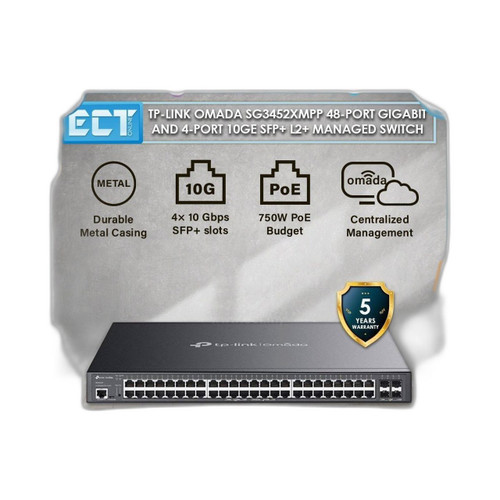
The TP-Link SG3452XMPP and Ubiquiti USW-48 are both 1U rack-mount, 48-port managed switches targeting enterprise access-layer deployments. The critical differentiator is PoE capability: the SG3452XMPP delivers up to 750 W of PoE++/PoE+/PoE budget across all 48 copper ports, while the USW-48 provides no PoE whatsoever. Buyers cross-shopping these two are weighing a high-density powered-device switch against a non-PoE aggregation or access switch, along with differences in uplink speed, switching fabric, and SDN ecosystem.
In This Guide
- How do port count, uplink speed, and switching fabric compare between the SG3452XMPP and USW-48?
- Which switch is better suited for powering cameras, access points, and other PoE devices?
- How do management ecosystems, operating environment ratings, and compliance compare?
- Which should you choose: the SG3452XMPP or the USW-48?
- Side-by-Side Specs
- FAQ
How do port count, uplink speed, and switching fabric compare between the SG3452XMPP and USW-48?
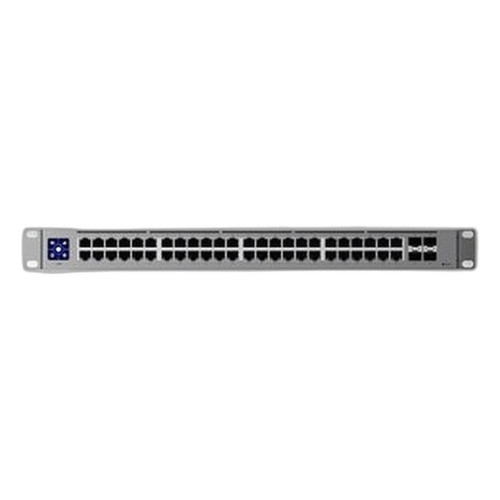
Both switches provide 48 × 1 Gbps copper RJ45 ports for access-layer connections. Uplinks diverge significantly: the SG3452XMPP offers 4 × 1/10GE SFP+ slots, giving each uplink up to 10 Gbps bandwidth, while the USW-48 provides only 4 × 1G SFP uplinks, capping trunk capacity at 1 Gbps per uplink.
Switching fabric reflects this gap directly. The SG3452XMPP runs a 176 Gbps switching capacity with a 130.94 Mpps packet forwarding rate. The USW-48 operates at 104 Gbps switching capacity, 52 Gbps non-blocking throughput, and 77 Mpps forwarding rate. For high-density camera or IoT deployments where aggregation bandwidth matters, the SG3452XMPP's 10GE uplinks and larger fabric provide meaningfully more headroom.
Which switch is better suited for powering cameras, access points, and other PoE devices?
The SG3452XMPP is a full PoE++ switch: it supports IEEE 802.3af/at/bt across all 48 copper ports, with 8 ports rated at 90 W (802.3bt PoE++) and 40 ports at 30 W (802.3at PoE+), backed by a 750 W total PoE budget. This supports high-draw devices such as PTZ cameras, multi-radio access points, and 90 W single-port loads without an external injector.
The USW-48 has no PoE capability whatsoever. It is a non-PoE switch designed for environments where devices are self-powered or where a separate PoE injector or midspan is already in place. Buyers requiring inline power from the switch itself cannot use the USW-48 for that function.
Total power consumption also differs: the SG3452XMPP draws 90 W typical (loaded PoE consumption will be substantially higher, up to the 750 W PoE budget), while the USW-48 draws only 40 W with a 60 W internal supply—a meaningful advantage in power-constrained closets where PoE is not needed.
How do management ecosystems, operating environment ratings, and compliance compare?
The SG3452XMPP is an L2+ managed switch operating in either standalone mode or under TP-Link's Omada SDN platform, with support for 802.1x authentication, RADIUS/TACACS+, VLAN management, SNMP trap/inform, and password recovery. Omada SDN enables centralized multi-site management through a cloud or on-premises controller. Memory is specified at 32 MB Flash and 512 MB DRAM.
The USW-48 is managed via Ubiquiti's UniFi controller ecosystem (Ethernet management interface noted in specs). It supports up to 1,000 VLANs. Specific authentication protocols such as RADIUS or TACACS+ are not listed in the provided specifications for the USW-48.
Operating temperature gives the USW-48 a modest advantage in harsh environments: it is rated from -15 °C to 40 °C versus the SG3452XMPP's 0 °C to 40 °C floor, providing 15 degrees more cold-side tolerance. The USW-48 carries explicit NDAA compliance certification along with CE, FCC, IC, and Anatel. NDAA compliance is not stated in the provided SG3452XMPP specifications. The USW-48 uses an SGCC steel enclosure; enclosure material is not specified for the SG3452XMPP.
Which should you choose: the SG3452XMPP or the USW-48?
Our take: The SG3452XMPP is the stronger choice when the deployment requires inline PoE power for cameras, access points, or other 802.3af/at/bt devices. Its 750 W PoE budget, 8-port 90 W PoE++ capability, 4 × 10GE SFP+ uplinks, and 176 Gbps switching fabric all substantially exceed what the USW-48 delivers. The USW-48 offers no PoE, 1G-only SFP uplinks, and a 104 Gbps fabric—but draws only 40 W versus the SG3452XMPP's 90 W typical (pre-PoE load), is rated 15 °C colder at the low end (-15 °C vs 0 °C), and carries explicit NDAA compliance not documented for the SG3452XMPP. Choose the USW-48 for a power-efficient, NDAA-required, non-PoE aggregation or access-layer switch in a UniFi environment. Choose the SG3452XMPP for any deployment where powering edge devices from the switch is required and 10GE uplink headroom matters.
Side-by-Side Comparison
Spec-for-spec, from manufacturer data.
| Specification | TP-Link SG3452XMPP | Ubiquiti USW-48 |
|---|---|---|
| Copper Ports | 48 × 1G RJ45 | 48 × 1G RJ45 |
| Uplink Ports | 4 × 1/10GE SFP+ | 4 × 1G SFP |
| Switching Capacity | 176 Gbps | 104 Gbps |
| Non-Blocking Throughput | 130.94 Mpps forwarding rate | 52 Gbps / 77 Mpps |
| PoE Support | 802.3af / at / bt (PoE++) | None |
| PoE Budget | 750 W | — |
| Max Single-Port PoE | 90 W (PoE++, 8 ports) | — |
| Power Consumption (typical) | 90 W | 40 W |
| Internal Power Supply | 100–240 V AC, 50/60 Hz | 60 W internal, 100–240 V AC |
| VLAN Support | Not specified in provided specs | Up to 1,000 VLANs |
| Management Platform | Standalone or Omada SDN (L2+) | UniFi controller (Ethernet mgmt) |
| Authentication | 802.1x, RADIUS, TACACS+ | Not specified in provided specs |
| Operating Temperature | 0 °C to 40 °C | -15 °C to 40 °C |
| NDAA Compliant | Not stated in provided specs | Yes |
| Dimensions | 440 × 330 × 44 mm | 442 × 285 × 44 mm |
| Form Factor | 1U Rack | 1U Rack |
Frequently Asked Questions
Which should you choose: the SG3452XMPP or the USW-48?
The SG3452XMPP is the stronger choice when the deployment requires inline PoE power for cameras, access points, or other 802.3af/at/bt devices. Its 750 W PoE budget, 8-port 90 W PoE++ capability, 4 × 10GE SFP+ uplinks, and 176 Gbps switching fabric all substantially exceed what the USW-48 delivers. The USW-48 offers no PoE, 1G-only SFP uplinks, and a 104 Gbps fabric—but draws only 40 W versus the SG3452XMPP's 90 W typical (pre-PoE load), is rated 15 °C colder at the low end (-15 °C vs 0 °C), and carries explicit NDAA compliance not documented for the SG3452XMPP. Choose the USW-48 for a power-efficient, NDAA-required, non-PoE aggregation or access-layer switch in a UniFi environment. Choose the SG3452XMPP for any deployment where powering edge devices from the switch is required and 10GE uplink headroom matters.
Can the USW-48 power IP cameras or access points directly?
No. The USW-48 provides no PoE capability on any port. Cameras and access points requiring inline power would need a separate PoE injector or midspan. The SG3452XMPP supports PoE++/PoE+/PoE (802.3bt/at/af) on all 48 copper ports with a 750 W total budget.
Which switch has faster uplinks for connecting to a core or distribution layer?
The SG3452XMPP provides 4 × 1/10GE SFP+ uplinks, each capable of 10 Gbps. The USW-48 provides 4 × 1G SFP uplinks only. If your aggregation or core switch supports 10GE, the SG3452XMPP offers ten times the uplink bandwidth per port.
Is either switch NDAA-compliant for government or federally funded projects?
The USW-48 is explicitly listed as NDAA-compliant in the provided specifications. NDAA compliance is not stated in the provided specifications for the SG3452XMPP; buyers with a federal compliance requirement should verify directly with TP-Link before specifying the SG3452XMPP.
More Network Switch Comparisons
- TP-Link SG6654XHP vs Ubiquiti USW-PRO-MAX-48
- TP-Link SG6654XHP vs Ubiquiti USW-PRO-48
- TP-Link SG6654XHP vs TP-Link SG3452XMPP
- TP-Link SG6654XHP vs TP-Link SG3452XP
- TP-Link SG3452XMPP vs Ubiquiti USW-PRO-MAX-48
- TP-Link SG3452XMPP vs Ubiquiti USW-PRO-48
Network Switch Buying Guides
Get a Second Opinion on Your Camera Choice
Share your site layout, coverage goals, and budget. Our team will validate the camera selection, flag anything we would change, and recommend products that match the use case.